Facts
The Petitioner was accused of an offence under Section 138 of the Negotiable Instruments Act, 1881, in a complaint filed by Respondent No. 2 on 06.04.2011
Source reference: p. 3During the trial (Criminal Case No. 1599 of 2011), the Petitioner failed to cross-examine the complainant despite several adjournments, leading the trial court to close his right to cross-examination
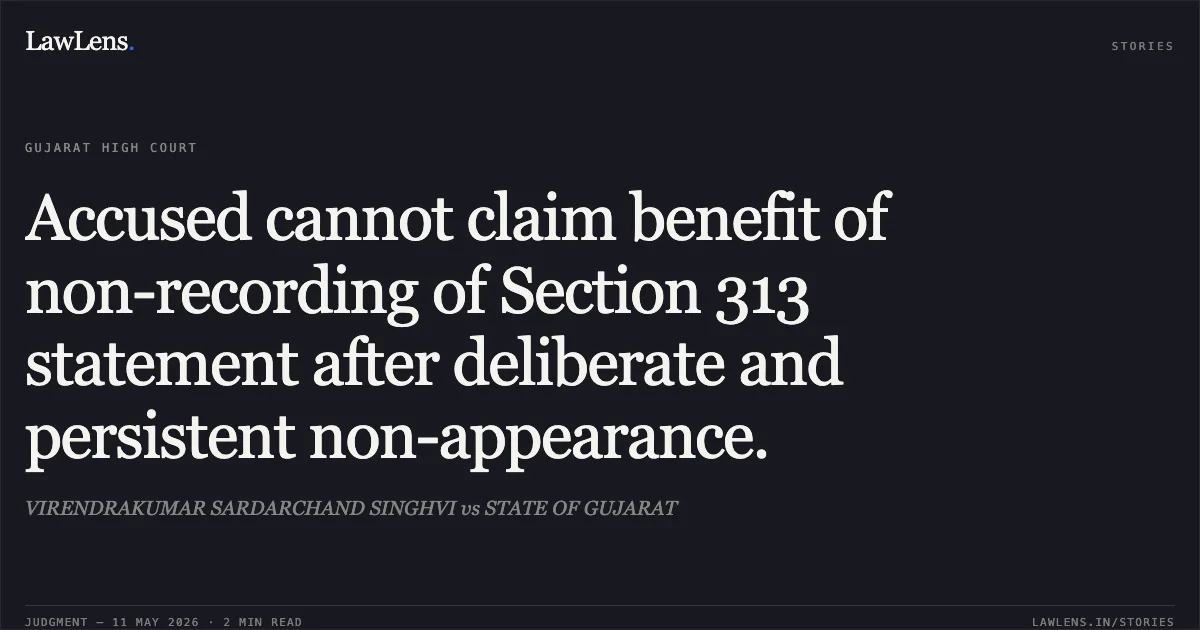
Source reference: p. 6Furthermore, the Petitioner did not remain present for the recording of his statement under Section 313 of the Cr.P.C.
Source reference: p. 6Consequently, the Additional Chief Judicial Magistrate, Gandhidham-Kachchh, convicted the Petitioner on 23.03.2026 and sentenced him to one year of imprisonment
Source reference: p. 5The Petitioner filed this writ petition under Articles 226/227 of the Constitution and Section 528 of the BNSS to quash the conviction and arrest warrant, alleging a violation of natural justice and citing personal safety concerns
Source reference: p. 1-2Issues
1. Whether the judgment of conviction is void due to the non-recording of the accused’s statement under Section 313 of the Cr.P.C.
Source reference: p. 32. Whether the Petitioner is entitled to the extraordinary remedy of a writ petition when a statutory right of appeal is available
Source reference: p. 53. Whether the Petitioner’s claims regarding threats to life and lack of legal representation justified his absence from trial proceedings
Source reference: p. 6Law Applied
The court considered Section 313 of the Cr.P.C. (and corresponding Section 351 of BNSS), which mandates the examination of the accused to explain incriminating evidence
Source reference: p. 3It evaluated the precedent Raj Kumar @ Suman v. State (NCT of Delhi) (2023) LiveLaw SC 434 regarding the mandatory nature of recording such statements
Source reference: p. 3Additionally, the court applied the principle of "exhaustion of alternative remedies," noting that a conviction under the Negotiable Instruments Act must primarily be challenged via a statutory appeal under criminal procedure law rather than a writ under Article 226/227
Source reference: p. 5Reasoning
The court rejected the Petitioner's contention that the trial court erred in law. It observed that the trial court was "constrained" to close the right to record the Section 313 statement because the Petitioner and his advocate deliberately remained absent despite multiple opportunities
Source reference: p. 6The court noted that the Petitioner had neither surrendered nor filed a regular appeal, attempting instead to bypass the standard legal process
Source reference: p. 5Regarding the Petitioner’s claim of "hostile atmosphere" and life threats at Gandhidham, the court found no evidence that these concerns were ever raised during the trial, dismissing them as a "lame excuse and afterthought"
Source reference: p. 6-7The court also found the claim regarding the unavailability of local advocates to be unsubstantiated, noting the Petitioner was adequately represented by counsel in the present High Court proceedings
Source reference: p. 7Holding
The Court dismissed the petition, holding it to be "devoid of merits"
The Court held that the proper remedy for the Petitioner is to surrender and file a statutory appeal before the appropriate forum rather than invoking the High Court's extraordinary jurisdiction
Source reference: p. 5The trial court was held not to be at fault for the non-recording of the Section 313 statement given the Petitioner’s persistent non-cooperation and conduct
Source reference: p. 6All prayers, including the quashing of the arrest warrant and the transfer of the case to Ahmedabad, were denied
Source reference: p. 7Acts & Sections Cited
4 provisions across 3 statutes referred to in this judgment. Each provision opens on LawLens.
Bharatiya Nagarik Suraksha Sanhita, 20232
Negotiable Instruments Act, 18811
Code of Criminal Procedure, 19731
Original Court PDF
VIRENDRAKUMAR SARDARCHAND SINGHVIvsSTATE OF GUJARAT
Click to open original judgment
Original judgment, available to read, download and summarize on LawLens.in