Facts
The appellant, Mohd. Yamin @ Yameen Khan, an Assistant Manager (Accounts) at ITDC, Hotel Samrat, New Delhi, was accused of demanding an illegal gratification of ₹500/- from PW3 on November 29, 1996, for processing the payment of taxi bills.
Source reference: no citationPW3's taxis were attached to Hotel Samrat, and approximately ₹32,000/- in bills were pending.
Source reference: no citationOn the morning of November 29, 1996, PW3 met the accused, who demanded ₹500/- and instructed him to return in the afternoon with the money for bill processing.
Source reference: p.21PW3 then lodged a complaint with the CBI.
Source reference: p.21A trap was laid, and the accused was apprehended after allegedly accepting the tainted money from PW3.
Source reference: p.23-24The phenolphthalein test on the accused's hands and trouser pocket yielded positive results, and the tainted currency notes were recovered from his possession.
Source reference: p.24The trial court, in its judgment dated October 6, 2004, convicted the appellant under Section 7 and Section 13(2) read with Section 13(1)(d) of the Prevention of Corruption Act, 1988 (PC Act), sentencing him to rigorous imprisonment and fines.
Source reference: p.5This appeal challenges that conviction and sentence.
Source reference: p.5-6Issues
Whether there was any infirmity in the impugned judgment calling for an interference by this court.
Source reference: p.20Law Applied
The court primarily applied Section 7 and Section 13(2) read with Section 13(1)(d) of the Prevention of Corruption Act, 1988 regarding the criminal misconduct of a public servant involving illegal gratification.
Source reference: p.2It referred to the explanation (d) of Section 7 of the PC Act (as it stood in 1996) which states that an offence is committed even if a public servant receives gratification as a motive or reward for doing something they do not intend to do or are not in a position to do.
Source reference: p.13The court also relied on precedents such as State of U.P. v. G.K. Ghosh, (1984) 1 SCC 254, stating that citizens do not lightly approach vigilance authorities for traps against public servants, and that trap-laying officers are not automatically unreliable witnesses.
Source reference: p.18-19Furthermore, it affirmed that defects in investigation do not render a prosecution case unacceptable if substantive evidence establishes the offence (*Hema v. State, (2013) 10 SCC 192* and *C. Muniappan v. State of T.N. (2010) 9 SCC 567*).
Source reference: p.47It also referenced *Mohan Lal v. State of Punjab; AIR 2013 SC 2408* and other cases to confirm that testimony of partially hostile witnesses can be considered to the extent it supports the prosecution case if credible.
Source reference: p.47-48Finally, it cited *M. Narsinga Rao v. State of A.P., 2001 SCC (Cri) 258* to establish that recovery of tainted currency notes from an accused without plausible explanation constitutes a strong incriminating circumstance.
Source reference: p.49-50Reasoning
The court analyzed the appellant's arguments regarding procedural irregularities and inconsistencies advanced by the defense.
Source reference: no citationIt found the delay in forwarding the FIR to the court to be sufficiently explained by the intervening weekend and the prompt production of the accused before the trial court with relevant documents.
Source reference: p.14, p.41The absence of a crime number in the handing over memo was deemed a procedural omission not negating substantive evidence.
Source reference: p.42Discrepancies in witness testimony regarding time, particularly PW7's approximation of the apprehension time, were considered minor variations not undermining the core prosecution case.
Source reference: p.43The court rejected the argument about the phenolphthalein powder's availability, stating that the demonstration was conducted, and the recovery of tainted notes with positive tests corroborated the prosecution.
Source reference: p.43-44The absence of an audio recording, despite PW5's inconsistent testimony, did not discredit the direct evidence of demand and acceptance, as its existence is not essential for trap validity when corroborated by other strong evidence.
Source reference: p.44-45Critically, the court applied Explanation (d) of Section 7 of the PC Act, concluding that even if PW3's bills were not matured for payment, the demand and acceptance of gratification still constituted the offense, as the official capacity and the act as motive/reward are sufficient.
Source reference: p.13-14, p.45-46The relevance of PW3's family marriage urgency was deemed immaterial to the determination of guilt.
Source reference: p.17-18, p.46The timing of the incident during a salary disbursement day was also considered inconsequential since the allegation was about demanding gratification, not actual payment of bills.
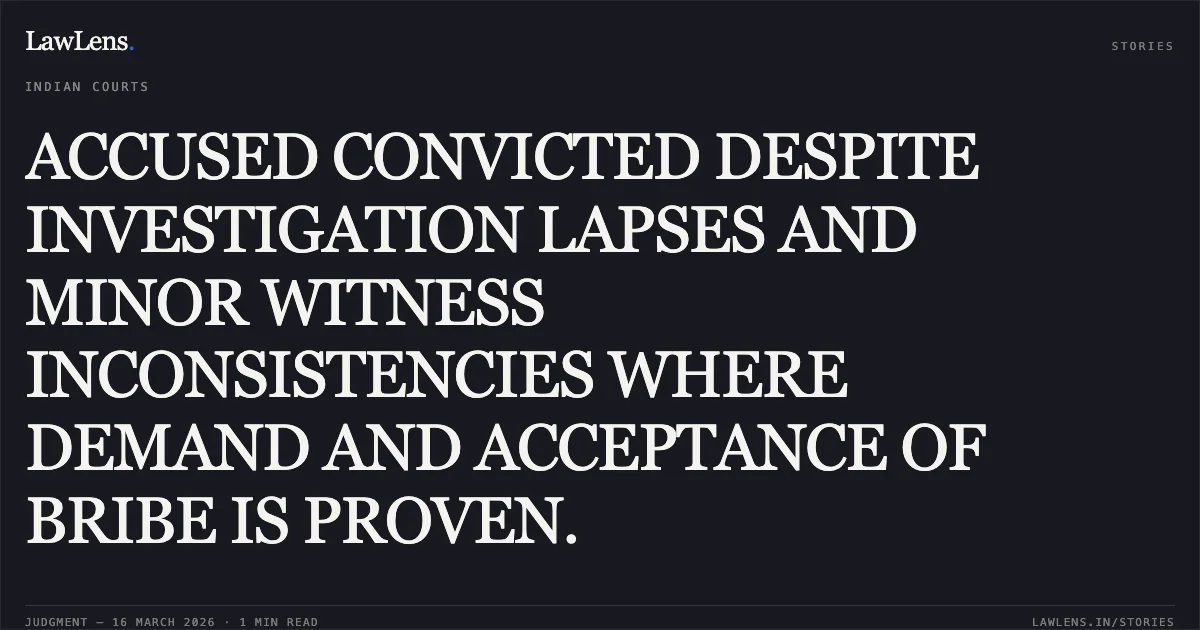
Source reference: p.46While acknowledging some investigative lapses, the court affirmed that these did not render the prosecution case unacceptable given the substantive evidence.
Source reference: p.47It emphasized that the partially hostile witnesses (PW1 and PW5) had admitted material aspects of the prosecution case, and their credible testimony could be relied upon.
Source reference: p.47-48The court found that PW3's testimony, corroborated by PW1 (shadow witness) and PW5 (recovery witness), and further by the recovery of tainted currency notes and positive phenolphthalein tests, established the demand and acceptance.
Source reference: p.48-49The appellant offered no plausible explanation for the recovered tainted money; instead, the defense suggested forcible insertion, which was unsubstantiated.
Source reference: p.49The lack of immediate protest by the accused at apprehension was also noted as significant.
Source reference: p.49Holding
The court found no infirmity in the impugned judgment.
The demand and acceptance of illegal gratification by the appellant were successfully established beyond reasonable doubt by the prosecution.
Source reference: p.19The appeal was dismissed, and the conviction was upheld.
Source reference: p.50Acts & Sections Cited
6 provisions across 2 statutes referred to in this judgment. Each provision opens on LawLens.
Code of Criminal Procedure, 19734
Prevention of Corruption Act, 19882
Original Court PDF
Hd. Yamin @ Yameen KhanvsState Thr. C.B.I
Click to open original judgment
Original judgment, available to read, download and summarize on LawLens.in


