Facts
The applicant sought to quash trial court orders dated 19.5.2025 and 5.4.2023
Source reference: para. 2An FIR was lodged in 2022 alleging the applicant raped a minor 6-7 years prior and caused a miscarriage
Source reference: para. 3While the victim's school certificate indicated she was over 18 at the time of the alleged incident (2016) and 24 at the time of the FIR, the Trial Court rejected a discharge application and framed charges under Section 376(3) IPC and Sections 3/4(2) of the POCSO Act
Source reference: paras. 4-5Following the victim's testimony, the applicant moved an application under Section 216 Cr.P.C. (Section 239 B.N.S.S.) to alter the charges, arguing the victim was a major at the time of the offense. The Trial Court rejected this on 19.5.2025
Source reference: para. 5Issues
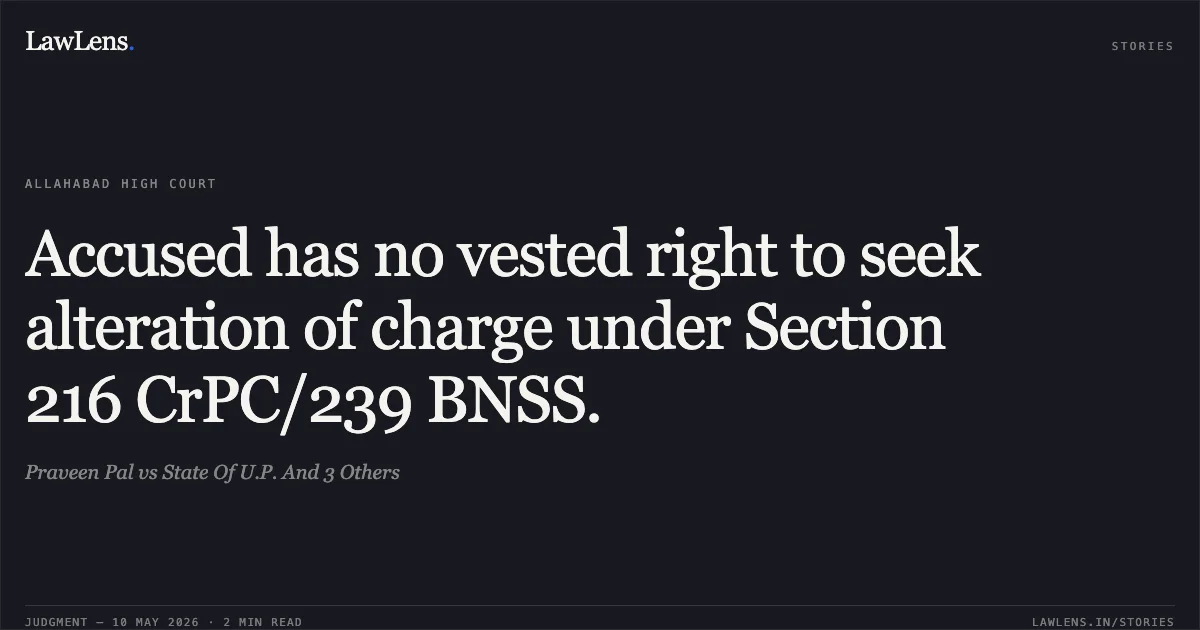
1. Whether an accused has a vested right to seek addition or alteration of charges by filing an application under Section 216 Cr.P.C. or Section 239 B.N.S.S.
Source reference: para. 92. Whether the Trial Court's refusal to alter charges based on an accused’s application despite conflicting evidence regarding the victim's age was legally sustainable
Source reference: para. 17Law Applied
Section 216 of the Cr.P.C. (corresponds to Section 239 of the B.N.S.S.), which empowers the Court to alter or add charges "at any time before judgment is pronounced"
Source reference: para. 9P. Kartikalakshmi v. Sri Ganesh and another (2017) 3 SCC 347, establishing that this power is "exclusive to the Court" and no party has a vested right to seek alteration as a matter of right
Source reference: para. 11Director of Revenue Intelligence v. Raj Kumar Arora (2025) and K. Ravi v. State of Tamil Nadu (2024), which clarify that Section 216 is an enabling provision and does not allow an accused to seek what is effectively a second discharge application under the guise of alteration
Source reference: paras. 10, 12Thakur Ram v. State of Bihar (1966) regarding the court’s suo motu discretion
Source reference: para. 14Reasoning
The Court reasoned that Section 216 Cr.P.C. (and Section 239 B.N.S.S.) is an enabling provision designed to ensure the trial remains fair and accurate, but it is not a tool for parties to demand changes to the indictment
Source reference: para. 13The Court observed that the applicant was essentially re-agitating the same plea of age/majority that had already been rejected at the discharge stage under Section 227 Cr.P.C.
Source reference: para. 7Following the precedent in K. Ravi, the Court noted that allowing such applications would derail trials and lead to "deplorable" delays
Source reference: para. 12Since the power to alter charges is a discretionary, suo motu power of the Trial Court based on its satisfaction with the evidence on record, the Trial Court was not legally "incumbent" to act upon the applicant’s specific request
Source reference: paras. 15-16Holding
The Court answered that the applicant had no vested right to file an application for alteration of charges
The High Court held that the Trial Court committed no illegality in rejecting the application dated 10.3.2025. The application under Section 528 B.N.S.S. was dismissed as misconceived and devoid of merits
Source reference: paras. 17, 18Acts & Sections Cited
23 provisions across 5 statutes referred to in this judgment. Each provision opens on LawLens.
Bharatiya Nagarik Suraksha Sanhita, 20232
Code of Criminal Procedure, 19736
Indian Penal Code, 1860
Juvenile Justice (Care and Protection of Children) Act, 2015.1
Original Court PDF
Praveen PalvsState Of U.P. And 3 Others
Click to open original judgment
Original judgment, available to read, download and summarize on LawLens.in