Facts
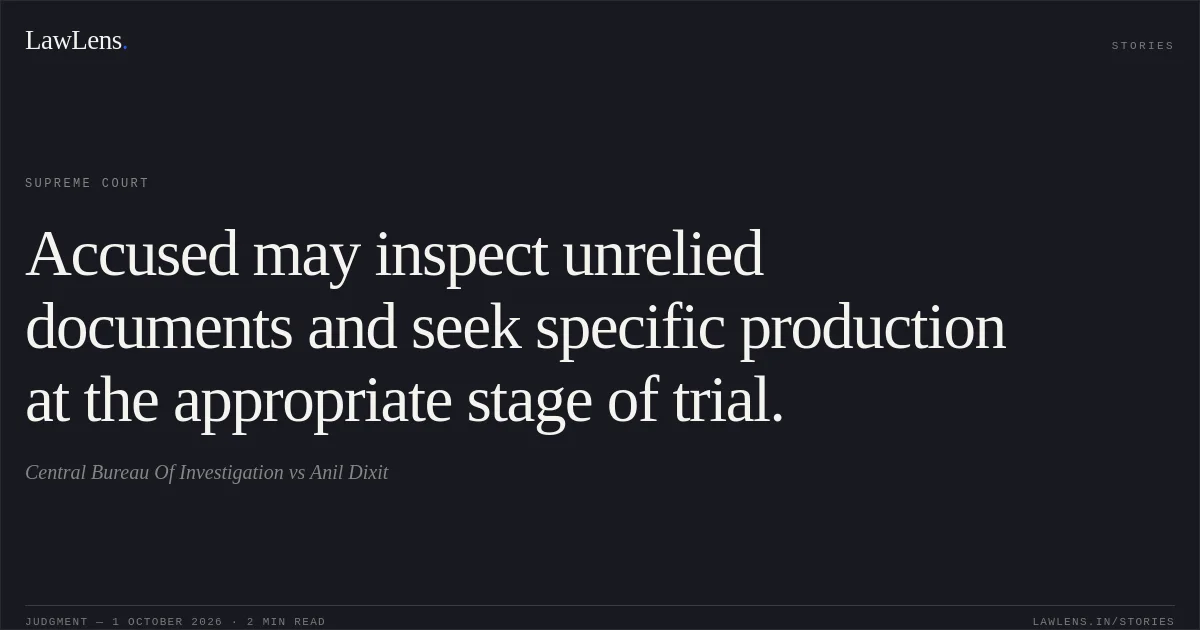
The accused applied under Section 91 of the Code of Criminal Procedure, 1973 (CrPC), for documents including unrelied-upon material, registers, committee minutes and other records.
Source reference: pp. 1–2, paras 2–3The Special Court allowed the application, and, after the CBI filed a compliance report resisting production of some documents or stating that they were unavailable, made a further order on 18 July 2022.
Source reference: pp. 1–2, paras 2–3The High Court affirmed that order.
Source reference: pp. 1–2, paras 2–3The CBI appealed, challenging the directions to produce documents at the charge-framing stage.
Source reference: pp. 1–2, paras 2–3Before the Supreme Court, the accused stated that he no longer sought the source-information records or case diaries.
Source reference: p. 2, para 5Issues
1. Whether, and at what stage, an accused may seek access to unrelied-upon documents held by the prosecuting agency.
Source reference: p. 3, para 72. Whether the CBI could be directed to produce documents that it stated were unavailable or confidential, and how the accused could obtain documents identified during inspection of voluminous unrelied-upon material.
Source reference: pp. 5–7, paras 9–13Law Applied
Section 91 CrPC provides for summons or production of documents or other things necessary or desirable for an investigation, inquiry, trial or other proceeding.
Source reference: pp. 2–3, paras 6–7In State of Orissa v. Debendra Nath Padhi, the Court stated that an accused’s entitlement to seek an order under Section 91 ordinarily arises at the defence stage;
Source reference: pp. 2–3, paras 6–7Sarla Gupta v. Directorate of Enforcement discussed that observation in the context of the record considered at the charge-framing stage and stated that, ordinarily, an accused is not entitled to copies of unrelied-upon documents at that stage.
Source reference: pp. 2–3, paras 6–7The Court did not resolve the scope of those precedents, proceeding instead on the premise that an accused is entitled to documents available with the prosecuting agency to prepare a defence; the stage for seeking particular documents depends on the documents sought.
Source reference: pp. 2–3, paras 6–7Reasoning
The Court distinguished between material held by the CBI and material it said was unavailable or confidential.
Source reference: p. 6, para 10It accepted that the seizure memos had been produced, while the accused had withdrawn his request for the CBI registers and source information.
Source reference: p. 6, para 10For the voluminous unrelied-upon documents, the accused could inspect them and identify specific documents for production when the relevant witness was examined; alternatively, the parties could record and sign the identified documents during inspection, with those documents then made available at trial.
Source reference: pp. 6–7, para 11If the specified committee minutes were among the records available for inspection, the accused could seek them through that process; if unavailable with the CBI, he could obtain and prove them in his defence, with their evidentiary value left to the Trial Court.
Source reference: p. 7, para 12The CBI could not be required to produce records it stated were unavailable.
Source reference: pp. 7–8, paras 13–14Holding
The Court set aside the impugned orders to facilitate an expeditious trial and directed the Trial Court to proceed in accordance with its directions.
The CBI was to keep the relevant files available for inspection and trial, and documents specifically identified through inspection were to be produced without delay; the accused could independently obtain unavailable documents and prove them in defence.
Source reference: pp. 6–8, paras 11–15The appeal was disposed of.
Source reference: p. 8, para 15Acts & Sections Cited
2 provisions across 1 statute referred to in this judgment. Each provision opens on LawLens.
Code of Criminal Procedure, 19732
Original Court PDF
Central Bureau Of InvestigationvsAnil Dixit
Click to open original judgment
Original judgment, available to read, download and summarize on LawLens.in