Facts
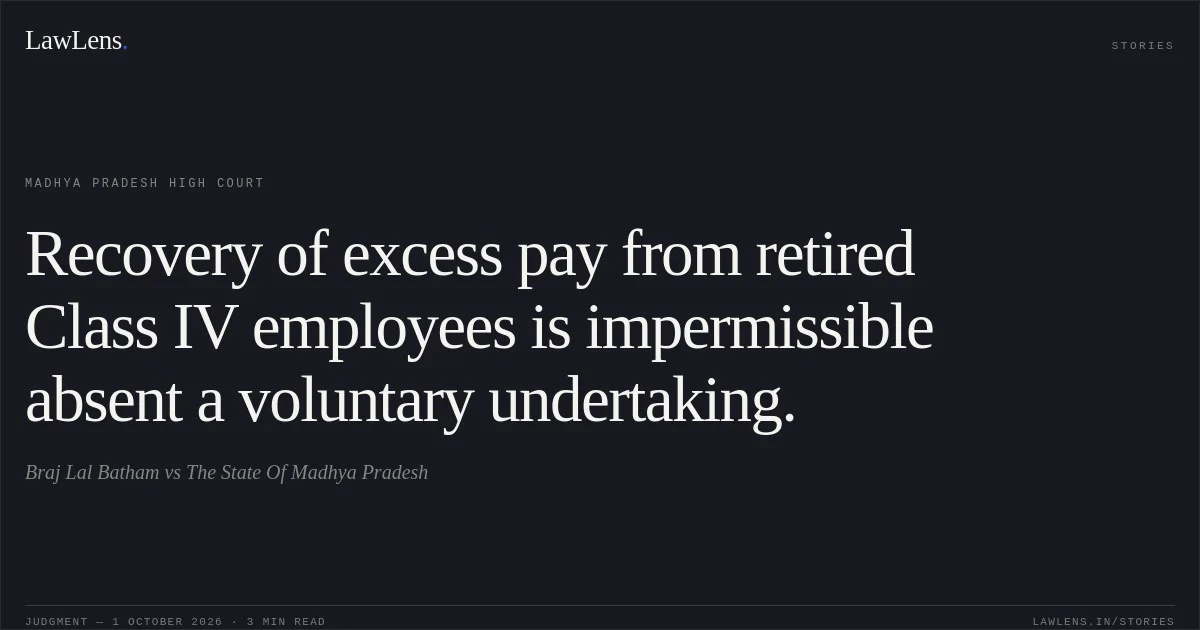
The petitioner, a Class IV employee who retired as a Peon on 31 October 2019, challenged recovery of ₹1,02,029 for alleged excess pay arising from a fixation made from 1 January 2006 to 31 October 2019.
Source reference: para. 1He contended that the recovery was ordered without notice or a hearing and that the incorrect fixation was not attributable to him.
Source reference: para. 3The State relied on an undertaking by the petitioner agreeing to repay excess amounts.
Source reference: para. 4The petitioner sought quashing of the recovery and repayment with interest.
Source reference: para. 1–4The Court considered the Full Bench ruling in State of Madhya Pradesh v. Jagdish Prasad Dubey, the Supreme Court’s decision in State of Punjab v. Rafiq Masih (White Washer), and related authorities.
Source reference: para. 6–10Issues
1. Whether recovery of alleged excess pay could be made from the petitioner after retirement, given that he was a Class IV employee and the excess payments related to a period exceeding five years.
Source reference: para. 3, 7, 112. Whether the undertaking relied upon by the State was sufficient to permit recovery when the State had not established that it was given voluntarily.
Source reference: para. 4, 9–103. Whether recovery ordered without notice or an opportunity of hearing was sustainable.
Source reference: para. 3, 8, 11Law Applied
Article 226 of the Constitution provides the basis for the Court’s judicial review of the recovery order.
Source reference: para. 1In Rafiq Masih, the Supreme Court identified circumstances in which recovery of mistaken excess payments is impermissible, including recovery from Class III/IV employees, retired employees, and cases involving payments made more than five years before the recovery order.
Source reference: para. 7The Full Bench in Jagdish Prasad Dubey held that an undertaking given when pay is refixed is not enforceable unless shown to have been voluntary; it also required consideration of hardship and the time limits stated in Rafiq Masih.
Source reference: para. 6The Court also relied on Jogeswar Sahoo, which treated recovery as unsustainable where retired employees had received no hearing and the record disclosed no fraud or misrepresentation.
Source reference: para. 8The principles in Central Inland Water Transport Corporation Ltd. v. Brojo Nath Ganguly informed the treatment of undertakings obtained in circumstances of unequal bargaining power or coercion.
Source reference: para. 10Reasoning
The petitioner’s recovery fell within the protections identified in Rafiq Masih: he was a Class IV employee, had retired before the recovery, and the alleged excess payments extended over a period beginning in 2006.
Source reference: para. 7, 10–11Although the State relied on an undertaking, it did not establish that the petitioner had given it voluntarily; under the Full Bench rule, the undertaking therefore could not support recovery.
Source reference: para. 9–10The recovery was also initiated without a show-cause notice or hearing, a circumstance reinforcing its unsustainability in light of Jogeswar Sahoo.
Source reference: para. 3, 8, 11Holding
The Court held the recovery of ₹1,02,029 impermissible and set aside the recovery order.
It directed the respondents to refund that amount with interest at 6% per annum from the date of retirement until payment; if the direction was not complied with within the prescribed period, interest at 12% per annum would apply from the date of entitlement until payment.
Source reference: para. 11–14The exercise was to be completed within 90 days of submission of a certified copy of the order, and the petition was disposed of.
Source reference: para. 11–14Original Court PDF
Braj Lal BathamvsThe State Of Madhya Pradesh
Click to open original judgment
Original judgment, available to read, download and summarize on LawLens.in