Facts
An FIR was registered against the appellant under Sections 64, 65(1) and 351 of the Bharatiya Nyaya Sanhita, 2023, read with Section 6 of the Protection of Children from Sexual Offences Act, 2012, alleging sexual abuse of a minor girl.
Source reference: para. 3.1The appellant was arrested on 17 May 2026 but was produced before the Magistrate only on 18 May 2026, beyond 24 hours.
Source reference: para. 3.2The Magistrate found that the appellant had not been furnished written grounds of arrest, violating Article 22(1) of the Constitution, Section 50 CrPC and Section 47 BNSS, and directed his immediate release.
Source reference: para. 3.3On the same day, the investigating officer filed a fresh application seeking custody and remand, but the Additional Chief Judicial Magistrate dismissed it as premature and not maintainable because the grounds of arrest had still not been supplied and the appellant was not in custody.
Source reference: paras. 3.4–3.5The High Court nevertheless held that the investigating agency could seek arrest warrants, re-arrest the appellant, or seek his custody, provided the subsequent arrest complied with law.
Source reference: paras. 3.6–3.9The appellant challenged that order before the Supreme Court, contending that both Articles 22(1) and 22(2) had been violated and that the State could not automatically re-arrest him.
Source reference: para. 2Issues
Whether an accused whose arrest and detention violated Article 22(1), due to non-supply of written grounds of arrest, may be re-arrested without prior judicial authorisation.
Source reference: paras. 2, 20.6–20.8, 24–25Whether detention beyond 24 hours without production before a Magistrate, in violation of Article 22(2), permits the investigating agency to automatically re-arrest the accused after his release.
Source reference: paras. 2, 27–36What procedure must be followed where the investigating agency continues to require custodial interrogation after an accused has been released for violation of Article 22(1) or Article 22(2).
Source reference: paras. 24–25.1, 36Law Applied
Article 22(1) requires that an arrested person be informed, as soon as may be, of the grounds of arrest; Article 22(2) requires production before the nearest Magistrate within 24 hours, excluding necessary journey time. These safeguards are reflected in Sections 50 and 57 CrPC and Sections 47 and 58 BNSS.
Source reference: paras. 12–16Pankaj Bansal v. Union of India and Prabir Purkayastha v. State (NCT of Delhi) establish that written grounds of arrest must ordinarily be furnished as a matter of course; Vihaan Kumar v. State of Haryana holds that breach of Article 22(1) renders the arrest unconstitutional and subsequent remand, charge-sheet or cognizance cannot cure it.
Source reference: paras. 17–19Mihir Rajesh Shah v. State of Maharashtra requires written grounds to be supplied at the earliest and, in exceptional cases, no later than two hours before production for remand; if this is not done, the arrest is illegal and the accused must be released.
Source reference: para. 20.5Any subsequent request for custody must be made before the Magistrate with reasons for re-arrest, necessity for custody and an explanation for the original non-compliance.
Source reference: paras. 20.6–20.8For violation of Article 22(2), Manoj v. State of Madhya Pradesh, Bhim Singh v. State of Jammu & Kashmir, and Directorate of Enforcement v. Subhash Sharma recognise that detention beyond the constitutional period is unlawful, may require release, and may also justify compensation.
Source reference: paras. 28–31The Court distinguished default-bail decisions such as Sanjay Dutt v. State and Rakesh Kumar Paul v. State of Assam, which concern a different statutory right under Section 167(2) CrPC/Section 187(2) BNSS.
Source reference: paras. 34–35Reasoning
The Court held that the appellant’s release was not a grant of bail but release from illegal and unconstitutional detention caused by breach of Article 22(1) and, on the pleaded facts, Article 22(2).
Source reference: paras. 23, 35Since the constitutional violation occurred at the threshold of arrest, the State could not rely on the seriousness of the alleged POCSO offence to bypass constitutional safeguards.
Source reference: para. 37Following and strengthening Mihir Rajesh Shah, the Court ruled that re-arrest cannot be left to the discretion of the same authority that violated Article 22(1).
Source reference: paras. 24–25If custodial interrogation remains necessary, the investigating agency must first furnish written grounds of arrest, then file an application before the jurisdictional Magistrate stating the reasons and necessity for re-arrest and explaining the initial failure.
Source reference: paras. 24–25The application must bear the endorsement of the immediate superior authority, and the Magistrate must decide it expeditiously, preferably within one week, after following natural justice.
Source reference: paras. 24–25Administratively, the superior authority must transfer the investigation to another officer and initiate departmental proceedings against the officers responsible for the constitutional breach.
Source reference: para. 25.1The same judicially controlled procedure applies where release followed violation of Article 22(2), with the additional possibility of public-law compensation.
Source reference: para. 36Accordingly, the High Court erred in permitting the investigating agency generally to seek warrants or re-arrest without prescribing these safeguards.
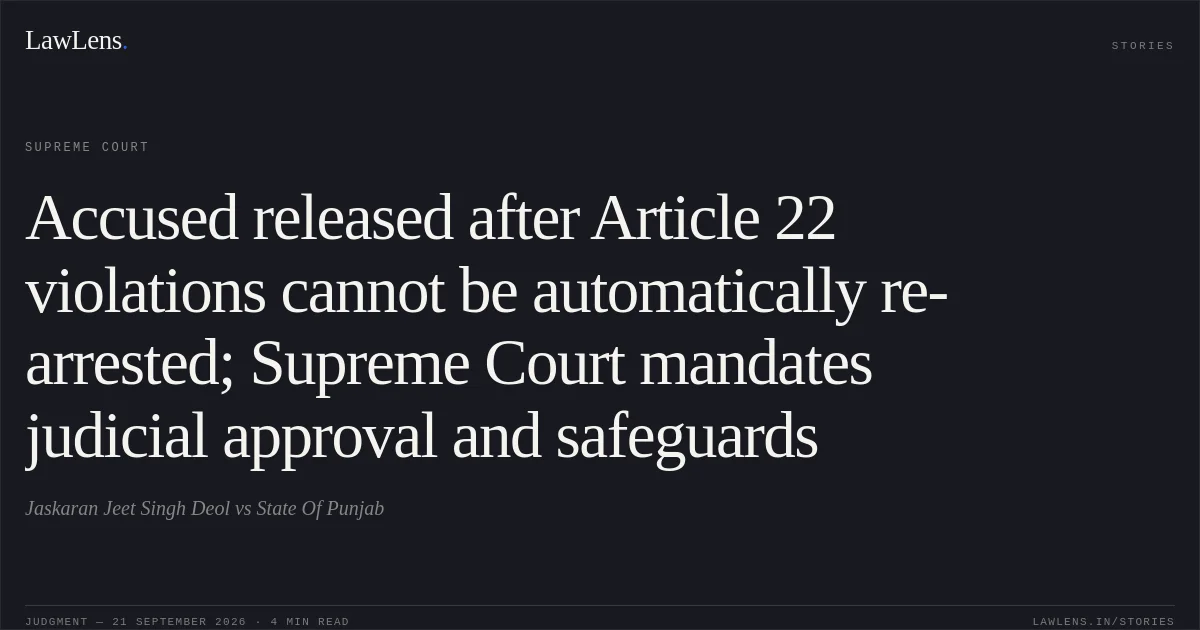
Source reference: paras. 27, 36Holding
The appeal was allowed.
The Supreme Court set aside the High Court’s order dated 29 May 2026 and quashed the relevant observations in the Magistrate’s order dated 18 May 2026.
Source reference: para. 38It held that an accused released because of violations of Articles 22(1) or 22(2) cannot be automatically re-arrested.
Source reference: paras. 36, 38If custodial interrogation is still considered necessary, the State must comply with Mihir Rajesh Shah and the additional safeguards laid down in paragraphs 24–25.1, including written supply of grounds, a reasoned application for re-arrest, superior-authority endorsement, judicial consideration, transfer of investigation and departmental action.
Source reference: paras. 36, 38In cases involving Article 22(2), the High Court may also award compensation as a public-law remedy.
Source reference: paras. 36, 38The Court expressed no opinion on the merits of the allegations against the appellant.
Source reference: para. 38Acts & Sections Cited
31 provisions across 7 statutes referred to in this judgment. Each provision opens on LawLens.
Bharatiya Nyaya Sanhita, 20235
Protection of Children from Sexual Offences Act, 20121
Code of Criminal Procedure, 19736
Bharatiya Nagarik Suraksha Sanhita, 20236
Prevention of Money-Laundering Act, 20022
Indian Penal Code, 1860
Narcotic Drugs and Psychotropic Substances Act, 19851
Original Court PDF
Jaskaran Jeet Singh DeolvsState Of Punjab
Click to open original judgment
Original judgment, available to read, download and summarize on LawLens.in