Facts
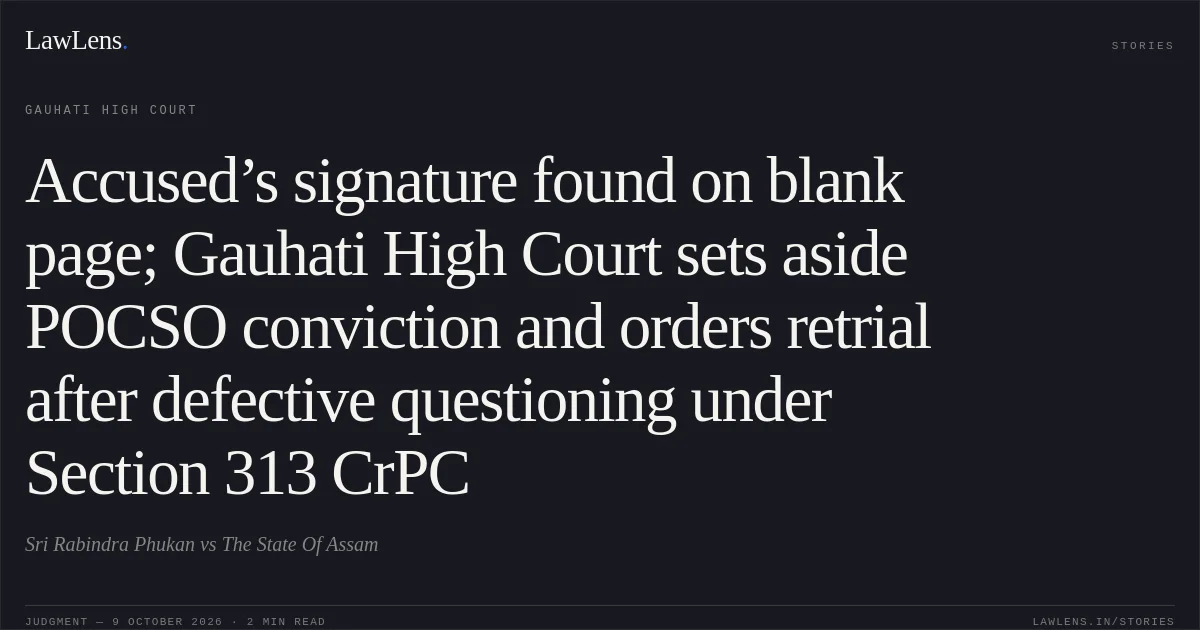
The appellant challenged his conviction under Section 4 of the POCSO Act and Section 377 IPC by the Special Judge (POCSO), Kamrup (Metro), in Sessions Case No. 256/2018.
Source reference: p. 2, para. 2In appeal, the High Court found that the trial court had put composite questions to the appellant under Section 313 CrPC, had not put the incriminating evidence of the medical officer and investigating officer to him, and that the record contained a page bearing the appellant’s signature but no writing.
Source reference: pp. 3–7, paras. 4–6, 11–12Issues
1. Whether the appellant’s examination under Section 313 CrPC was adequate where multiple incriminating circumstances were combined in single questions and material evidence was not put to him.
Source reference: pp. 5–7, paras. 7–122. Whether the deficiencies in that examination and the trial record warranted setting aside the conviction and remanding the case for further proceedings.
Source reference: pp. 7–8, paras. 12–15Law Applied
Section 313 CrPC requires the court to question the accused fairly and carefully about the incriminating circumstances, putting each material fact or circumstance separately so the accused can understand and answer the case against him.
Source reference: no citationThe court relied on Satbir Singh v. State of Haryana, (2021) 6 SCC 1, and Nar Singh v. State of Haryana, (2015) 1 SCC 496, for the trial court’s duty to conduct a proper examination under Section 313 CrPC.
Source reference: p. 5, paras. 8–9Evidence or material not put to the accused under that provision cannot be used against him.
Source reference: p. 7, para. 12Reasoning
The trial court presented each prosecution witness’s evidence as a single composite question, requiring the appellant to respond to several distinct allegations at once.
Source reference: pp. 3–7, paras. 4, 7, 11It also failed to put the medical evidence—including the findings of contusions around the anal margin and the opinion of recent anal penetration—and the investigating officer’s evidence to him.
Source reference: pp. 3–7, paras. 4, 7, 11The High Court held that these omissions denied the appellant a fair opportunity to explain or rebut material relied on by the prosecution.
Source reference: no citationThe signed but otherwise blank page in the record further raised concern about the integrity and reliability of the proceedings.
Source reference: p. 7, para. 12The Section 313 examination was therefore not merely defective but fell short of the applicable legal requirements.
Source reference: p. 7, para. 12Holding
The High Court allowed the appeal to the extent necessary, set aside the judgment of conviction, and remanded the case for retrial from the stage of examination under Section 313 CrPC.
It directed the trial court to put separate questions on each relevant fact or circumstance and to endeavour to conclude the case within six months of receiving the order.
Source reference: pp. 7–8, paras. 13, 15The appellant was permitted to seek bail during the remainder of the trial, with any application to be considered on its own merits.
Source reference: p. 8, para. 14Acts & Sections Cited
3 provisions across 3 statutes referred to in this judgment. Each provision opens on LawLens.
Protection of Children from Sexual Offences Act, 20121
Indian Penal Code, 18601
Code of Criminal Procedure, 19731
Original Court PDF
Sri Rabindra PhukanvsThe State Of Assam
Click to open original judgment
Original judgment, available to read, download and summarize on LawLens.in