Facts
The deceased, Shanmugam, was returning home after closing his medical shop on 14.06.2009 at about 9.30 p.m. when two persons allegedly approached him on a motorcycle and threw sulphuric acid, causing fatal burn injuries. P.W.3 reached the spot immediately, sustained acid burns while assisting the deceased, and informed the deceased’s wife. The deceased was taken to various hospitals and ultimately died at Coimbatore Government Medical College Hospital. Before losing the ability to speak, he allegedly wrote the word “Apollo” on a paper, leading the initial investigation towards persons connected with Apollo Medicals
Source reference: paras. 2.1, 2.6, 11The prosecution relied principally on P.W.5, who claimed to have seen the appellants on the motorcycle during the attack, and P.W.6, who saw them near a tea shop immediately before the occurrence and observed them leave towards the direction of the deceased. A-2 was allegedly treated for acid injuries at a private hospital shortly after the incident. Both appellants were subsequently medically examined and found to have acid or scald burn injuries
Source reference: paras. 2.2–2.4, 13–15The investigation resulted in the seizure of clothing, a helmet, a motorcycle, a mug and other articles connected with the appellants. Forensic examination detected sulphuric acid on several seized articles, including the appellants’ clothing, the helmet, the motorcycle swab and the deceased’s clothes. A-2 also allegedly made an extra-judicial confession before the Village Administrative Officer, while A-1’s confession led to the recovery of material objects
Source reference: paras. 2.5, 14–15, 18The trial court convicted A-1 under Section 302 IPC and A-2 under Section 302 read with Section 109 IPC, sentencing both to imprisonment for life and fine. A-3 and A-4 were acquitted. A-1 and A-2 challenged their convictions before the High Court under Section 374(2) Cr.P.C.
Source reference: paras. 1, 3–6Issues
1. Whether the prosecution proved beyond reasonable doubt that A-1 and A-2 were the persons who attacked the deceased with sulphuric acid, notwithstanding the absence of a test identification parade?
Source reference: paras. 7–9, 12–15, 20–212. Whether the medical, forensic and circumstantial evidence, including the acid injuries sustained by the appellants and the recovery of articles containing sulphuric acid, established their involvement in the murder?
Source reference: paras. 13–183. Whether the absence of proof of motive and the alleged defects in the evidence, including the non-production of the paper on which “Apollo” was written and the absence of an accident register relating to A-2, created reasonable doubt?
Source reference: paras. 7–9, 11, 15, 224. Whether the convictions of A-1 under Section 302 IPC and A-2 under Section 302 read with Section 109 IPC were sustainable?
Source reference: paras. 1, 6, 22–23Law Applied
The Court applied Section 302 IPC concerning murder and Section 302 read with Section 109 IPC concerning abetment of murder
Source reference: para. 1It applied Section 106 of the Evidence Act, holding that although the prosecution must first establish the foundational facts beyond reasonable doubt, facts especially within the accused’s knowledge—such as the manner in which they sustained acid injuries—must be explained by them; the Court relied on Ram Gulam Chaudhary v. State of Bihar, (2001) 8 SCC 311, and Sabitri Samantaray v. State of Odisha, (2023) 11 SCC 813
Source reference: paras. 16–17The Court held that a test identification parade is not substantive evidence, is not mandatory, and its omission does not render in-court identification inadmissible where the witness’s evidence is otherwise reliable, relying on Dharmendra Kumar v. State of M.P., (2024) 8 SCC 60
Source reference: paras. 20–21It further held that failure to prove motive is not fatal where credible direct or corroborative evidence establishes the accused’s involvement, relying on Bipin Kumar Mondal v. State of West Bengal, (2010) 12 SCC 91
Source reference: para. 22The Court also relied on Balu Sudam Khalde v. State of Maharashtra, (2023) 13 SCC 365, for the principle that incriminating answers elicited through defence suggestions may be considered with the other evidence
Source reference: para. 14Reasoning
The Court found that P.W.5 had seen both appellants near the place of occurrence in the light and identified them as the persons who approached the deceased on a motorcycle, with the pillion rider carrying a container and throwing the acid. P.W.6 independently placed both appellants near the tea shop immediately before the occurrence and stated that they left towards the deceased’s direction shortly before the acid attack. Their evidence was supported by P.W.3’s immediate account of the attack and by the prompt medical treatment of the deceased
Source reference: paras. 11–13, 20The Court treated the appellants’ acid injuries as a significant incriminating circumstance. A-2 appeared at a private hospital on the night of the occurrence with acid burns, while A-1 and A-2 were later medically found to have injuries consistent with acid or scald burns. The appellants did not provide a satisfactory explanation for these injuries; their suggestions that the injuries could have resulted from an acid tanker or boiling liquid were considered incriminating in the circumstances
Source reference: paras. 13–15Forensic evidence further demonstrated the presence of sulphuric acid on the seized articles, the appellants’ clothing, the helmet, the motorcycle and the deceased’s clothes, corroborating the eyewitness and medical evidence
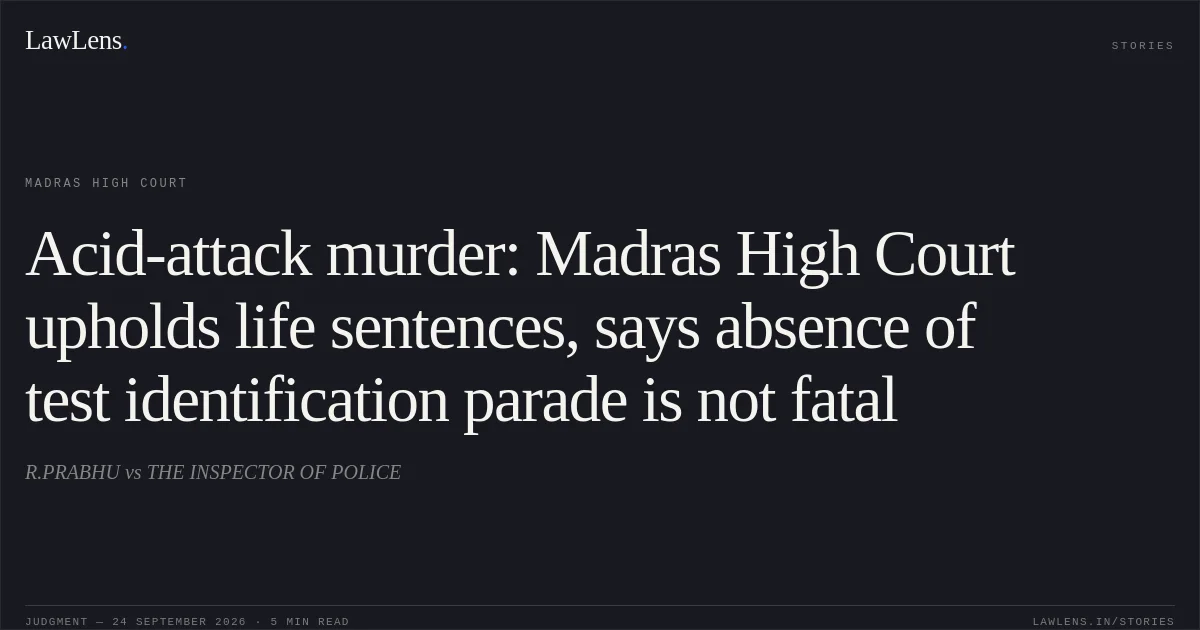
Source reference: paras. 14–18The absence of a test identification parade was held non-fatal because P.W.5 identified the appellants in court and had observed them at close quarters in sufficient lighting. Similarly, the lack of a proved motive did not undermine the prosecution case, since motive was unnecessary where the eyewitness, medical and scientific evidence formed a consistent chain implicating the appellants. The non-production of the “Apollo” paper and the absence of an accident register for A-2 were treated as non-material defects that did not displace the substantial corroborative evidence
Source reference: paras. 11–15, 20–22Holding
The High Court held that the prosecution had proved beyond reasonable doubt that A-1 and A-2 participated in the sulphuric-acid attack that caused the deceased’s death. The eyewitness testimony, the appellants’ unexplained acid injuries, recoveries, forensic evidence and surrounding circumstances established their complicity, and the absence of a test identification parade or proof of motive did not create reasonable doubt
Accordingly, the Court dismissed both criminal appeals and confirmed the judgment dated 11.03.2021 in S.C. No. 164 of 2010, including the convictions under Section 302 IPC and Section 302 read with Section 109 IPC and the sentences of life imprisonment with fine. The connected miscellaneous petition was closed
Source reference: para. 23Acts & Sections Cited
5 provisions across 2 statutes referred to in this judgment. Each provision opens on LawLens.
Code of Criminal Procedure, 19733
Indian Penal Code, 18602
Original Court PDF
R.PRABHUvsTHE INSPECTOR OF POLICE
Click to open original judgment
Original judgment, available to read, download and summarize on LawLens.in