Facts
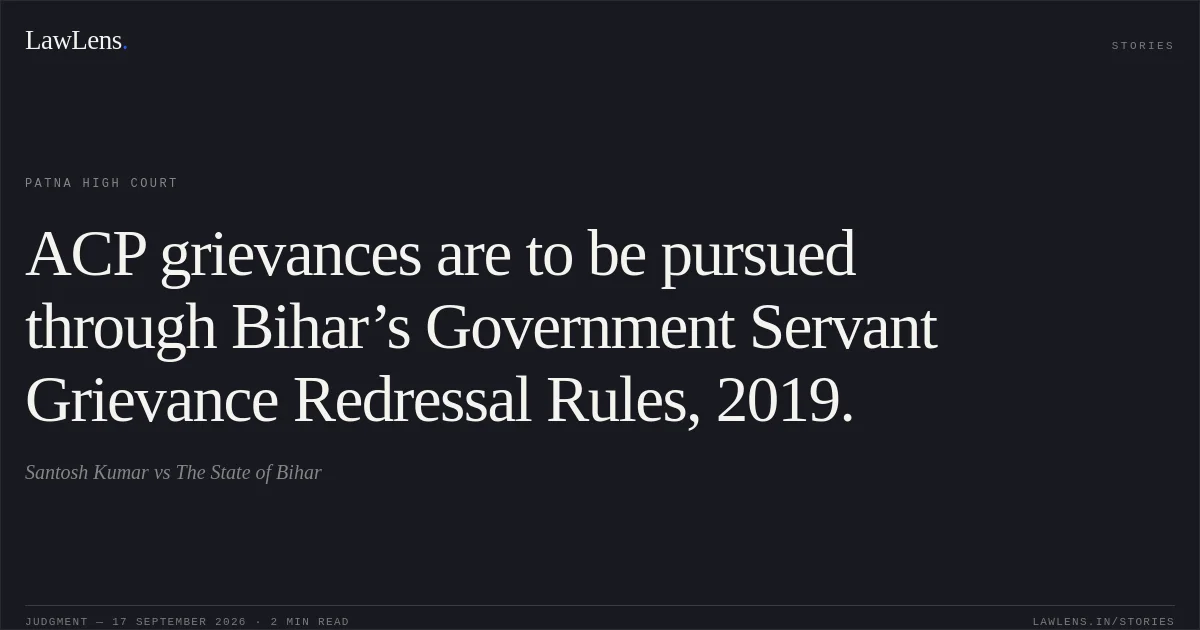
The petitioner, Santosh Kumar, an Assistant Engineer in the Bihar Rural Works Department, sought a writ of mandamus directing the respondents to grant him the benefit of the first Assured Career Progression (“A.C.P.”) with effect from 1 January 2016.
Source reference: p. 2He alleged that Assistant Engineers junior to him had already been granted the same benefit by Memo No. 5304 dated 26 July 2019, and contended that, as on 1 January 2016, no departmental proceeding was pending against him and he was not under suspension.
Source reference: p. 2The petitioner had also submitted a representation dated 31 January 2022.
Source reference: p. 2During the hearing, the Court noted that the grievance concerned denial of A.C.P. benefits allegedly granted to juniors.
Source reference: p. 2The State did not appear at the hearing.
Source reference: p. 1Issues
Whether the petitioner’s claim for grant of first A.C.P. benefits with effect from 1 January 2016 could be pursued as a service grievance under the Bihar Government Servant Grievance Redressal Rules, 2019?
Source reference: pp. 2–5Whether the writ petition should be disposed of by directing the petitioner to avail the statutory grievance-redressal mechanism rather than seeking immediate adjudication of the A.C.P. claim on merits?
Source reference: pp. 2–5Law Applied
The Court applied the Bihar Government Servant Grievance Redressal Rules, 2019.
Source reference: pp. 2–5Rule 2(c) defines “complaint” to include matters relating to service benefits, including promotion, A.C.P. and M.A.C.P., while excluding matters already pending before a court, disciplinary or departmental proceedings, transfers/postings/deputation, and matters under the Right to Information Act.
Source reference: pp. 2–3Rule 3 prescribes that serving or retired State Government employees may file complaints relating to service matters or retirement benefits through the online mechanism; ordinarily, only one subject may be raised in each complaint.
Source reference: pp. 3–4The governing principle applied was that an available statutory or administrative grievance-redressal mechanism should ordinarily be pursued for service-benefit disputes before the High Court grants substantive relief under writ jurisdiction.
Source reference: pp. 2–5Reasoning
The petitioner’s grievance concerned the alleged non-grant of first A.C.P. benefits, a subject expressly covered by Rule 2(c)(4) of the 2019 Rules.
Source reference: p. 3Since the dispute related to a service benefit and was not shown to fall within any of the exclusions under Rule 2(c), the Court held that the petitioner had an available remedy under the prescribed grievance-redressal mechanism.
Source reference: p. 3Rather than adjudicating whether the petitioner was substantively entitled to A.C.P. benefits from 1 January 2016, the Court directed him to file a complaint before the competent authority in accordance with Rule 3.
Source reference: pp. 3–5Holding
The Court did not decide the petitioner’s entitlement to first A.C.P. benefits on merits.
It directed the petitioner to file a complaint under the Bihar Government Servant Grievance Redressal Rules, 2019 within 30 days from the date of judgment.
Source reference: p. 5The concerned authority was directed to decide the complaint strictly within the time prescribed under the Rules.
Source reference: p. 5The writ petition was accordingly disposed of.
Source reference: p. 5Original Court PDF
Santosh KumarvsThe State of Bihar
Click to open original judgment
Original judgment, available to read, download and summarize on LawLens.in