Facts
On a complaint concerning incidents dated 20 May 2019, Jagaddal Police Station Case No. 475 of 2019 was registered under Sections 435, 147, 148, 149, 447, 448, 341, 379, 427 and 34 of the Indian Penal Code, 1860.
Source reference: paras. 1–2The allegations were that a group of persons forcibly entered houses, damaged household articles, committed theft and looted money, and that several houses were damaged or set on fire.
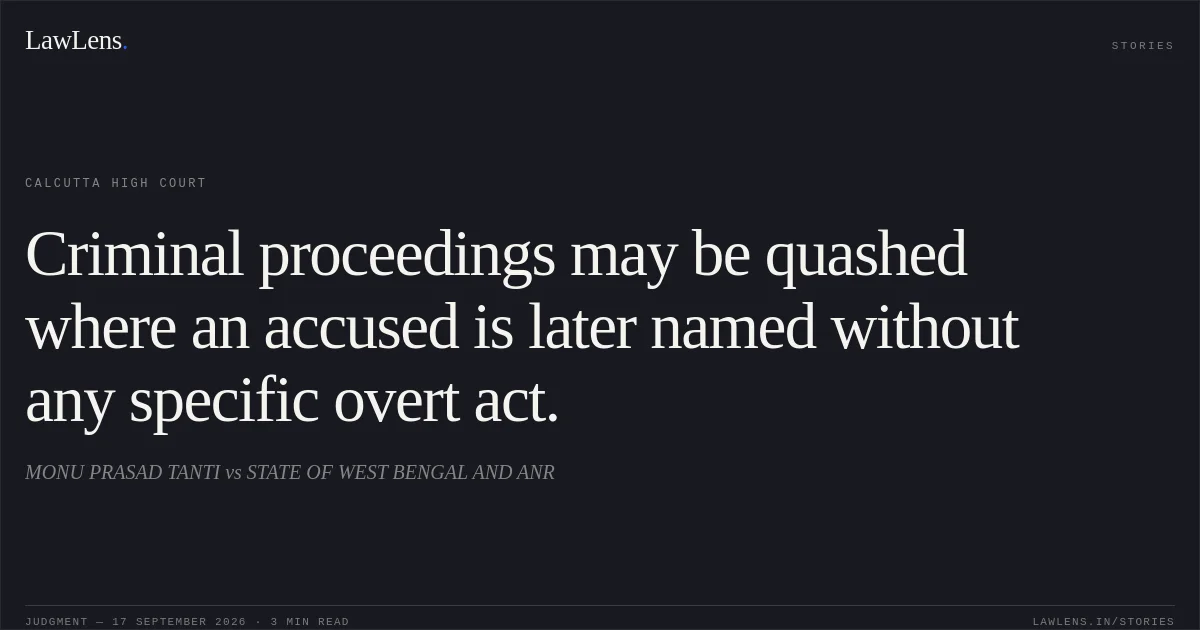
Source reference: paras. 1–2The de facto complainant specifically named 22 persons in the written complaint, but the petitioner, Monu Prasad Tanti, was not named in the FIR. His name appeared for the first time in the charge-sheet on the basis of statements made by witnesses, who collectively named approximately 30 persons. No specific overt act was attributed to the petitioner.
Source reference: paras. 4, 6The petitioner sought quashing of the criminal proceeding and the charge-sheet pending before the Additional Chief Judicial Magistrate, Barrackpore, in GR Case No. 2658 of 2019.
Source reference: para. 1Issues
Whether the criminal proceeding and charge-sheet could be quashed against the petitioner where he was not named in the FIR, his name emerged only during investigation, and no specific overt act was attributed to him.
Source reference: paras. 4, 6Whether continuation of the proceeding against the petitioner fell within the categories warranting exercise of the High Court’s quashing jurisdiction under the principles laid down in State of Haryana v. Bhajan Lal.
Source reference: paras. 7–8Law Applied
The Court applied the principles governing quashing of criminal proceedings under the High Court’s inherent jurisdiction, particularly the categories identified by the Supreme Court in State of Haryana v. Ch. Bhajan Lal, 1992 Supp. (1) SCC 335 / AIR 1992 SC 604.
Source reference: para. 7Proceedings may be quashed where the allegations and materials collected, even if accepted at face value, do not disclose the commission of an offence or make out a case against the accused; where the allegations are inherently improbable; or where continuation of the proceeding would otherwise amount to abuse of process or defeat the ends of justice.
Source reference: para. 7The Court also noted the petitioner’s reliance on Salib @ Shalu @ Salim v. State of U.P., 2023 SCC OnLine SC 947, and Haji Iqbal @ Bala through S.P.O.A. v. State of U.P., 2023 SCC OnLine SC 948.
Source reference: para. 5Reasoning
The Court found that the de facto complainant had specifically named 22 persons in the original complaint, whereas the petitioner was not among them. His name surfaced only during the investigation through witness statements, which named around 30 persons generally.
Source reference: para. 6The materials did not attribute any specific overt act to the petitioner.
Source reference: para. 6Applying the Bhajan Lal categories, the Court concluded that the uncontroverted allegations and materials collected did not sufficiently disclose a case against the petitioner individually.
Source reference: paras. 7–8Consequently, continuation of the proceeding against him would not serve the interests of justice and was covered by the principles permitting quashing of proceedings to prevent abuse of process.
Source reference: paras. 7–8Holding
The revisional application, CRR 4788 of 2024, was allowed.
The proceedings arising from Jagaddal Police Station Case No. 475 of 2019, including the charge-sheet in GR Case No. 2658 of 2019, were quashed in respect of Monu Prasad Tanti only.
Source reference: para. 10All connected applications were disposed of, any interim order was vacated, and a copy of the judgment was directed to be sent to the trial court for necessary compliance.
Source reference: paras. 11–13Acts & Sections Cited
13 provisions across 2 statutes referred to in this judgment. Each provision opens on LawLens.
Indian Penal Code, 1860
Code of Criminal Procedure, 19733
Original Court PDF
MONU PRASAD TANTIvsSTATE OF WEST BENGAL AND ANR
Click to open original judgment
Original judgment, available to read, download and summarize on LawLens.in