Facts
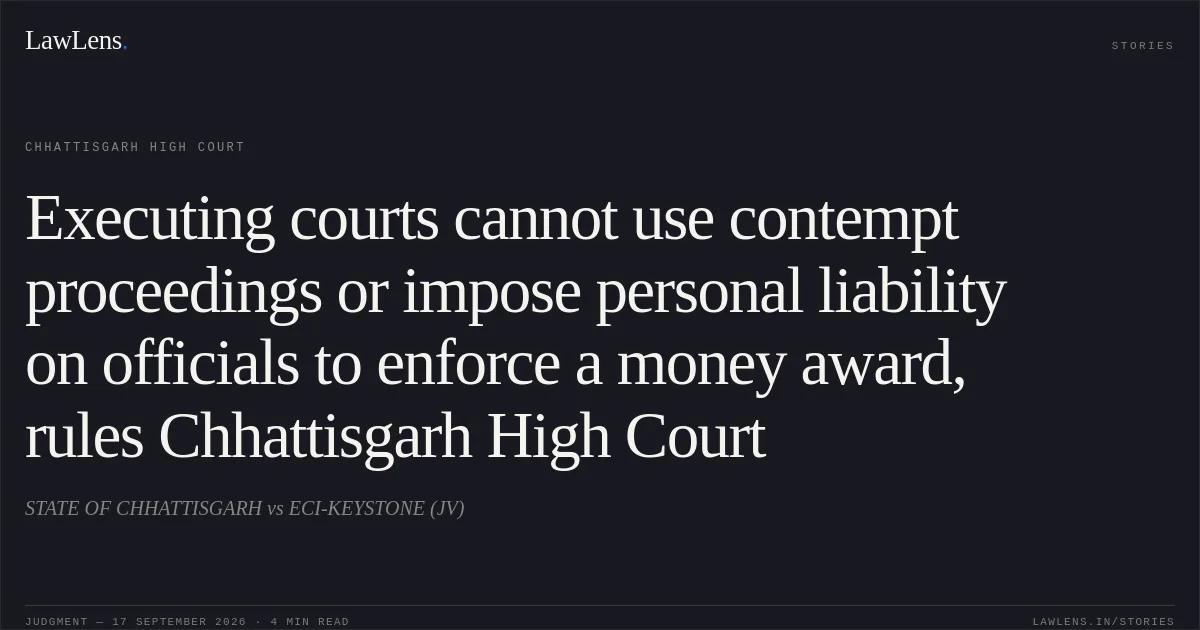
The Government of Chhattisgarh, through the Public Works Department, executed a National Highway project funded by the Ministry of Road Transport and Highways. ECI-Keystone (JV), the contractor, completed the work and subsequently raised an additional claim, which was rejected by the department. The contractor invoked arbitration, resulting in an ex parte award dated 02.09.2022 directing payment of approximately ₹160.30 crores with interest.
Source reference: para. 2The State’s challenge to the award under Section 34 of the Arbitration and Conciliation Act, 1996 was dismissed as time-barred; the subsequent appeal under Section 37 and Special Leave Petition were also dismissed.
Source reference: para. 3Execution proceedings were thereafter initiated by the award-holder. Although an objection under Section 47 of the Arbitration Act was initially accepted by the Executing Court, that order was set aside by the High Court, and the Supreme Court dismissed the challenge thereto.
Source reference: para. 4During execution, the Commercial Court directed senior PWD officers to appear personally, file affidavits disclosing financial particulars, provide timelines for payment, and warned that personal financial liability and contempt proceedings could follow for non-payment of the award.
Source reference: paras. 11–15Issues
Whether an executing court enforcing a final arbitral money award under Section 36 of the Arbitration and Conciliation Act, 1996 may impose personal financial liability or require personal undertakings from officers who are not judgment-debtors under the award
Source reference: paras. 16–17, 22–23Whether contempt jurisdiction or coercive personal-appearance directions may be used as a substitute for the statutory execution procedure applicable to a money award
Source reference: paras. 18–21, 26–27Whether the Executing Court’s observations regarding the prospects of pending review petitions before the Supreme Court were permissible
Source reference: para. 24Law Applied
Section 36 of the Arbitration and Conciliation Act, 1996 provides that an arbitral award is enforceable as if it were a decree of the court and must therefore be executed in accordance with the CPC, particularly Order XXI.
Source reference: para. 16An executing court must enforce the decree or award as it stands, cannot travel beyond it, and cannot create a personal liability not imposed by the award.
Source reference: paras. 16–17The Court relied on R.N. Dey v. Bhagyabati Pramanik, (2000) 4 SCC 400, holding that contempt should not ordinarily be used to execute a money decree where an alternative execution remedy exists.
Source reference: para. 18Food Corporation of India v. Sukh Deo Prasad, (2009) 5 SCC 665, holding that the remedy for non-payment of a money decree is execution, not contempt.
Source reference: para. 19Kanwar Singh Saini v. High Court of Delhi, (2012) 4 SCC 307, reiterating that contempt cannot replace the remedies under Order XXI CPC.
Source reference: para. 20State of Uttar Pradesh v. Dr. Manoj Kumar Sharma, (2021) 7 SCC 806, which cautioned against routinely summoning or pressurising executive officers in the discharge of administrative functions.
Source reference: para. 21Civil contempt requires clear, conscious and wilful disobedience of an independent judicial direction and cannot be employed merely to secure payment of a money award.
Source reference: paras. 18, 26Reasoning
The High Court distinguished between legitimate execution of the award and impermissible coercive measures against individual officers.
Source reference: no citationSince the award was against the State department and not against the Engineer-in-Chief, Chief Engineer, Secretary or other officers in their personal capacities, the Executing Court could require the competent authority to disclose assets, funds, sanctions and steps taken for payment, and could adopt the modes of execution available under Order XXI CPC.
Source reference: paras. 17, 22–25However, it could not convert departmental affidavits or statements regarding anticipated governmental approval into personal undertakings or personal monetary liability.
Source reference: para. 23The continued accrual of interest and the State’s administrative difficulties justified expeditious execution but did not authorise departure from the statutory execution procedure.
Source reference: no citationThe Executing Court’s directions threatening personal liability and contempt for non-payment of the award improperly treated execution as contempt proceedings, contrary to the principles in R.N. Dey, Sukh Deo Prasad and Kanwar Singh Saini.
Source reference: paras. 18–22, 26Further, the Executing Court ought not to have commented on the likely success of review petitions pending before the Supreme Court; although such proceedings did not operate as a stay in the absence of a specific stay order, their merits were for the Supreme Court to determine.
Source reference: para. 24Holding
The High Court partly allowed the writ petition.
It set aside the impugned directions insofar as they required personal affidavits or undertakings from individual officers, threatened to impose personal financial liability for the accruing interest, or contemplated contempt proceedings merely for non-payment of the money award.
Source reference: para. 27The execution proceedings were permitted to continue, but strictly under Section 36 of the Arbitration and Conciliation Act, 1996 and Order XXI CPC, including disclosure of assets and adoption of legally permissible modes of execution.
Source reference: para. 28The Court clarified that the award-holder’s entitlement to the awarded amount and interest remained unaffected, and that the Executing Court could require competent authorities to provide information and take lawful steps for satisfaction of the award.
Source reference: para. 29No order as to costs was made.
Source reference: para. 30Acts & Sections Cited
6 provisions across 3 statutes referred to in this judgment. Each provision opens on LawLens.
Arbitration and Conciliation Act, 19964
Code of Civil Procedure, 19081
Contempt of Courts Act, 19711
Original Court PDF
STATE OF CHHATTISGARHvsECI-KEYSTONE (JV)
Click to open original judgment
Original judgment, available to read, download and summarize on LawLens.in