Facts
The petitioner was appointed as an Assistant Teacher in 1971 at Guru Nanak High School, a government-aided minority institution
Source reference: para 2(i)In 2001, she was appointed as In-charge Headmaster
Source reference: para 2(ii)The School Managing Committee (MC) recommended her for permanent promotion to Headmaster on 07.08.2009; however, the Director of Secondary Education rejected this via an order dated 16.05.2016, noting she lacked the mandatory Post-Graduation (PG) degree at the time of the initial recommendation
Source reference: para 2(iii)-(vi)The petitioner subsequently obtained her M.A. degree on 14.11.2009, and the MC issued a fresh recommendation for her promotion effective 01.12.2009 via a resolution dated 27.12.2010
Source reference: para 2(v), 6The State contended that the MC later cancelled this second resolution in 2013, after the petitioner’s retirement on 31.10.2012
Source reference: para 7-8Issues
1. Whether a candidate must possess the prescribed eligibility qualifications on the date of recommendation for promotion to the post of Headmaster?
Source reference: para 11-122. Whether the eligibility criteria under Rule 4(i)(kha) (Post-Graduation + experience) and Rule 4(ii)(Aa) (Selection Grade + seniority) of the 2004 Notification are to be read in isolation or conjunction?
Source reference: para 20-233. Whether the State’s failure to act upon a recommendation made after the petitioner attained eligibility constitutes a violation of her rights?
Source reference: para 15-19Law Applied
The court applied the Recruitment/Promotion Rules notified on 05.11.2004, specifically Rule 4(i)(kha), which mandates a second-class PG degree and ten years of teaching experience for promotion to Headmaster, and Rule 4(ii)(Aa), which allows for promotion based on senior selection grade and seniority
Source reference: para 9-10Establishment that eligibility qualifications must be possessed by the prescribed date and cannot be cured post-facto as per Rakesh Kumar Sharma v. State (NCT and Delhi)
Source reference: para 12The right to be considered for promotion is a fundamental right under Article 16(1) of the Constitution of India as per Union of India v. Manpreet Singh Poonam and Ajit Singh (II) v. State of Punjab
Source reference: para 13Reasoning
The Court initially upheld the Director’s rejection of the first recommendation (August 2009) because the petitioner did not hold a PG degree on that date, rendering her ineligible under Rule 4(i)(kha)
Source reference: para 12, 14Regarding the second recommendation (December 2010), the Court noted the petitioner had by then obtained her M.A. degree
Source reference: para 17The Court found the State’s “sitting tight” on this subsequent recommendation for years—only to claim it was cancelled by the MC after the petitioner’s retirement—was arbitrary
Source reference: para 18-19On the interpretation of the 2004 Rules, the Court clarified that Rules 4(i)(kha) and 4(ii)(Aa) provide independent and parallel tracks for eligibility; a teacher can qualify via academic PG credentials or via the senior selection grade/seniority route
Source reference: para 21-23Holding
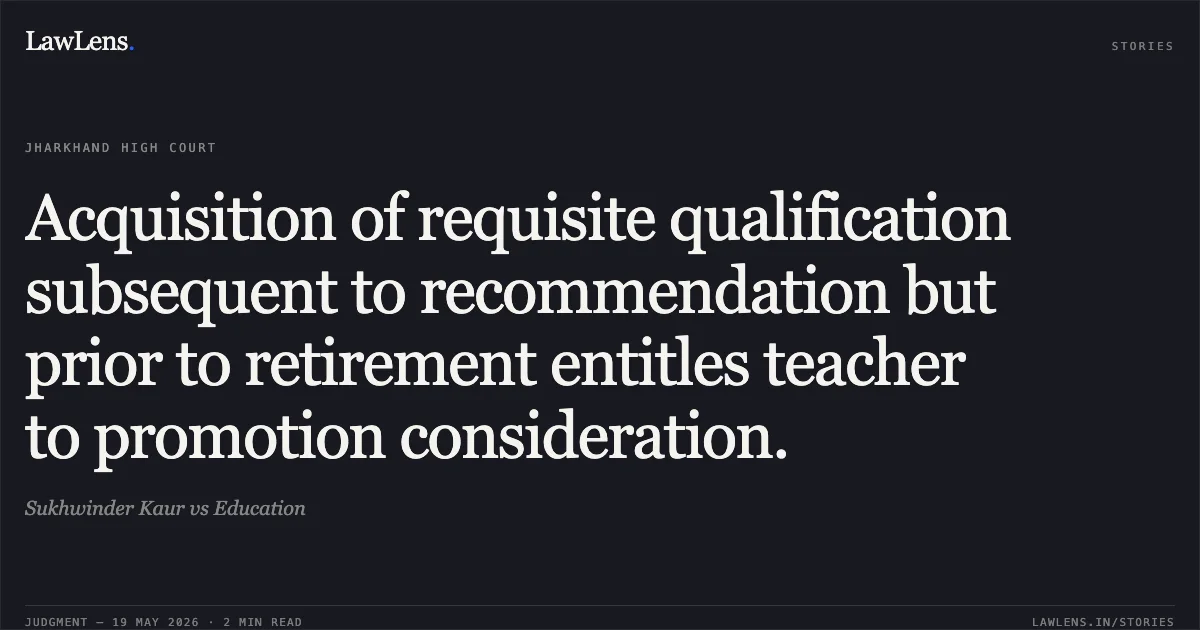
The Court held that while the initial rejection was legally sound, the failure to consider the subsequent 2010 recommendation after the petitioner attained eligibility was an infraction of her fundamental right to be considered for promotion
The Court answered that Rules 4(i)(kha) and 4(ii)(Aa) operate independently
Source reference: para 23Without quashing the 2016 impugned order, the Court directed Respondent No. 2 to pass a fresh order based on the MC’s December 2010 recommendation within three months and ordered the release of all consequential and pensionary benefits to the petitioner
Source reference: para 26, 27Original Court PDF
Sukhwinder KaurvsEducation
Click to open original judgment
Original judgment, available to read, download and summarize on LawLens.in