Facts
The petitioners challenged the notification dated 09.11.1993 issued under Section 4 and the declaration dated 19.06.1995 issued under Section 6 of the Land Acquisition Act, 1894 (“1894 Act”), by which their lands at Dhani Poonchla Wali, Neemkathana, District Sikar, were acquired for expansion of a RIICO industrial area.
Source reference: para. 1The petitioners’ lands, measuring 0.51 hectare each and comprised in Khasra Nos. 364/4, 364/3 and 364/5, were substantially occupied by residential houses and formed part of the local abadi, although parts were recorded as banjar or used agriculturally.
Source reference: paras. 3–4, 48They objected under Section 5A, asserting that residential land was being acquired despite the availability of adjoining banjar and barani land, and that intervening pasture, cremation-ground and other lands had been excluded from the acquisition.
Source reference: paras. 6, 9–11An award dated 20.06.1997 covered other acquired lands but expressly did not assess compensation for the petitioners’ lands.
Source reference: paras. 18, 23, 58Earlier dismissals of the writ petitions were set aside in intra-court appeals, and the matters were remanded for fresh consideration on 19.02.2018.
Source reference: para. 17Issues
Whether the acquisition notifications and declaration were invalid because the Section 5A enquiry and the Government’s satisfaction under Section 6 were vitiated by non-application of mind, failure to consider relevant objections, and absence of reasons.
Source reference: paras. 29–32, 44, 48–56Whether acquisition for RIICO required compliance with Part VII of the 1894 Act governing acquisition for companies.
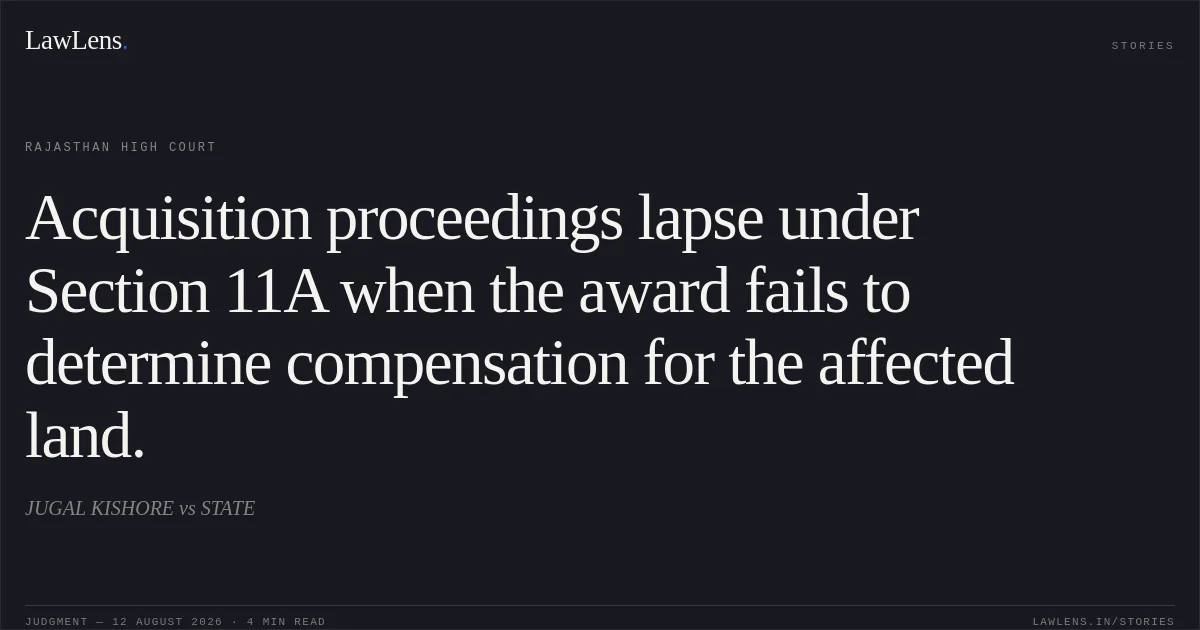
Source reference: paras. 12, 45–46Whether the acquisition proceedings lapsed under Section 11A of the 1894 Act because no valid award determining compensation for the petitioners’ lands was made within the prescribed period.
Source reference: paras. 23, 57–67Whether the respondents could rely on the acquisition and utilisation of other lands, acceptance of compensation by other landowners, or Section 24 of the Right to Fair Compensation and Transparency in Land Acquisition, Rehabilitation and Resettlement Act, 2013 (“2013 Act”) to sustain the petitioners’ acquisition.
Source reference: paras. 28, 68–71Law Applied
The Court applied Sections 4, 5A, 6 and 11A of the Land Acquisition Act, 1894, read with Article 300A of the Constitution.
Source reference: no citationSection 5A confers a valuable and substantive right to object to compulsory acquisition, requiring an effective hearing, objective consideration of objections, reasoned recommendations by the Collector and independent application of mind by the appropriate Government before issuing a Section 6 declaration.
Source reference: paras. 31–36The Court relied on Munshi Singh v. Union of India, Union of India v. Mukesh Hans, Hindustan Petroleum Corpn. Ltd. v. Darius Shapur Chenai, Raghbir Singh Sehrawat v. State of Haryana, Kamal Trading Pvt. Ltd. v. State of West Bengal, Dev Sharan v. State of Uttar Pradesh, Radhy Shyam v. State of Uttar Pradesh, Usha Stud & Agricultural Farms Pvt. Ltd. v. State of Haryana and Women’s Education Trust v. State of Haryana, which establish that Section 5A is not an empty formality and that objections concerning residential occupation, suitability, alternative land, comparative hardship and arbitrariness must be meaningfully considered.
Source reference: paras. 33–43Acquisition legislation is expropriatory and must be strictly construed; compulsory deprivation of property must be fair, reasonable and authorised by law.
Source reference: paras. 30, 37–38Under Section 11A, an award determining compensation must be made within two years from publication of the Section 6 declaration, excluding only the period during which proceedings were actually stayed by a court.
Source reference: paras. 57, 60RIICO, being a Government Company owned and controlled by the State, was excluded from the definition of “Company” under Section 3(e), read with Section 3(cc), and therefore Part VII was inapplicable.
Source reference: para. 45Reasoning
Although expansion of an industrial area constituted a legitimate public purpose, the Court held that this did not authorise arbitrary selection of private land.
Source reference: paras. 46–47The preliminary Tehsildar report had already disclosed substantial residential occupation, and the petitioners’ Section 5A objections specifically raised the existence of houses, alternative banjar and barani land, the exclusion of intervening khasras and the discriminatory retention of their lands.
Source reference: paras. 48–50The Land Acquisition Officer’s report merely stated that the objections were baseless and that acquisition would not adversely affect the petitioners; it did not examine the residential character of the land, the availability of alternatives, the intervening lands or the differential treatment of released parcels.
Source reference: para. 48Consequently, the report contained conclusions without supporting reasons and could not provide a lawful foundation for the Government’s satisfaction under Section 6.
Source reference: paras. 49, 53–56The Part VII challenge failed because RIICO was a State-controlled Government Company, but that finding did not cure the defective Section 5A process.
Source reference: paras. 45–46Independently, the 20.06.1997 award did not assess compensation for the petitioners’ lands and therefore could not constitute a valid award in respect of them.
Source reference: paras. 58–59, 66The interim status quo order could justify exclusion only for the period it remained operative; it ceased upon dismissal of the writ petitions in 2006/2007, and the respondents showed no subsequent restraint or valid award within the statutory period.
Source reference: paras. 60–65Acceptance of compensation by other landowners and development of the remaining acquired land could not validate an acquisition independently unlawful qua the petitioners.
Source reference: paras. 68–70Holding
The Court allowed all three writ petitions.
It quashed and set aside, insofar as they concerned the petitioners’ lands measuring 0.51 hectare each in Khasra Nos. 364/4, 364/3 and 364/5, the Section 4 notification dated 09.11.1993 and the Section 6 declaration dated 19.06.1995.
Source reference: para. 72It further held that the acquisition proceedings had lapsed under Section 11A because no valid award determining compensation for the petitioners’ lands was made within the prescribed period.
Source reference: paras. 67, 72The respondents were restrained from proceeding with acquisition of those lands pursuant to the impugned notifications, and pending applications were disposed of.
Source reference: paras. 72–73Original Court PDF
JUGAL KISHOREvsSTATE
Click to open original judgment
Original judgment, available to read, download and summarize on LawLens.in