Facts
On 26 June 1998, Ratan, the complainant’s son, was allegedly confronted by the accused over non-payment of “chandla” money.
Source reference: paras. 3–3.3The prosecution alleged that accused No. 1, Ramanbhai, struck Ratan on the back of the neck with a wooden stick, while the other accused assaulted him with fists and kicks, resulting in his death.
Source reference: paras. 3–3.3An FIR was lodged on 27 June 1998, and the accused were subsequently charge-sheeted under Sections 302, 323, 504 and 114 of the Indian Penal Code, 1860 (“IPC”).
Source reference: paras. 3–3.3The Sessions Court acquitted all four accused under Section 235(1) of the Code of Criminal Procedure, 1973 (“CrPC”), granting them the benefit of doubt.
Source reference: para. 3.3The State challenged the acquittal before the High Court.
Source reference: para. 4Issues
Whether the prosecution proved beyond reasonable doubt that accused No. 1, Ramanbhai, inflicted the fatal stick blow on the deceased’s neck.
Source reference: para. 8Whether the involvement of accused Nos. 2 to 4 in assaulting the deceased was established through reliable and corroborated evidence.
Source reference: paras. 9–11Whether the Trial Court’s order of acquittal was so unreasonable or perverse as to warrant interference in an appeal against acquittal.
Source reference: paras. 20–21Law Applied
The Court considered the charges framed under Sections 302, 323, 504 and 114 of the IPC, requiring the prosecution to establish the accused persons’ criminal acts and common participation beyond reasonable doubt.
Source reference: paras. 2–3.3It applied the principle that material contradictions, improvements, inconsistencies with medical evidence, and unexplained circumstances creating reasonable doubt must operate in favour of the accused.
Source reference: paras. 9–19The Court also applied the settled limitation on appellate interference with an acquittal, holding that where the Trial Court’s view is a plausible one, the appellate court should not substitute its own view merely because another view is possible.
Source reference: para. 20In this regard, it relied on Mallappa & Ors. v. State of Karnataka, (2024) 3 SCC 544, and Babu Sahebgouda Rudragoudar & Ors. v. State of Karnataka, AIR 2024 SC 2252.
Source reference: para. 20Reasoning
The High Court found substantial inconsistencies in the prosecution evidence.
Source reference: no citationThe complaint attributed fists and kicks to accused Nos. 2 to 4, whereas the complainant later improved his testimony by alleging the use of sticks; the medical evidence did not support injuries caused by fists or kicks.
Source reference: paras. 9–11Different witnesses gave conflicting accounts involving fists, kicks, sticks and stones, and no witness specified which part of the deceased’s body was struck by accused Nos. 2 to 4.
Source reference: paras. 10–11The prosecution’s account that the deceased had travelled to another village was rendered doubtful by the inquest evidence regarding his clothing, while three of the four injuries remained unexplained.
Source reference: paras. 12–13The alleged eyewitnesses were also found unreliable: the distances between their houses and the scene raised doubt about their ability to hear the altercation, their accounts differed regarding who arrived first, and their court testimony contained material improvements over their police statements.
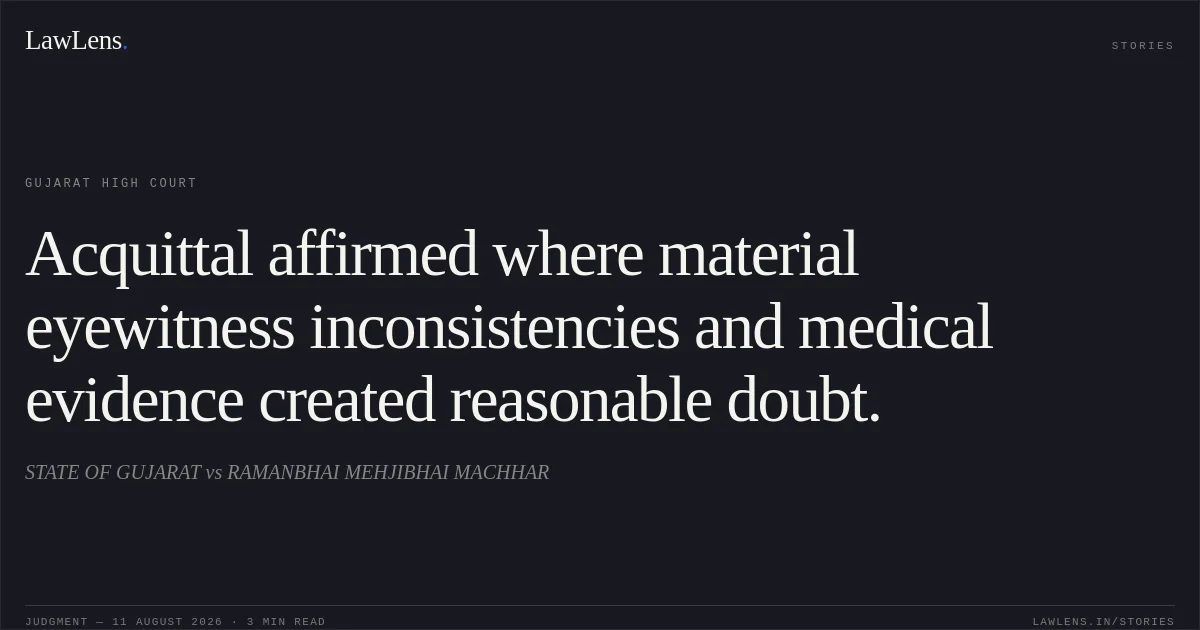
Source reference: paras. 14–19In view of these contradictions and the absence of dependable corroboration, the Court held that the prosecution had failed to prove the accused’s involvement beyond reasonable doubt.
Source reference: paras. 20–21Since the Trial Court’s acquittal was a plausible view based on the evidence, the restricted scope of appellate review required dismissal of the State’s appeal.
Source reference: paras. 20–21Holding
The High Court answered the issues against the prosecution and held that the involvement of the accused, including the attribution of the fatal stick blow to accused No. 1, was not proved beyond reasonable doubt.
It found no perversity or legal infirmity in the Trial Court’s order granting the accused the benefit of doubt.
Source reference: no citationThe State’s appeal was accordingly dismissed, the acquittal dated 23 February 2000 in Sessions Case No. 252 of 1998 was affirmed, the bail bonds of the accused were ordered to stand discharged, and the record and proceedings were directed to be returned to the Trial Court.
Source reference: para. 22Acts & Sections Cited
7 provisions across 2 statutes referred to in this judgment. Each provision opens on LawLens.
Indian Penal Code, 18604
Code of Criminal Procedure, 19733
Original Court PDF
STATE OF GUJARATvsRAMANBHAI MEHJIBHAI MACHHAR
Click to open original judgment
Original judgment, available to read, download and summarize on LawLens.in