Facts
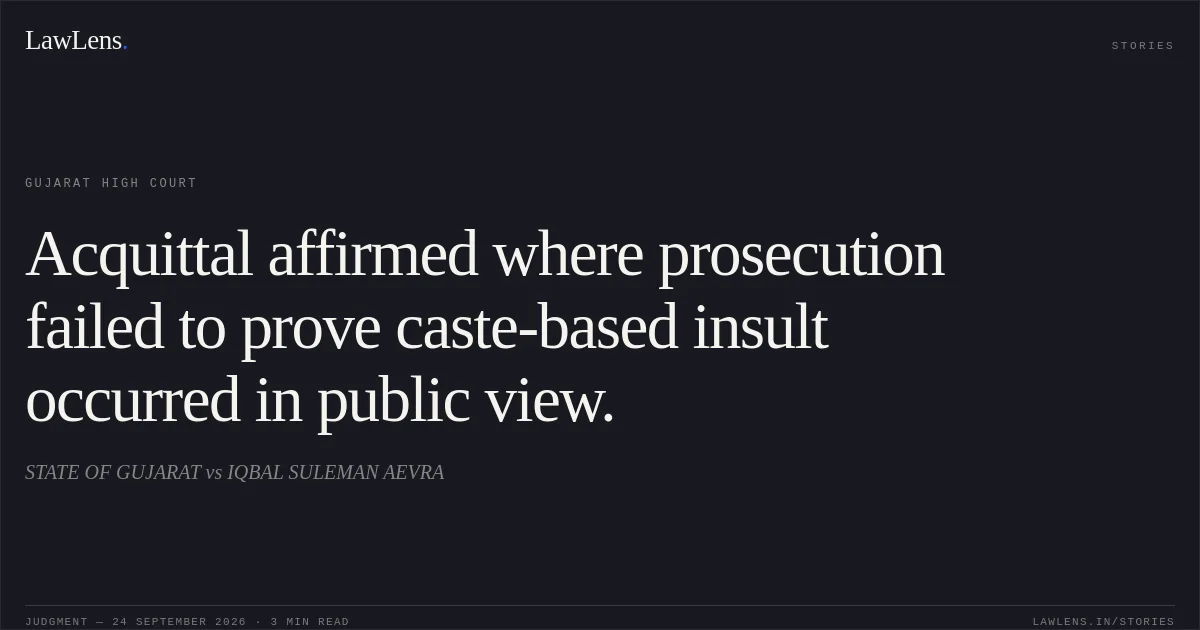
The complainant, Rameshbhai Bhikhabhai Makwana, alleged that on 21 October 2010, near Jawahar Shopping Centre at Village Basu, the respondent-accused abused him by using caste-related derogatory words and threatened to kill him. The alleged incident arose against the background of a dispute concerning the construction of a school building on Government waste land and the complainant’s objections to that construction. The accused was prosecuted under Sections 504 and 506(2) of the IPC read with Section 3(1)(10) of the Scheduled Castes and Scheduled Tribes (Prevention of Atrocities) Act, 1989 (“Atrocities Act”).
Source reference: paras. 2, 10; pp. 2, 5The trial court examined ten prosecution witnesses and considered documentary evidence, but acquitted the accused by judgment dated 28 February 2012 in Special (Atrocity) Case No. 17 of 2011. The State preferred an appeal against acquittal under Section 378(1) and (3) of the Code of Criminal Procedure, 1973.
Source reference: paras. 1, 2.4, 4; pp. 1–3Issues
Whether the trial court was justified in acquitting the accused of the offences under Sections 504 and 506(2) of the IPC and Section 3(1)(10) of the Atrocities Act.
Source reference: para. 9; p. 5Whether the trial court properly appreciated the oral and documentary evidence led by the prosecution.
Source reference: para. 9; p. 5Whether the acquittal suffered from any illegality, irregularity, perversity, or manifest error warranting appellate interference.
Source reference: para. 9; p. 5Law Applied
The Court applied Sections 504 and 506(2) of the IPC concerning intentional insult likely to provoke breach of peace and criminal intimidation involving a threat to cause death, respectively, together with Section 3(1)(10) of the Atrocities Act concerning intentional insult or intimidation of a member of a Scheduled Caste or Scheduled Tribe in public view.
Source reference: paras. 1–2; pp. 1–2It held that an offence under the Atrocities Act required reliable proof that the insulting or intimidating incident occurred at a public place and within public view. In an appeal against acquittal under Section 378 CrPC, the appellate court has power to reappreciate the evidence, but must recognise the double presumption of innocence and should not interfere where two reasonable views are possible. The Court relied on Chandrappa v. State of Karnataka, (2007) 4 SCC 415; Rajesh Prasad v. State of Bihar, (2022) 3 SCC 471; Babu Sahebagouda Rudragoudar v. State of Karnataka, (2024) 8 SCC 149; and Ramesh v. State of Karnataka, (2024) 9 SCC 169, which reiterate these principles governing appeals against acquittal.
Source reference: paras. 14–18; pp. 8–11Reasoning
The High Court found that PW-1 to PW-4 did not support the prosecution. Although the complainant, PW-5, implicated the accused and stated that PW-6 and PW-7 were present, the testimonies of PW-5, PW-6, and PW-7 contained material discrepancies and did not consistently corroborate the allegations of caste-based abuse or threat to murder.
Source reference: para. 11; p. 6Their evidence also required cautious scrutiny because of the underlying dispute concerning Government land and the alleged encroachment proceedings initiated by the accused, who was the village Deputy Sarpanch. The complainant’s history of lodging several complaints further affected the assessment of his credibility. Most significantly, although the alleged incident occurred in an open public area near a shopping centre and bus stand, the prosecution did not examine shop owners or other independent persons who could establish that the incident occurred in public view. Applying the principles governing appellate interference with acquittals, the Court concluded that the trial court’s assessment was a reasonable view of the evidence and was neither perverse nor legally infirm.
Source reference: paras. 12–14, 19–20; pp. 6–8, 12Holding
The High Court answered the issues against the State and held that the prosecution failed to prove the alleged offences beyond reasonable doubt. The trial court had properly appreciated the evidence, and no illegality, perversity, or manifest error justified interference with the acquittal.
The State’s appeal was dismissed, the judgment and order of acquittal dated 28 February 2012 were confirmed, the bail bond was cancelled, and the record and proceedings were directed to be returned to the trial court.
Source reference: para. 21; p. 12Acts & Sections Cited
6 provisions across 3 statutes referred to in this judgment. Each provision opens on LawLens.
Code of Criminal Procedure, 19733
Indian Penal Code, 18602
Scheduled Castes and the Scheduled Tribes (Prevention of Atrocities) Act, 19891
Original Court PDF
STATE OF GUJARATvsIQBAL SULEMAN AEVRA
Click to open original judgment
Original judgment, available to read, download and summarize on LawLens.in