Facts
Pushpaben, the deceased, was married to the respondent-accused and had one daughter. The prosecution alleged that, after approximately six months of marriage, the accused subjected Pushpaben to physical and mental cruelty, allegedly on account of his extramarital relationship with another woman. On 25 June 2011, the accused allegedly abused the complainant, the deceased’s mother, and asked her to take Pushpaben to her parental home. Later that day, Pushpaben was found hanging and was declared dead by a doctor
Source reference: p.2The complainant lodged an FIR alleging offences under Sections 306 and 498A of the Indian Penal Code. The police conducted the investigation, prepared the scene panchnama, recorded witness statements, and filed a chargesheet. The trial court framed charges, examined 15 prosecution witnesses, and admitted 10 documentary exhibits. By judgment dated 2 July 2012, the Additional Sessions Judge acquitted the accused
Source reference: pp.2–3The State preferred the present appeal under Section 378(1) and (3) of the Code of Criminal Procedure, 1973
Source reference: para.1Issues
Whether the prosecution proved beyond reasonable doubt that the respondent subjected Pushpaben to cruelty punishable under Section 498A IPC?
Source reference: pp.6–7, para.10Whether the prosecution established the ingredients of abetment of suicide under Sections 306 and 107 IPC, including a proximate and legally sufficient act of instigation, intentional aid, or continuous cruelty?
Source reference: pp.6–7, paras.10–13Whether the trial court’s acquittal was so perverse or legally erroneous as to warrant interference in an appeal against acquittal?
Source reference: pp.8–11, paras.14–19Law Applied
The court applied Sections 498A, 306 and 107 of the IPC, requiring the prosecution to prove cruelty and the essential ingredients of abetment of suicide beyond reasonable doubt.
Source reference: no citationIt referred to the principles concerning cruelty and the statutory presumption under the Evidence Act discussed in Ramesh Kumar v. State of Chhattisgarh, 2001 (9) SCC 618, and Ram Pyarey v. State of Uttar Pradesh, 2025 (6) SCC 820
Source reference: para.11The court also relied on State of Gujarat v. Bhaveshbhai Manilalbhai Patel, State of Gujarat v. Haji Haroon Meman, State of Gujarat v. Ashwinbhai Naginbhai Tandel, and Naresh Kumar v. State of Haryana, 2024 (3) SCC 573, concerning proof of cruelty and abetment
Source reference: para.12On appellate review of acquittal, the court applied the principles in Chandrappa v. State of Karnataka, (2007) 4 SCC 415; Rajesh Prasad v. State of Bihar, (2022) 3 SCC 471; Babu Sahebagouda Rudragoudar v. State of Karnataka, (2024) 8 SCC 149; and Ramesh v. State of Karnataka, (2024) 9 SCC 169: an appellate court may reappreciate the evidence, but an acquittal carries a double presumption of innocence, and where two reasonable views are possible, the acquittal should not be disturbed
Source reference: paras.14–17Reasoning
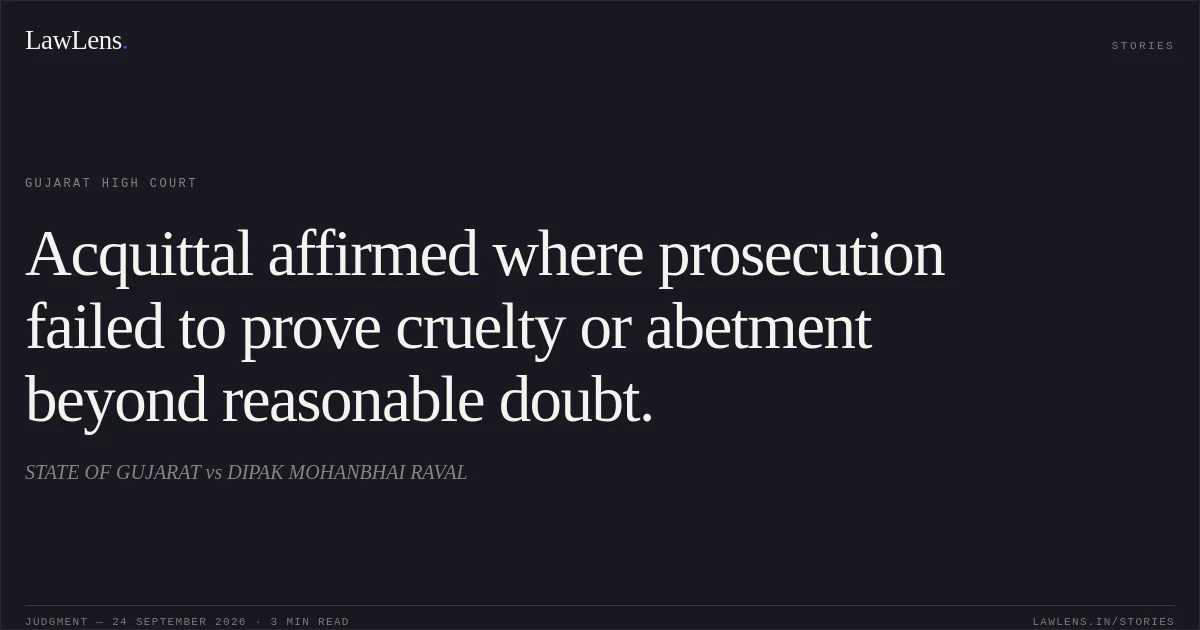
The court found that the prosecution evidence did not establish either cruelty under Section 498A IPC or abetment under Sections 306 and 107 IPC.
Source reference: no citationThe principal witnesses relied upon by the prosecution were not proximate or sufficiently reliable: PW-2 had not been in contact with the deceased or accused for about one month before the incident, while PW-14 stated that the deceased had disclosed ill-treatment approximately six months before her death, with no subsequent communication
Source reference: p.6, para.10The complainant, other family witnesses, and several neighbours did not support the prosecution and were declared hostile.
Source reference: no citationThe allegation of an extramarital relationship was also unsupported by cogent evidence or investigation
Source reference: pp.6–7, para.13Consequently, the court held that the prosecution had failed to prove continuous cruelty, harassment, or any proximate act of instigation or intentional aid linking the accused to the suicide beyond reasonable doubt
Source reference: pp.6–7, paras.10–13Since the trial court’s appreciation of evidence was a reasonably possible view and was not manifestly illegal or perverse, the principles governing appeals against acquittal required appellate restraint
Source reference: pp.8–11, paras.14–19Holding
The High Court held that the prosecution failed to prove the offences under Sections 498A and 306 read with Section 107 IPC beyond reasonable doubt.
The trial court’s acquittal was found to be supported by the evidence and free from perversity or legal infirmity.
Source reference: paras.18–20The State’s appeal was accordingly dismissed, the order of acquittal dated 2 July 2012 was confirmed, the accused’s bail bond was cancelled, and the record and proceedings were directed to be returned to the trial court
Source reference: paras.18–20Acts & Sections Cited
5 provisions across 2 statutes referred to in this judgment. Each provision opens on LawLens.
Code of Criminal Procedure, 19733
Indian Penal Code, 18602
Original Court PDF
STATE OF GUJARATvsDIPAK MOHANBHAI RAVAL
Click to open original judgment
Original judgment, available to read, download and summarize on LawLens.in