01Facts
The Appellant was appointed as a Public Prosecutor in the CBI against a Scheduled Caste-reserved vacancy on the basis of a caste certificate certifying him as belonging to the “Pan” community.
pp. 2–5 · ¶ 4(a)–(k), 35–38Following verification, the District Magistrate, Bhagalpur, reported that no such certificate had been issued and that the issuing authority’s signature appeared doubtful.
pp. 2–5 · ¶ 4(a)–(k), 35–38On that basis, an FIR was registered against the Appellant under Sections 420, 468 and 471 IPC.
pp. 2–5 · ¶ 4(a)–(k), 35–38The Appellant was subsequently acquitted by the learned Magistrate, principally because the prosecution failed to prove the District Magistrate’s report, authenticate the disputed signature, prove the relevant register, or establish that the certificate was forged or that the Appellant had cheated the authorities.
pp. 2–5 · ¶ 4(a)–(k), 35–38The Appellant thereafter claimed Rs.1,99,00,000 as damages for malicious prosecution, defamation, loss of reputation, mental agony, family hardship and legal expenses.
pp. 15–22 · ¶ 21, 28–43The Trial Court dismissed the suit, holding that the Appellant had failed to prove malice, absence of reasonable and probable cause, defamation and the quantum of damages.
pp. 15–22 · ¶ 21, 28–43The present first appeal challenged that dismissal.
p. 1 · ¶ 102Issues
i.Whether the Appellant established the essential ingredients of malicious prosecution—particularly absence of reasonable and probable cause and malice—despite the criminal proceedings having ended in his acquittal
pp. 23–24, 27–31 · ¶ 26–31ii.Whether the acquittal judgment conclusively established that the criminal prosecution was malicious or was instituted without reasonable and probable cause
pp. 27–30 · ¶ 39–45iii.Whether the Appellant proved actionable defamation, consequential injury and the quantum of damages claimed
pp. 31–32 · ¶ 51–54iv.Whether the Trial Court’s dismissal of the suit disclosed any perversity, illegality or material misappreciation warranting interference in a first appeal under Section 96 CPC
pp. 10–15, 22–24 · ¶ 16–20, 2503Law Applied
The Court applied Section 96 CPC and Order XLI Rule 31 CPC, holding that a first appellate court must independently reconsider questions of fact and law and give reasons, while ordinarily deferring to findings supported by proper appreciation of evidence.
pp. 10–15 · ¶ 17–20An action for malicious prosecution requires proof that the defendant instituted the criminal proceedings, the proceedings terminated in the plaintiff’s favour, they were initiated without reasonable and probable cause, and the defendant acted with malice.
pp. 15–18, 23–24 · ¶ 27, 26Under West Bengal State Electricity Board v. Dilip Kumar Ray, malice means an improper or indirect motive, and even malice will not create liability where reasonable and probable cause existed; both malice and absence of reasonable and probable cause must be proved by the plaintiff.
p. 18 · ¶ 32Mere acquittal does not establish malicious prosecution, as recognised in Tarwinder Kumar Bedi v. Jit Parkash, Trilok Chand Bansal v. Bharat Bhushan Bansal and Deepak Rathaur v. Shashi Bhushan Lal Dass.
pp. 17–20 · ¶ 31, 36–37Findings in a criminal judgment are not binding in civil proceedings, although the criminal judgment may be relevant to the fact and result of the prosecution, as explained in Vishnu Dutt Sharma v. Daya Sapra.
pp. 20–21 · ¶ 37–39For civil defamation, the claimant must prove that the statement was false, defamatory and published, together with resulting injury to reputation.
pp. 18–19 · ¶ 34–35Provisions in the judgment · 6 · Linked ones open on LawLens
Code of Civil Procedure, 1908 Section 96Section 100Section 151
Indian Penal Code, 1860 Section 420Section 468Section 471
04Reasoning
The Court accepted that the Appellant proved institution of the criminal proceedings and their termination in his favour, but held that these were only two of the required ingredients.
pp. 23–24 · ¶ 29–30The prosecution had been preceded by official verification and the District Magistrate’s report stating that the certificate had not been issued and that the signature appeared doubtful. This furnished a reasonable basis, at the relevant time, for seeking investigation, even though the evidence ultimately proved insufficient for conviction.
pp. 24–29 · ¶ 32–45The deficiencies identified in the acquittal judgment—failure to prove the District Magistrate’s report and register, absence of scientific comparison of signatures, and lack of proof that the certificate was forged—explained the failure of the prosecution but did not retrospectively establish absence of reasonable and probable cause.
pp. 25–29 · ¶ 35–45The Appellant also produced no specific evidence of personal animosity, collateral purpose, knowledge of falsity or any improper motive on the part of the Respondents; therefore, malice was not proved.
pp. 29–31 · ¶ 46–50The Respondents’ failure to lead evidence did not automatically discharge the Appellant’s burden of proving the foundational ingredients of his claim.
p. 30 · ¶ 49His claims for defamation, reputational injury, mental agony, family honour, legal expenses and substantial monetary compensation were likewise unsupported by evidence establishing actionable injury or the amount claimed.
pp. 31–32 · ¶ 51–5405Holding
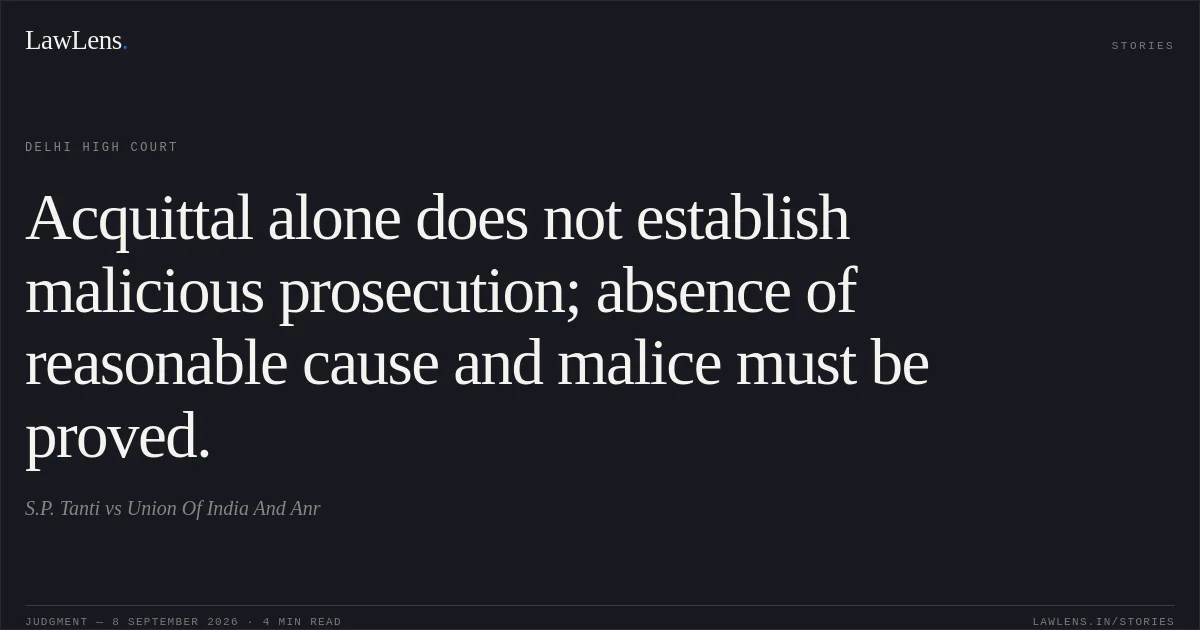
The Court held that the acquittal did not, by itself, establish malicious prosecution, absence of reasonable and probable cause or malice.
pp. 32–33 · ¶ 55–61The Appellant failed to prove the foundational tort of malicious prosecution, actionable defamation, consequential injury or the quantum of damages.
pp. 32–33 · ¶ 55–61The Trial Court’s judgment was therefore affirmed, the appeal was dismissed, all pending applications were also dismissed, and no order as to costs was made.
pp. 32–33 · ¶ 55–61Original Court PDF
S.P. TantivsUnion Of India And Anr
Click to open original judgment
Original judgment, available to read, download and summarize on LawLens.in