01Facts
On 16 May 1997, the Sub-Divisional Food Inspector inspected the petitioner’s sweetmeat shop and found approximately 8 kg of curd stored in earthen pots.
p. 2 · ¶ 2–3He purchased 600 grams of mixed curd for ₹15, prepared and sealed the samples, and sent one part to the Public Analyst, while the remaining parts were forwarded to the local health authority in accordance with the Prevention of Food Adulteration Act, 1954.
p. 2 · ¶ 2–3The Public Analyst reported that the curd was “adulterated for low fat content,” following which a complaint was instituted against the petitioner.
p. 5 · ¶ 12The Chief Judicial Magistrate convicted the petitioner under Sections 16(1)(a)(i) and 7(1) of the Prevention of Food Adulteration Act and sentenced him to six months’ imprisonment and a fine of ₹1,000.
p. 2 · ¶ 5The appellate court affirmed the conviction, leading to the present revision.
p. 3 · ¶ 602Issues
i.Whether the prosecution established beyond reasonable doubt that the curd was “adulterated” within the meaning of Section 2(ia) of the Prevention of Food Adulteration Act merely because the Public Analyst reported low fat content.
p. 7 · ¶ 17–18ii.Whether the prosecution proved the identity, integrity, and proper transmission of the sample through reliable evidence, despite the non-examination of the Public Analyst, messenger, and officials connected with the local health authority.
p. 5 · ¶ 13iii.Whether the conviction could be sustained where the prosecution evidence did not establish that the curd was harmful, spurious, injurious to health, or otherwise unfit for human consumption.
p. 6 · ¶ 14 · p. 7 · ¶ 1803Law Applied
The court applied Sections 7(1) and 16(1)(a)(i) of the Prevention of Food Adulteration Act, which penalise the sale of adulterated food; Section 2(ia), particularly Section 2(ia)(m), which covers food that does not conform to the prescribed standards or is otherwise adulterated; and the evidentiary requirements governing the collection, sealing, transmission, and proof of food samples.
p. 3 · ¶ 7 · p. 5 · ¶ 13The court also considered the safeguards under Section 13(2) of the Act and the petitioner’s reliance on Section 10(7) of the Act and Section 100(4) of the Code of Criminal Procedure concerning independent witnesses.
p. 3 · ¶ 7 · p. 5 · ¶ 13It relied on Dinesh Kumar v. State of Madhya Pradesh, holding that a finding of adulteration must be supported by evidence showing how the alleged deficiency affected the nature, substance, or quality of the article.
p. 6 · ¶ 14It relied on Vishwanath v. State of Maharashtra, concerning the absence of proof that samples drawn from different containers represented the entire seized substance.
p. 6 · ¶ 15It relied on Bhagwan Singh v. State of Rajasthan, on the benefit of reasonable doubt where material circumstances undermine the prosecution case.
p. 6 · ¶ 16It relied on State (Delhi Administration) v. Puran Mal, concerning the interpretation of “otherwise unfit for human consumption” in the statutory definition of adulteration.
p. 6 · ¶ 17Provisions in the judgment · 3 · Linked ones open on LawLens
Code of Criminal Procedure, 1973 Section 100Section 360Section 361
04Reasoning
The court held that the conviction rested substantially on the Public Analyst’s report stating only that the curd had low fat content.
p. 5 · ¶ 12 · p. 7 · ¶ 19That report did not explain whether the low fat content resulted from the addition of an inferior substance, rendered the curd spurious, affected its nature, substance, or quality, or made it harmful or unfit for human consumption.
p. 6 · ¶ 14 · p. 7 · ¶ 18The prosecution also failed to prove the chain of custody satisfactorily: the record did not disclose when the sample was sent or received, the messenger was not examined, the Public Analyst did not testify, and no witness from the local health authority was produced.
p. 5 · ¶ 13Further, there was no reliable evidence demonstrating the manner in which the sample was collected from the several pots or establishing that the sample represented the entire quantity of curd.
In these circumstances, the court found that the statutory requirement of proving adulteration under Section 2(ia)(m) had not been met beyond reasonable doubt.
p. 7 · ¶ 1805Holding
The court answered the issues in favour of the petitioner.
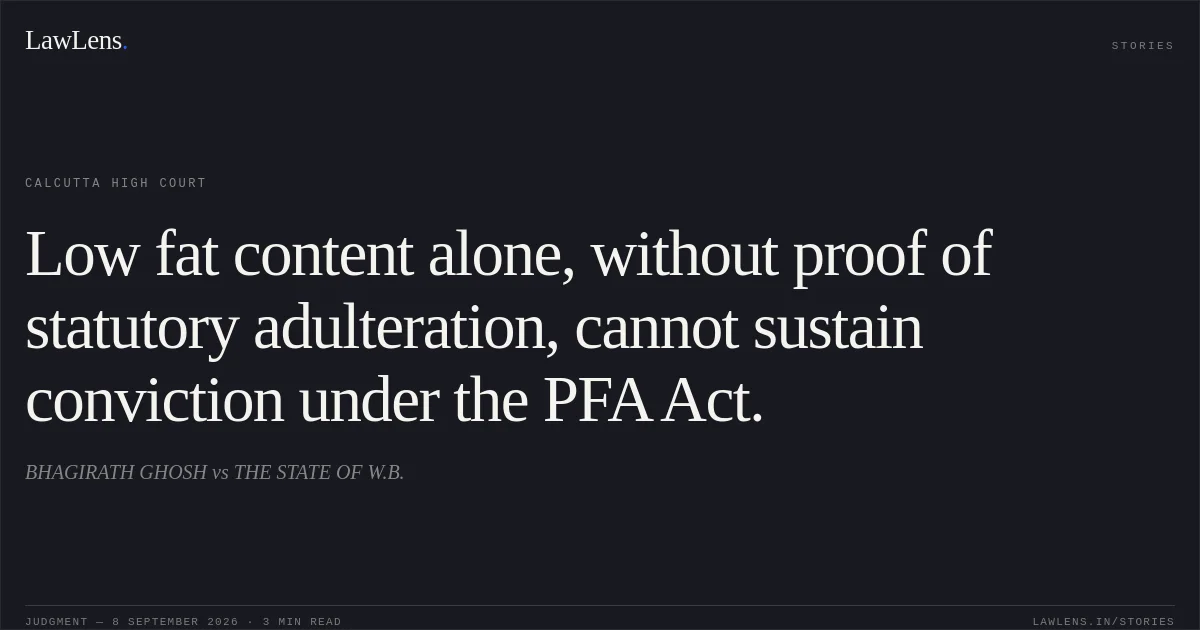
It held that low fat content, without evidence that the curd was injurious, spurious, or otherwise adulterated within the meaning of Section 2(ia), was insufficient to sustain a conviction under Sections 7(1) and 16(1)(a)(i) of the Prevention of Food Adulteration Act.
p. 7 · ¶ 19The criminal revision was allowed; the conviction and sentence imposed by the Chief Judicial Magistrate and affirmed by the appellate court were set aside.
p. 8 · ¶ 20–21The petitioner was directed to be released forthwith from his bail bond, and the connected application was disposed of.
p. 8 · ¶ 20–21Original Court PDF
BHAGIRATH GHOSHvsTHE STATE OF W.B.
Click to open original judgment
Original judgment, available to read, download and summarize on LawLens.in