01Facts
The petitioner, initially appointed as an Assistant Engineer in the Public Works Department in 1979 and later promoted as Assistant Executive Engineer, claimed that he was medically unfit and was not permitted to rejoin duty despite possessing a medical fitness certificate.
¶ 2He consequently remained away from duty from 27 July 2005 to 22 February 2007. From 23 February 2007 to 31 July 2010, he was under suspension until his superannuation.
¶ 7The petitioner had been implicated in a criminal case concerning an alleged promise to secure government employment in return for ₹50,000. He was acquitted by the Metropolitan Magistrate, Egmore, in C.C. No. 8124 of 2006 on 5 February 2020.
¶ 2, 4Parallel departmental proceedings were initiated and continued after his superannuation under Rule 9 of the applicable Pension Rules. Those proceedings culminated in the punishment of withholding ₹3,000 from his pension per month for two years, and the punishment attained finality.
¶ 4, 9By G.O. (D) No. 207 dated 8 September 2023, the respondents treated the period of unauthorised absence and suspension as extraordinary leave without pay and allowances. The petitioner challenged that order and sought treatment of both periods as duty, along with consequential salary and retirement benefits.
¶ 1, 202Issues
i.Whether the petitioner’s acquittal in the criminal case rendered the suspension period from 23 February 2007 to 31 July 2010 wholly unjustified, thereby entitling him to pay and other service benefits.
¶ 7–9ii.Whether the period from 27 July 2005 to 22 February 2007 should be treated as medical leave or duty, rather than unauthorised absence.
¶ 12–13iii.Whether the respondents’ decision to regulate the relevant periods as extraordinary leave without pay and allowances was arbitrary or perverse and liable to be interfered with in judicial review.
¶ 10–11, 1503Law Applied
The Court applied Rule 54-B-1(7) of the Fundamental Rules, under which the competent authority has discretion to determine whether a suspension was wholly justified or wholly unjustified; only where suspension is found wholly unjustified is the employee entitled to full pay and allowances for the period.
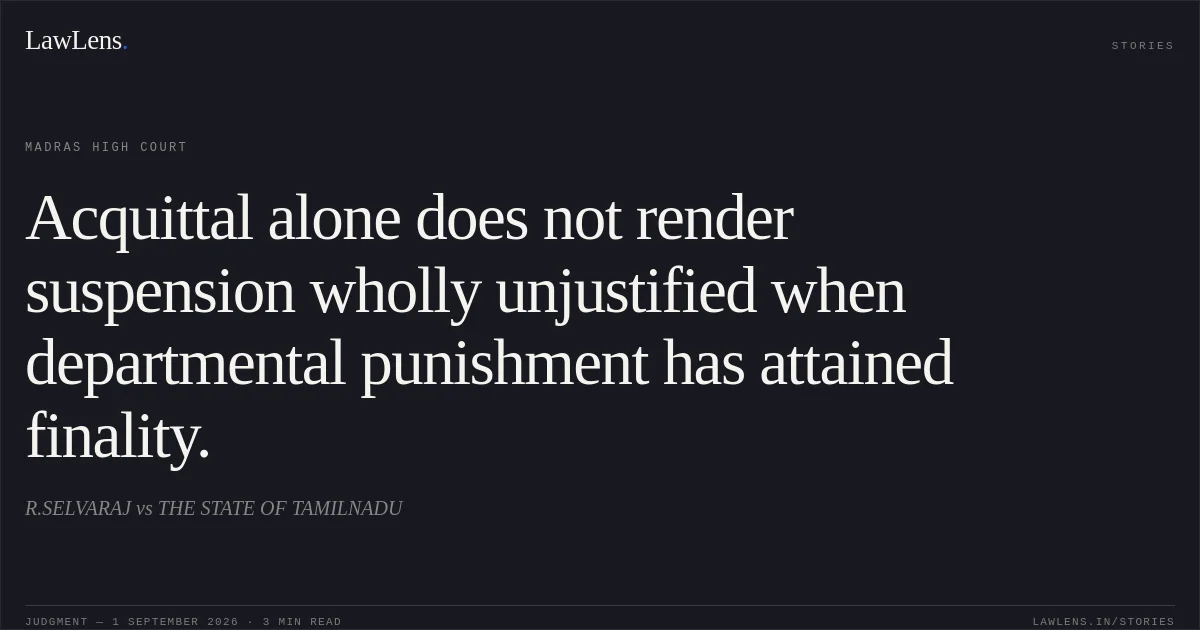
¶ 7The Court also recognised that departmental disciplinary proceedings are distinct from criminal proceedings, and that an acquittal in a criminal case does not automatically invalidate departmental findings or the consequential treatment of suspension.
¶ 9The disciplinary proceedings having continued under Rule 9 of the Pension Rules, and the punishment having attained finality, the petitioner could not rely solely on his criminal acquittal.
¶ 4, 9On judicial review, the Court reiterated that interference is limited to cases involving incompetence, perversity, or comparable legal infirmity in the administrative decision.
¶ 10The decision in W.P. No. 10407 of 2007 dated 26 March 2024 was distinguished because, unlike the present case, no departmental disciplinary proceedings had been initiated in that matter.
¶ 1404Reasoning
The Court held that the petitioner’s acquittal did not, by itself, establish that his suspension was wholly unjustified under Rule 54-B-1(7).
¶ 8The suspension arose from serious allegations forming the subject of both criminal and departmental proceedings; the departmental proceedings resulted in a final pensionary punishment.
¶ 8–11Accordingly, the respondents’ refusal to grant full service benefits for the suspension period was not arbitrary or perverse.
¶ 8–11Regarding the earlier period, the Court rejected the petitioner’s claim that he was absent due to medical reasons.
¶ 12His prolonged silence, alleged abscondence, and subsequent resort to anticipatory bail while facing criminal prosecution undermined the medical-leave explanation.
¶ 12–13The Court reasoned that, had he genuinely been prevented from rejoining duty, he would have contemporaneously protested or sought judicial relief.
¶ 12–13His conduct therefore supported the conclusion that the period constituted unauthorised absence.
¶ 12–13The precedent relied upon by the petitioner was inapplicable because the present case involved concluded departmental proceedings and an operative punishment.
¶ 1405Holding
The Court answered the issues against the petitioner.
¶ 15It held that the criminal acquittal did not entitle him to have the suspension period treated as wholly unjustified or as duty, and that the period from 27 July 2005 to 22 February 2007 was properly regarded as unauthorised absence rather than medical leave.
¶ 15Finding no perversity or illegality in G.O. (D) No. 207 dated 8 September 2023, the Court dismissed the writ petition and declined the requested salary, service, and retirement benefits.
¶ 15No costs were imposed.
¶ 15Original Court PDF
R.SELVARAJvsTHE STATE OF TAMILNADU
Click to open original judgment
Original judgment, available to read, download and summarize on LawLens.in