Facts
The petitioner applied for the post of Constable (GD) in the Central Armed Police Force (CAPF) and was issued an offer of appointment on 20.12.2024 after qualifying the selection process
Source reference: para 4-5During the verification process at the CISF training center, it was discovered that FIR No. 134/2024 had been registered against him for serious offences, including Section 307 (attempt to murder) and Section 325 (voluntary causing grievous hurt) of the IPC
Source reference: para 6Although the petitioner was acquitted by the Court of Sessions on 25.09.2025, the respondents withdrew his offer of appointment on 09.10.2025 on the grounds that the acquittal was not "honourable"
Source reference: para 6, 8The petitioner challenged this withdrawal, contending that since he was acquitted, he was entitled to the appointment
Source reference: para 9Issues
1. Whether the respondents were justified in withdrawing the offer of appointment despite the petitioner’s acquittal in a criminal case involving serious offences
Source reference: para 112. Whether an acquittal based on a compromise and witnesses turning hostile can be categorized as a "clean" or "honourable" acquittal for the purpose of employment in a disciplined force
Source reference: para 13Law Applied
Paragraph 2(V) of the MHA Guidelines (01.02.2012), which states that candidates acquitted of serious offences due to compromise or hostile witnesses are generally unsuitable for CAPFs
Source reference: para 6Supreme Court’s decision in Avtar Singh v. Union of India (2016) 8 SCC 471, specifically paragraph 38.4.3, which establishes that if an acquittal for a serious offence is on technical grounds or based on the benefit of doubt rather than being a "clean" acquittal, the employer has the discretion to determine the candidate's suitability based on their antecedents
Source reference: para 12Reasoning
The court scrutinized the criminal court's judgment and found that the acquittal was predicated on the fact that the complainant and witnesses had "settled the matter amicably" and subsequently turned hostile
Source reference: para 9-10The court noted that the Investigating Officer and medical witnesses were never examined, leading the trial court to conclude that the prosecution failed to prove its case beyond reasonable doubt
Source reference: para 8, 11The High Court distinguished a "clean acquittal"—where the court definitively finds the accused did not commit the offence—from the petitioner’s case, where the acquittal resulted from technical failures and witness compromise
Source reference: para 13The court reasoned that in a disciplined force like the CISF, the employer holds the ultimate domain to assess the fitness and character of a candidate. Given the heinous nature of the charges (e.g., Section 307 IPC), the respondents were well within their rights to deem the petitioner unsuitable despite the acquittal
Source reference: para 14-15Holding
The court dismissed the writ petition, holding that the respondents were justified in withdrawing the offer of appointment
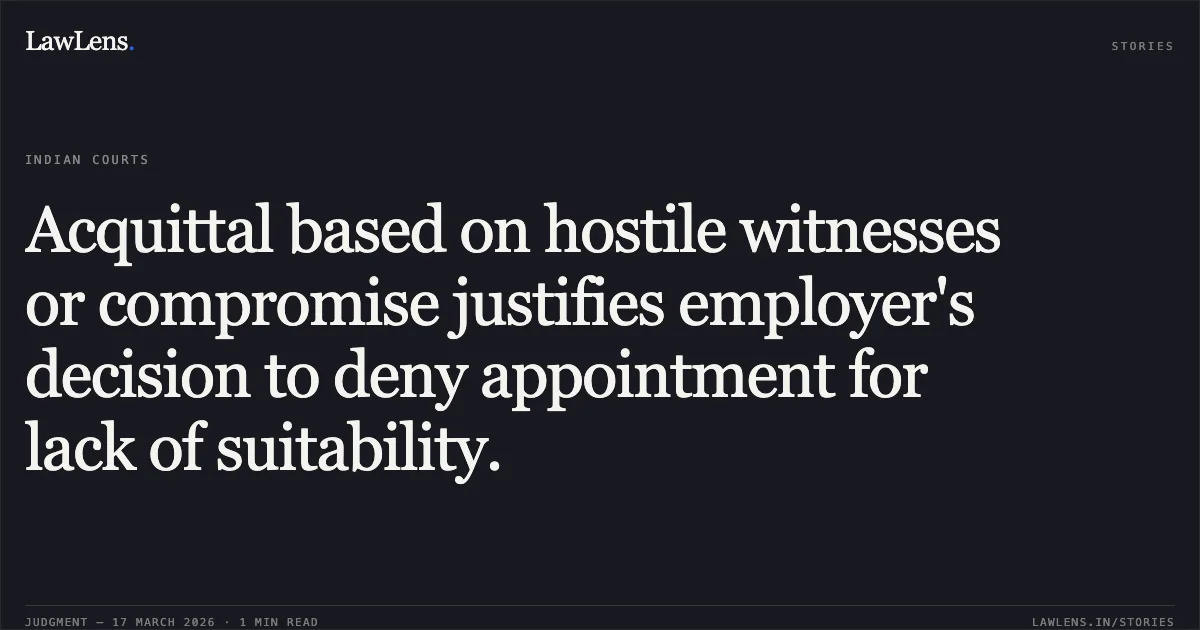
The court concluded that an acquittal based on hostile witnesses or compromise is a technical acquittal and does not override the employer's right to assess the suitability of a candidate for a disciplined force
Source reference: para 13-14All pending applications were disposed of accordingly
Source reference: para 1-2, 16Acts & Sections Cited
7 provisions across 1 statute referred to in this judgment. Each provision opens on LawLens.
Indian Penal Code, 18607
Original Court PDF
Kislay ThakurvsUnion Of India & Ors.
Click to open original judgment
Original judgment, available to read, download and summarize on LawLens.in