Facts
The complainant-appellants filed criminal complaints against the respondent mill alleging offences under Sections 101, 106 and 107 of the Bombay Industrial Relations Act, 1946 (“B.I.R. Act”). They alleged that, between 22 February 2000 and 4 June 2000, the mill prevented them and other workers from entering the premises without the requisite application under Section 42(1) of the B.I.R. Act.
Source reference: paras. 3.1, pp. 2–3They further alleged that the mill required workers to sign an undertaking before resuming duty, contrary to a settlement dated 6 May 2000 under Section 2(p) of the Industrial Disputes Act, and failed to pay “Kharchi” on the 25th day of each month in breach of Section 46 of the B.I.R. Act.
Source reference: paras. 3.1, pp. 2–3After recording the complainants’ evidence and cross-examination, the Labour Court acquitted the accused in Criminal Case Nos. 3 of 2001 and 13 of 2002 by judgments dated 6 January 2011 and 11 July 2012, respectively.
Source reference: paras. 3.2, 4, pp. 3–4The complainants challenged the acquittals under Section 378(4) of the Code of Criminal Procedure.
Source reference: para. 2, p. 2Issues
Whether the complainants proved beyond reasonable doubt that the respondent committed offences under Sections 101, 106 and 107 of the B.I.R. Act by preventing the workers from entering or resuming work and by requiring them to furnish undertakings.
Source reference: paras. 3.1, 5, 8, pp. 2–4Whether the alleged failure to pay “Kharchi” on the 25th day of each month constituted a proved and continuing breach of the B.I.R. Act.
Source reference: paras. 3.1, 5, 8, pp. 2–4Whether the Labour Court’s orders of acquittal were so perverse or manifestly illegal as to warrant interference in an appeal against acquittal under Section 378(4) CrPC.
Source reference: paras. 9–12, pp. 5–7Law Applied
The Court considered the alleged offences under Sections 101, 106 and 107 of the B.I.R. Act, the alleged breach of Section 46 of that Act, and the appellate jurisdiction under Section 378(4) CrPC.
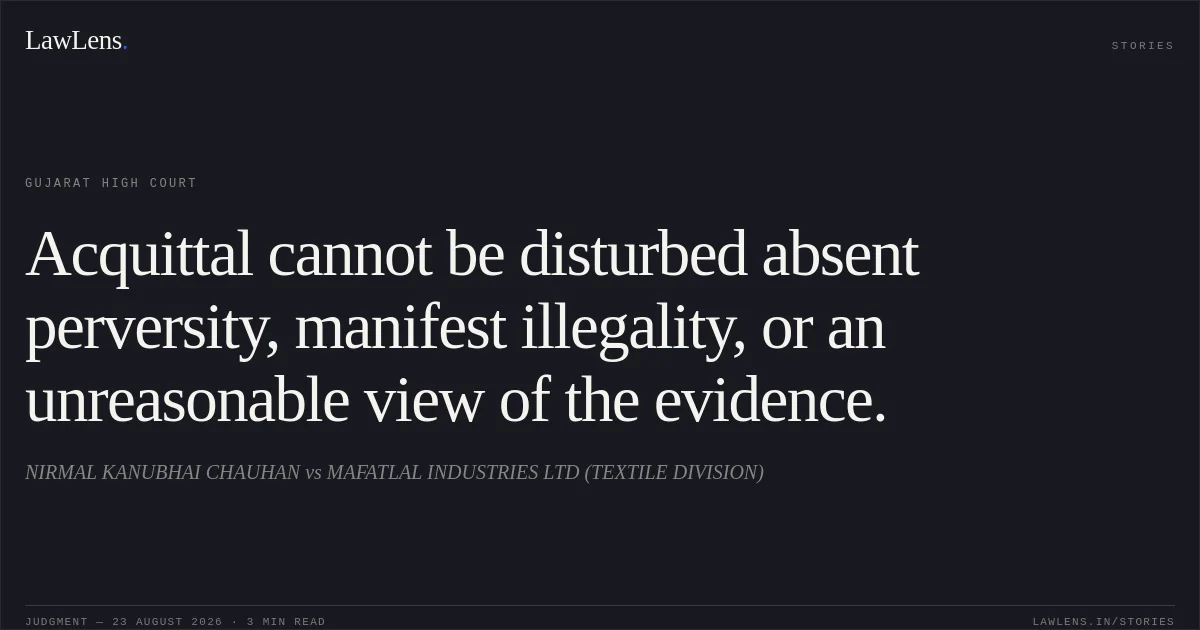
Source reference: paras. 2, 3.1, pp. 2–3In an appeal against acquittal, the appellate court may reappreciate the evidence, but ordinarily should not interfere where the trial court’s view is reasonably possible; interference is justified only where the acquittal is affected by manifest illegality, perversity, or a conclusion that no reasonable person could reach.
Source reference: para. 9, relying on State of Goa v. Sanjay Thakran, (2007) 3 SCC 75, p. 5The Court also relied on State of U.P. v. Ram Veer Singh, 2007 AIR SCW 5553, Girja Prasad (Dead) by LRs v. State of M.P., 2007 AIR SCW 5589, and Mookkiah v. State, AIR 2013 SC 321, for the principle that, although the High Court can fully review the evidence in an acquittal appeal, conviction should follow only where the evidence provides absolute assurance of guilt and not merely because another view is possible.
Source reference: paras. 10–11, pp. 5–6Reasoning
The Court found that the complainants failed to produce reliable proof of the alleged undertaking or settlement binding the respondent in the manner asserted.
Source reference: para. 8, p. 4In cross-examination, they admitted that the alleged undertaking was merely a blank form without writing or signatures, and there was no satisfactory evidence connecting them with any settlement or contract executed by the Majur Mahajan.
Source reference: para. 8, p. 4The allegation that the respondent failed to pay “Kharchi” on the 25th of each month was likewise unsupported by cogent evidence, and the alleged continuing nature of the offence was not established.
Source reference: para. 8, p. 4Since the essential factual allegations were not proved beyond reasonable doubt, the Labour Court’s acquittal was a reasonably possible view based on the oral and documentary evidence.
Source reference: paras. 8, 12, pp. 4, 6–7Applying the restricted standard governing appeals against acquittal, the High Court held that the findings were neither perverse nor manifestly illegal and disclosed no ground for appellate interference.
Source reference: paras. 8, 12, pp. 4, 6–7Holding
The High Court answered the issues against the complainant-appellants and held that the alleged violations under the B.I.R. Act, including the refusal to permit resumption of duty and non-payment of “Kharchi,” were not proved beyond reasonable doubt.
The acquittals recorded by the Labour Court in Criminal Case Nos. 3 of 2001 and 13 of 2002 were confirmed.
Source reference: paras. 12–13, p. 7Both criminal appeals were dismissed; bail bonds, if any, were cancelled, and the record and proceedings were directed to be returned to the trial court.
Source reference: paras. 12–13, p. 7Acts & Sections Cited
11 provisions across 5 statutes referred to in this judgment. Linked provisions open on LawLens.
Code of Criminal Procedure, 19731
Bombay Industrial Relations Act, 19465
Industrial Disputes Act, 19471
the Act (alias, unresolved)1
Indian Penal Code, 18603
Original Court PDF
NIRMAL KANUBHAI CHAUHANvsMAFATLAL INDUSTRIES LTD (TEXTILE DIVISION)
Click to open original judgment
Original judgment, available to read, download and summarize on LawLens.in