Facts
The accused were prosecuted in Sessions Case Nos. 495 of 2021 and 227 of 2023 for offences under Sections 302, 212 and 114 of the Indian Penal Code and Section 135 of the Gujarat Police Act.
Source reference: paras. 2, 4; pp. 1–2The prosecution alleged that, owing to the deceased Rohit’s relationship with the sister of accused Prashant, Prashant called him to the place of occurrence on 7 February 2020 and stabbed him repeatedly.
Source reference: paras. 2, 4; pp. 1–2The other accused allegedly sheltered or assisted Prashant after the incident.
Source reference: paras. 2, 4; pp. 1–2The deceased was taken to hospital and declared dead, following which his father lodged the FIR.
Source reference: paras. 2, 4; pp. 1–2The investigation included recording witness statements, post-mortem examination, preparation of the spot panchnama, arrest of the accused, recovery of the alleged knife, and forensic examination of the seized articles.
Source reference: paras. 2, 4; pp. 1–2The prosecution examined 28 witnesses and produced 30 documents.
Source reference: paras. 5–7; p. 3The accused denied the allegations in their statements under Section 313 of the Code of Criminal Procedure.
Source reference: paras. 5–7; p. 3The Sessions Court acquitted the accused, principally holding that the alleged eyewitnesses and the deceased’s father did not support the prosecution, while the recovery and discovery panchnama had not been proved in accordance with Section 27 of the Evidence Act.
Source reference: para. 8; pp. 3–4The State consequently filed the present appeal against acquittal and sought leave to appeal under Section 419 of the Bharatiya Nagarik Suraksha Sanhita, 2023, corresponding to Section 378 of the CrPC.
Source reference: para. 1; p. 1Issues
Whether the State had made out a case for granting leave to appeal against the order of acquittal under Section 419 of the BNSS, 2023.
Source reference: paras. 1, 11–12; pp. 1, 4–5Whether the Sessions Court’s acquittal was perverse or otherwise warranted appellate interference in light of the direct, circumstantial, recovery, and forensic evidence on record.
Source reference: paras. 14–18; pp. 5–7Whether the prosecution had proved the accused’s involvement in the alleged murder beyond reasonable doubt.
Source reference: paras. 15–17; pp. 6–7Law Applied
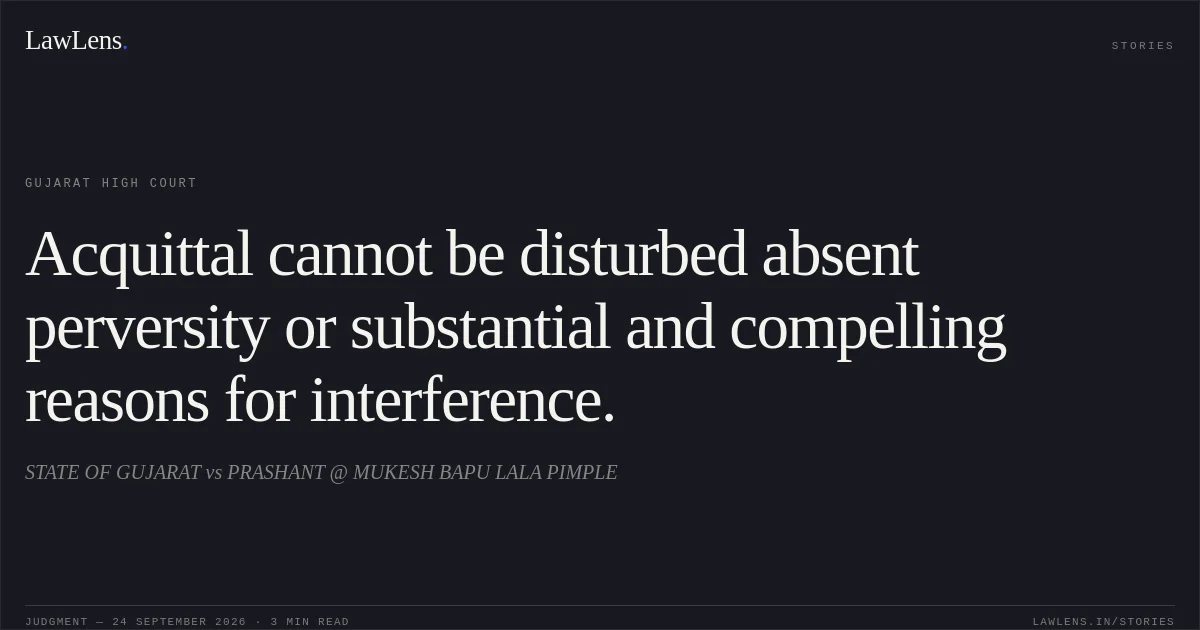
An appellate court hearing an appeal against acquittal must exercise restraint because an acquittal reinforces the accused’s presumption of innocence; interference is justified only where there are compelling reasons and the judgment is perverse, manifestly erroneous, or unsustainable, and not merely because another view is possible.
Source reference: para. 14; p. 5The prosecution bears the burden of proving the charged offences beyond reasonable doubt.
Source reference: paras. 8, 16; pp. 3–4, 6Evidence relating to a discovery or recovery is admissible under Section 27 of the Indian Evidence Act only to the extent that the information supplied by the accused distinctly relates to the fact discovered; the discovery must therefore be proved through reliable evidence.
Source reference: paras. 8, 16; pp. 3–4, 6The charges in the present case arose under Sections 302, 212 and 114 of the IPC and Section 135 of the Gujarat Police Act.
Source reference: para. 2; p. 1The State also relied on Section 8 of the Evidence Act concerning subsequent conduct, but the Court ultimately found that the prosecution’s principal circumstances had not been proved.
Source reference: para. 10; p. 4Reasoning
The High Court found that the alleged eyewitnesses, including PW-12 and PW-25, did not support the prosecution even after being declared hostile, and that the deceased’s father denied the prosecution version by stating that the deceased had suffered injuries in a motor accident.
Source reference: paras. 8(i), 15; pp. 3, 6Consequently, there was no reliable direct evidence connecting the accused with the offence.
Source reference: para. 15; p. 6The prosecution’s circumstantial case also failed because the panch witnesses to the discovery panchnama were hostile and the investigating officer did not prove the precise disclosure allegedly made by the accused or the contents of the panchnama as required for reliance under Section 27 of the Evidence Act.
Source reference: paras. 8(ii), 16; pp. 3–4, 6In the absence of proved recovery/discovery evidence and reliable supporting forensic or other circumstances, the chain of circumstances was incomplete.
Source reference: paras. 14, 16–18; pp. 5–7The Sessions Court’s view was therefore a reasonably possible view based on the evidence and was not perverse or legally unsustainable.
Source reference: paras. 14, 16–18; pp. 5–7Holding
The High Court held that the prosecution had failed to prove the accused’s involvement through either direct evidence or a complete and legally admissible chain of circumstantial evidence.
Since no perversity, substantial error, or compelling ground for interference with the acquittal was established, the Court refused to grant leave to appeal.
Source reference: para. 18–19; p. 7The State’s appeal was accordingly dismissed at the admission stage.
Source reference: para. 18–19; p. 7Acts & Sections Cited
7 provisions across 4 statutes referred to in this judgment. Each provision opens on LawLens.
Bharatiya Nagarik Suraksha Sanhita, 20231
Code of Criminal Procedure, 19732
Indian Penal Code, 18603
Gujarat Police Act, 1951.1
Original Court PDF
STATE OF GUJARATvsPRASHANT @ MUKESH BAPU LALA PIMPLE
Click to open original judgment
Original judgment, available to read, download and summarize on LawLens.in