Facts
On 22 October 2005, at Ranchhodji Pole, Manjalpur, Vadodara, the prosecution alleged that the respondents abused the complainant and assaulted him with sticks, causing injuries to his eye and head.
Source reference: p.2, paras 2–2.3It was further alleged that the public assault and humiliation induced the complainant to commit suicide by pouring kerosene on himself and setting himself ablaze.
Source reference: p.2, paras 2–2.3An FIR was registered at Makarpura Police Station as II-C.R. No. 203 of 2005, followed by investigation and filing of a chargesheet for offences under Sections 306, 504 and 114 of the IPC and Section 135 of the Bombay Police Act.
Source reference: p.2, paras 2–2.3The trial court acquitted the accused of those offences but convicted them under Section 323 IPC, sentencing each to one year’s simple imprisonment and a fine of Rs.500, with a default sentence of one month’s simple imprisonment.
Source reference: p.1, para 1; p.3, para 4The State preferred the present appeal against the acquittal.
Source reference: no citationIt was noted that the accused had already undergone the sentence imposed under Section 323 IPC and that the State’s separate sentence-enhancement appeal, Criminal Appeal No. 901 of 2012, had been dismissed.
Source reference: p.3, para 7; p.5, para 9Issues
Whether the trial court erred in acquitting the respondents of offences under Sections 306, 504 and 114 IPC and Section 135 of the Bombay Police Act.
Source reference: p.5, para 10Whether the evidence disclosed a legally sustainable basis for convicting the respondents of the alleged offences beyond reasonable doubt.
Source reference: p.8, para 15; p.9, para 16Whether, applying the principles governing appellate interference with an acquittal, the High Court ought to overturn the trial court’s findings.
Source reference: pp.6–8, paras 11–14Law Applied
The Court considered the substantive offences alleged under Sections 306, 504 and 114 of the IPC and Section 135 of the Bombay Police Act, as well as the State’s appellate jurisdiction under Section 378(1) and (3) of the Code of Criminal Procedure.
Source reference: p.1, para 1It applied the settled principles governing appeals against acquittal, namely that an appellate court may fully review and reappreciate the evidence, but must give due weight to the accused’s double presumption of innocence—first arising from the general principles of criminal jurisprudence and then reinforced by the trial court’s acquittal.
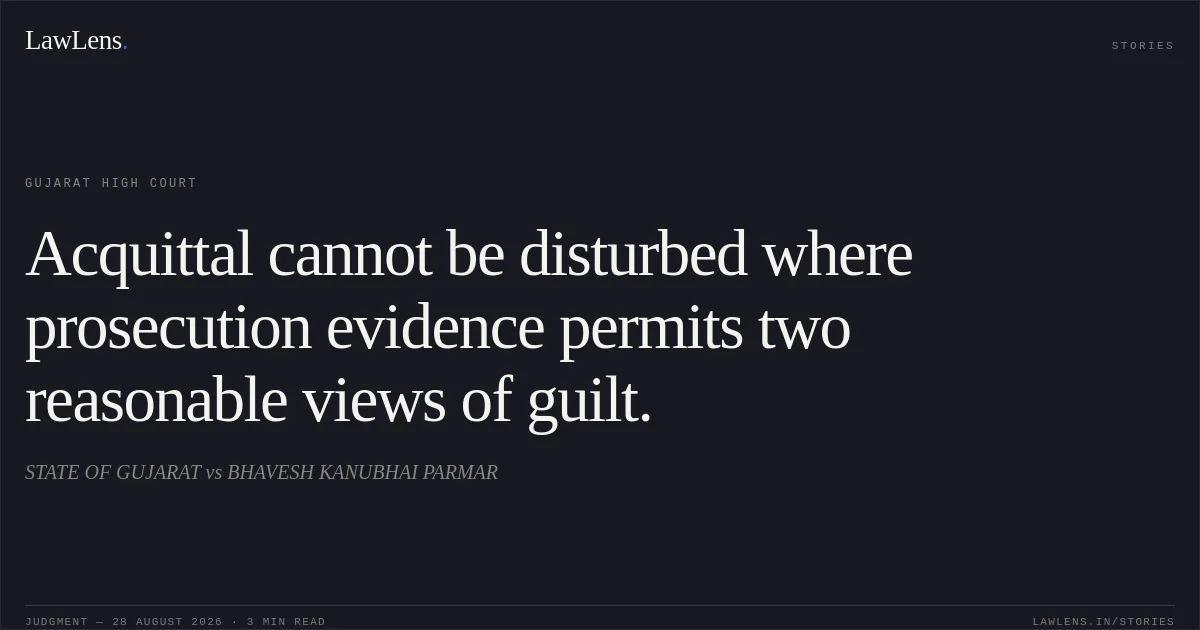
Source reference: pp.6–8, paras 11–14Relying on Chandrappa v. State of Karnataka, (2007) 4 SCC 415; Rajesh Prasad v. State of Bihar, (2022) 3 SCC 471; Babu Sahebagouda Rudragoudar v. State of Karnataka, (2024) 8 SCC 149; and Ramesh v. State of Karnataka, (2024) 9 SCC 169, the Court held that where two reasonable views are possible, the acquittal should not be disturbed unless the trial court’s approach is manifestly illegal, perverse, or unsustainable on the evidence.
Source reference: pp.6–8, paras 11–14Reasoning
The High Court reviewed the trial court’s appreciation of the oral and documentary evidence and found that the prosecution witnesses had not supported the case concerning Sections 306, 504 and 114 IPC or Section 135 of the Bombay Police Act.
Source reference: p.5, para 10The evidence was therefore insufficient to establish either the alleged acts constituting the charged offences or the respondents’ connection with the complainant’s suicide beyond reasonable doubt.
Source reference: p.8, para 15Since the trial court had considered the relevant evidence and its conclusions were a possible and reasonable view of the record, they did not disclose perversity, illegality, or material infirmity.
Source reference: pp.5–6, paras 10–12; p.9, para 16Applying the heightened restraint applicable in an appeal against acquittal, the High Court found no basis for substituting its own view for that of the trial court.
Source reference: pp.5–6, paras 10–12; p.9, para 16Holding
The High Court answered the issues against the State, holding that the prosecution had failed to prove the alleged offences beyond reasonable doubt and that the trial court had committed no error in acquitting the respondents.
The appeal was dismissed, the trial court’s judgment and order of acquittal were confirmed, the bail bonds were cancelled, and the record and proceedings were directed to be returned to the trial court.
Source reference: p.9, para 17Acts & Sections Cited
7 provisions across 2 statutes referred to in this judgment. Each provision opens on LawLens.
Code of Criminal Procedure, 19733
Indian Penal Code, 18604
Original Court PDF
STATE OF GUJARATvsBHAVESH KANUBHAI PARMAR
Click to open original judgment
Original judgment, available to read, download and summarize on LawLens.in
![Courts will not interfere with transfers absent mala fides or violation of statutory rules.. M Ramya vs EMPLOYEES STATE INSURANCE CORPORATION (ESIC). CAT - ['Chennai']. LawLens](/stories/thumbnails/courts-will-not-interfere-with-transfers-absent-mala-fides-or-violation-of-statutory-rules-a6845e9ca6f548fca284c51c8351957f.webp)
![Courts cannot direct one-time recruitment age relaxation absent authority in the governing rules or advertisement.. UT OF PUDUCHERRY vs M ANDAL. CAT - ['Chennai']. LawLens](/stories/thumbnails/courts-cannot-direct-one-time-recruitment-age-relaxation-absent-authority-in-the-governing-895d78fde47143e2a8ed0207c4b6a44f.webp)
![A review cannot correct an allegedly erroneous decision absent an error apparent on the record.. Ajit Kumar Jha vs RAILWAY BOARD. CAT - ['Delhi']. LawLens](/stories/thumbnails/a-review-cannot-correct-an-allegedly-erroneous-decision-absent-an-error-apparent-on-the-re-8ac952fd4eba470c92f7da20af72a220.webp)