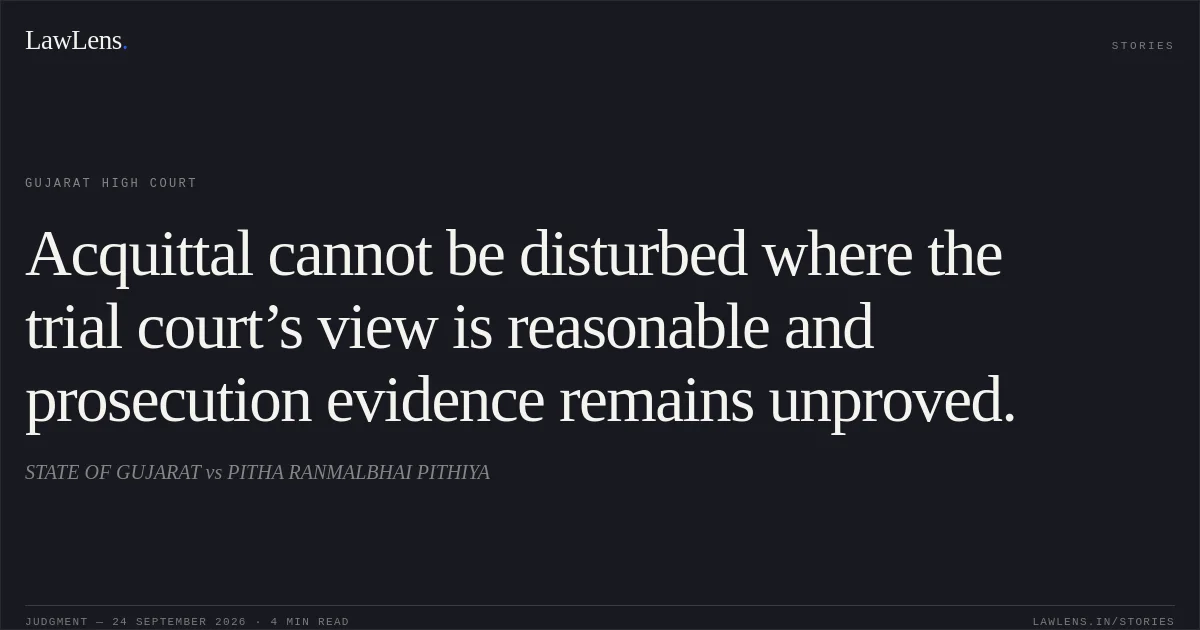
Facts
The State challenged the acquittal of six accused by the Additional Sessions Judge, Keshod, in Sessions Case No. 05 of 2022. The prosecution alleged that the victim’s brother-in-law repeatedly raped her; that other accused also subjected her to sexual assault; that her husband assaulted her and that, on 30 June 2017, he forcibly stitched her private parts with a needle and thread. Allegations under Sections 376(D), 498(A), 326, 323, 506(2) and 114 of the IPC were registered and investigated
Source reference: paras. 1–2.3; pp. 1–3The trial court acquitted all accused under Section 235(1) of the CrPC, principally extending the benefit of doubt. The State contended that the trial court had failed to properly appreciate the victim’s FIR and Section 164 CrPC statement, medical evidence, seizure evidence and the testimony of the investigating officers
Source reference: paras. 2.4, 3.1–3.6; pp. 3–5Before the High Court, the victim did not support the prosecution case and denied or failed to recall material allegations. She was declared hostile, and the prosecution’s cross-examination did not yield supporting evidence
Source reference: paras. 9–11; pp. 7–8The panch witnesses formally identified their signatures on seizure panchnamas but did not testify about the collection, sealing, forwarding or contents of the samples. The investigating officers mainly proved the steps taken during investigation, but the prosecution lacked substantive supporting evidence connecting the accused with the alleged offences
Source reference: paras. 5–8, 14–21; pp. 6–11Issues
Whether the State established, through legally admissible and reliable evidence, that the accused committed the offences under Sections 376(D), 498(A), 326, 323, 506(2) and 114 of the IPC?
Source reference: paras. 9–21; pp. 7–11Whether the victim’s FIR and statement under Section 164 CrPC, medical material, seizure panchnamas and investigation evidence could sustain the prosecution case despite the victim and material witnesses not supporting it in court?
Source reference: paras. 10–12, 18–21; pp. 7–11Whether the High Court should interfere with the trial court’s order of acquittal in an appeal by the State?
Source reference: paras. 22–23; pp. 11–16Law Applied
The prosecution was required to prove the alleged offences under Sections 376(D), 498(A), 326, 323, 506(2) and 114 of the IPC beyond reasonable doubt
Source reference: paras. 1, 2.3; pp. 1–3A statement under Section 164 CrPC is not substantive evidence and cannot, by itself, be used to prove the truth of its contents; it may be relevant only in accordance with the rules governing corroboration and contradiction
Source reference: para. 12; p. 8A panchnama is not substantively proved merely because a panch witness identifies his signature; the witness must speak to the underlying facts and circumstances recorded in it
Source reference: paras. 5–8; pp. 6–7Evidence of investigating officers and documents collected during investigation cannot substitute for substantive evidence proving the commission of the offence
Source reference: paras. 18–21; pp. 10–11On an appeal against acquittal, the appellate court may reappreciate the evidence, but must respect the strengthened presumption of innocence and should not interfere where the trial court’s view is reasonably possible. Interference is justified only where the acquittal is perverse, rests on a material misreading or omission of evidence, or where guilt is the only possible conclusion. The Court applied the principles in Chandrappa v. State of Karnataka, as reiterated in Babu Sahebagouda Rudragoudar v. State of Karnataka, H.D. Sundara v. State of Karnataka and Tulasareddi @ Mudakappa v. State of Karnataka
Source reference: para. 22; pp. 11–15Reasoning
The High Court held that the victim, the principal witness, did not support the allegations of rape, cruelty, assault or forcible stitching in her deposition and that the prosecution’s cross-examination did not cure the evidentiary deficiency
Source reference: paras. 9–11; pp. 7–8Her FIR and Section 164 statement could not independently establish guilt because they were not substantive evidence
Source reference: para. 12; p. 8The panch witnesses proved only their signatures and not the actual seizure or handling of the samples, rendering the relevant panchnamas substantively unproved
Source reference: paras. 5–8; pp. 6–7The evidence of the investigating officers established, at most, the steps taken during investigation and could not replace direct or otherwise legally sufficient proof of the alleged offences
Source reference: paras. 14–21; pp. 9–11In these circumstances, the trial court’s conclusion that the prosecution had failed to prove the charges beyond reasonable doubt was a possible and reasonable view, not a perverse one. The principles governing appellate restraint in acquittal appeals therefore barred interference
Source reference: paras. 22–23; pp. 11–16Holding
The High Court answered the issues against the State. It held that the prosecution had not produced sufficient substantive and reliable evidence to establish the accused’s guilt beyond reasonable doubt, and that the trial court had correctly extended the benefit of doubt
The State’s appeal against acquittal was dismissed, the judgment and order dated 29 January 2026 in Sessions Case No. 05 of 2022 was confirmed, and the record and proceedings were directed to be remitted to the concerned court
Source reference: paras. 24–26; p. 16Acts & Sections Cited
8 provisions across 3 statutes referred to in this judgment. Each provision opens on LawLens.
Indian Penal Code, 18604
Bharatiya Nagarik Suraksha Sanhita, 20231
Code of Criminal Procedure, 19733
Original Court PDF
STATE OF GUJARATvsPITHA RANMALBHAI PITHIYA
Click to open original judgment
Original judgment, available to read, download and summarize on LawLens.in
![A provisional GDS employee cannot be terminated after prolonged service without notice and due process.. DIPAK KUMAR NATH vs DEPARTMENT OF POSTS. CAT - ['Guwahati']. LawLens](/stories/thumbnails/a-provisional-gds-employee-cannot-be-terminated-after-prolonged-service-without-notice-and-b8fdaceb96934e83b3fc58cdd042d5ad.webp)
![Authorities must consider long-serving casual workers for regularisation under applicable schemes and precedent.. SRI SIMANTA HAZARIKA AND ORS vs M/O FINANCE. CAT - ['Guwahati']. LawLens](/stories/thumbnails/authorities-must-consider-long-serving-casual-workers-for-regularisation-under-applicable-fa8d31ef9ea04f5e967de0c9394393ae.webp)