Facts
The applicants, original accused Nos. 8 and 9, invoked Section 482 of the Code of Criminal Procedure, 1973, seeking quashing of FIR I-C.R. No. 255 of 2016 registered at Umra Police Station, Surat, for offences under Sections 406, 420, 465, 467, 468, 471 and 114 of the Indian Penal Code, 1860.
Source reference: para. 1The FIR concerned a disputed chain of land transactions, tenancy rights, powers of attorney, agreements to sell, possession receipts and mutation entries, which had been challenged in revenue proceedings.
Source reference: pp. 3–5; paras. 6–6.4The applicants were alleged to have obtained a general power of attorney and entered into an agreement to sell the property for ₹2,51,00,000, against which ₹7,00,000 was paid by cheque.
Source reference: para. 2.1The FIR did not attribute any specific act of forgery, cheating, misappropriation, impersonation or unlawful gain to the applicants and merely concluded with a general request to investigate all the accused.
Source reference: paras. 2–2.1, 6.9Despite service of notice, the original complainant did not appear; the State opposed quashing on the ground that the applicants, as power-of-attorney holders, ought to have verified the title of the property.
Source reference: paras. 3–5Issues
Whether the allegations in the FIR disclosed the essential ingredients of cheating under Section 420 IPC or criminal breach of trust under Section 406 IPC against the applicants.
Source reference: paras. 6.5–6.6Whether the FIR disclosed the commission of forgery-related offences under Sections 465, 467, 468 and 471 IPC by alleging the making or use of a “false document”.
Source reference: para. 6.7Whether the prosecution against the applicants was an abuse of process because the dispute was essentially civil in nature and the FIR contained vague and omnibus allegations without attributing specific criminal acts to them.
Source reference: paras. 6.8–6.9Whether the FIR and consequential proceedings should be quashed under the High Court’s inherent jurisdiction under Section 482 Cr.P.C.
Source reference: paras. 7–9Law Applied
The Court applied Section 482 Cr.P.C., which empowers the High Court to quash criminal proceedings to prevent abuse of process and secure the ends of justice.
Source reference: paras. 1, 8For Section 420 IPC, the prosecution must establish a fraudulent or dishonest intention from the inception, a deceptive representation, and inducement resulting in delivery of property.
Source reference: para. 6.5Section 406 IPC requires entrustment or dominion over property followed by dishonest misappropriation, conversion or disposal in violation of law or contract; criminal intent is essential.
Source reference: para. 6.6Sections 465, 467, 468 and 471 IPC require the making, use or circulation of a “false document” within the meaning of Section 464 IPC, ordinarily involving forgery, impersonation, fabrication or unauthorized execution.
Source reference: para. 6.7The Court further relied on State of Haryana v. Bhajan Lal, 1992 Supp (1) SCC 335, particularly the categories concerning cases where the allegations do not disclose an offence or where continuation of proceedings amounts to abuse of process.
Source reference: para. 6.9A civil dispute involving defective title or property rights does not, without the requisite criminal ingredients, become cheating, breach of trust or forgery.
Source reference: paras. 6.5–6.8Reasoning
The Court found that the FIR merely described the applicants’ agreement to sell, power of attorney and payment of advance consideration, without alleging that they deceived or induced the complainant, received property from him, misappropriated entrusted property, or obtained unlawful personal benefit.
Source reference: paras. 2.1, 6.5–6.6The applicants’ alleged failure to verify title could potentially affect the civil validity or consequences of the transaction, but did not constitute dishonest misappropriation or criminal breach of trust.
Source reference: para. 6.6There was also no allegation that the applicants forged signatures, impersonated any person, fabricated documents or altered official records; therefore, the statutory requirement of a false document for the forgery offences was absent.
Source reference: para. 6.7The surrounding facts showed a complicated dispute concerning land title, tenancy rights and revenue mutations, with multiple civil and revenue proceedings, rather than a prima facie criminal conspiracy or fraud by the applicants.
Source reference: para. 6.8Since the applicants were implicated only through vague and omnibus allegations and no specific overt act or criminal intent was attributed to them, continuation of the prosecution was held to be an abuse of process.
Source reference: para. 6.9Holding
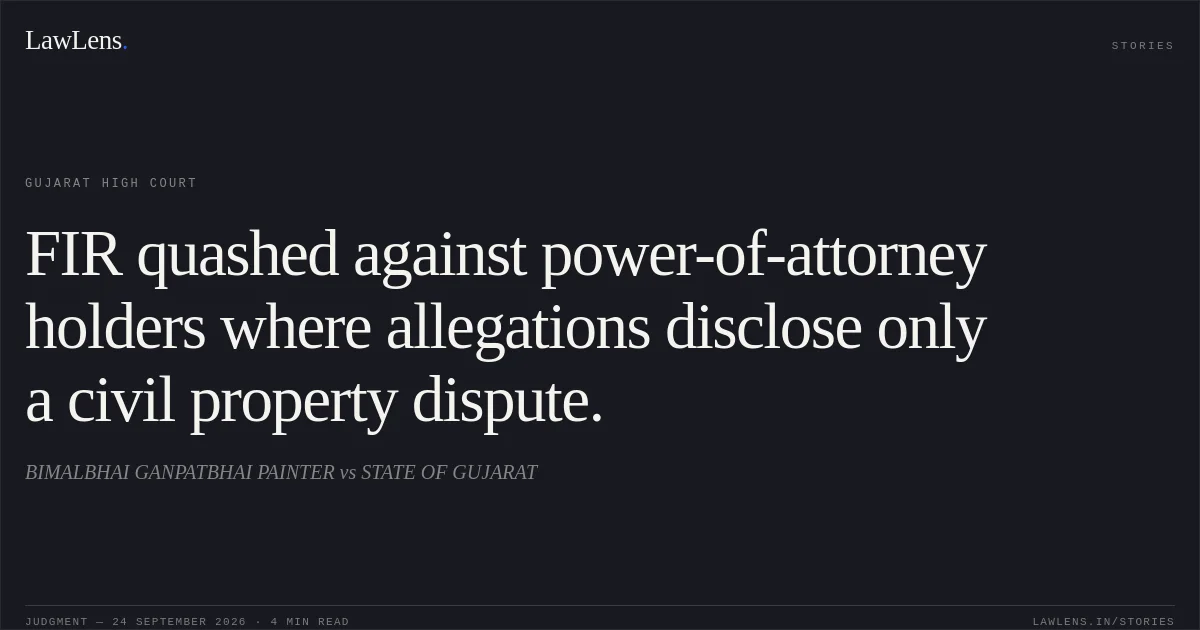
The Court held that no prima facie offence under Sections 406, 420, 465, 467, 468, 471 or 114 IPC was made out against the applicants, original accused Nos. 8 and 9.
Exercising jurisdiction under Section 482 Cr.P.C., it allowed the application and quashed FIR I-C.R. No. 255 of 2016 registered with Umra Police Station, Surat, together with all consequential proceedings, solely insofar as they concerned the applicants.
Source reference: para. 8The rule was made absolute to that extent and direct service was permitted.
Source reference: para. 9Acts & Sections Cited
9 provisions across 2 statutes referred to in this judgment. Each provision opens on LawLens.
Code of Criminal Procedure, 19731
Indian Penal Code, 18608
Original Court PDF
BIMALBHAI GANPATBHAI PAINTERvsSTATE OF GUJARAT
Click to open original judgment
Original judgment, available to read, download and summarize on LawLens.in