Facts
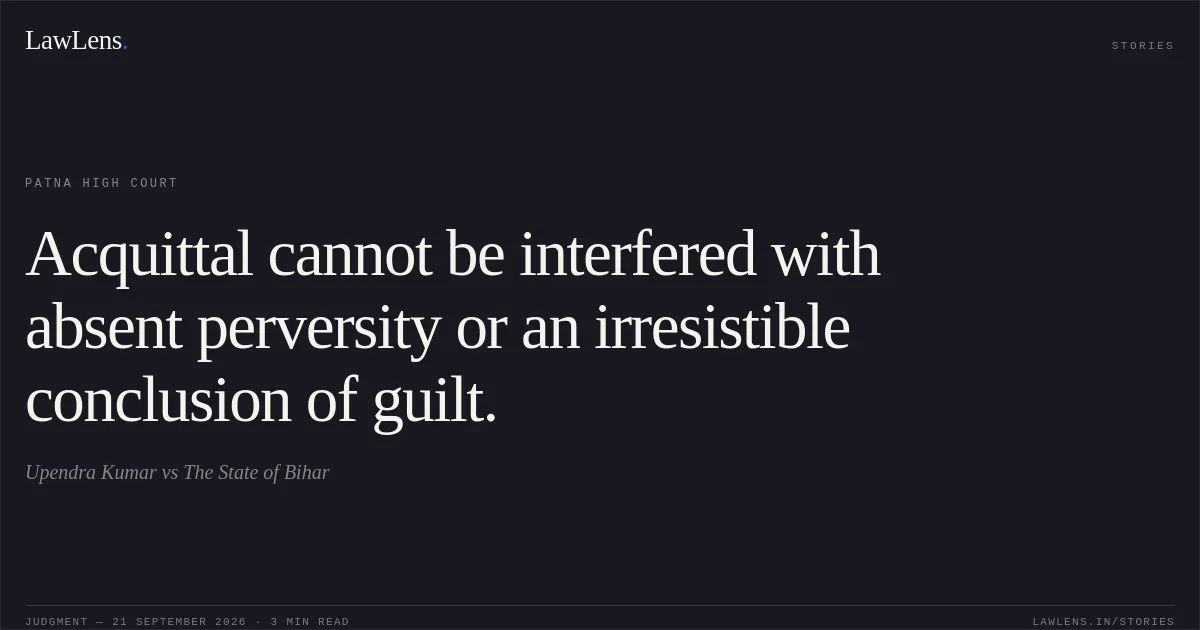
The appellant, Upendra Kumar, lodged the fardbeyan alleging that his father, Krishnadev Prasad, was surrounded and assaulted by the accused persons near the house of Jaddu Gope at about 9:00 a.m. Sitaram Prasad allegedly threw a spear at the deceased’s forehead, while the other accused assaulted him with sticks. The deceased was taken towards Barh Hospital but died on the hospital premises. The prosecution alleged that the assault was committed pursuant to a common intention arising from old enmity
Source reference: paras. 2–3; pp. 1–3After investigation, a charge-sheet was filed under Sections 302/34 of the Indian Penal Code against five accused persons. During the trial, three accused died, and proceedings ultimately continued against Sitaram Prasad and Satyendra Prasad
Source reference: paras. 4–6; pp. 3–4The Trial Court acquitted the surviving accused on the ground that the prosecution witnesses were unreliable, material contradictions existed regarding the assault and place of occurrence, and the Investigating Officer and doctor had not been examined
Source reference: para. 8; p. 4The informant preferred the present appeal against acquittal.
Source reference: no citationIssues
Whether the prosecution evidence reliably established that the respondents had assaulted the deceased with the common intention of causing his death, thereby proving the offence under Sections 302/34 IPC?
Source reference: paras. 3, 11–13; pp. 2–9Whether the Trial Court’s acquittal was so perverse or unreasonable as to warrant interference in an appeal against acquittal?
Source reference: paras. 8–9, 13–14; pp. 4–6, 9Law Applied
The prosecution was required to prove the charge of murder under Section 302 IPC and the principle of constructive liability based on common intention under Section 34 IPC beyond reasonable doubt
Source reference: paras. 2–3; pp. 1–3In an appeal against acquittal, the appellate court does not ordinarily interfere merely because another view is possible; interference is justified only where the acquittal is perverse or the evidence leads to an irresistible conclusion of guilt
Source reference: para. 13; p. 9The Court also applied the general evidentiary principles that material contradictions, failure to establish the place and manner of occurrence, and non-examination of material witnesses such as the Investigating Officer and the doctor may materially weaken the prosecution case
Source reference: paras. 11–13; pp. 7–9Reasoning
The High Court found that the prosecution witnesses could not be treated as reliable eyewitnesses. Although they claimed to have witnessed the occurrence, their accounts materially differed from the fardbeyan regarding the use of the spear: the fardbeyan alleged that the pointed end struck the deceased’s forehead, whereas the witnesses stated that the spear was used like a stick. One witness expressly stated that he had not seen the pointed side of the spear being used
Source reference: para. 12; pp. 7–8The informant placed the occurrence near Jaddu Gope’s house, but the other evidence did not corroborate the place of occurrence. The Investigating Officer, who could have established the scene and surrounding circumstances, was not examined, and neither the doctor nor the injury or post-mortem report was properly proved
Source reference: para. 12; pp. 8–9The Court also noted the absence of an FSL report concerning the seized bloodstains and spear, and deficiencies in the seizure list, including the failure to specify the place of seizure
Source reference: paras. 8, 12–13; pp. 4, 8–9These deficiencies created reasonable doubt and demonstrated that the Trial Court’s view was a permissible and reasoned view of the evidence, not a perverse one
Source reference: paras. 11–13; pp. 7–9Holding
The High Court held that the prosecution had failed to establish the respondents’ guilt under Sections 302/34 IPC beyond reasonable doubt and that the Trial Court’s acquittal was not perverse.
Since no irresistible conclusion of guilt could be drawn from the evidence, the Court declined to interfere with the acquittal. The appeal was dismissed, and the judgment and trial court record were directed to be transmitted to the Trial Court
Source reference: paras. 13–15; p. 9Acts & Sections Cited
2 provisions across 1 statute referred to in this judgment. Each provision opens on LawLens.
Indian Penal Code, 18602
Original Court PDF
Upendra KumarvsThe State of Bihar
Click to open original judgment
Original judgment, available to read, download and summarize on LawLens.in