Facts
The petitioner-informant challenged the order of the learned 1st Additional Sessions Judge, Cuttack, in S.T. Case No. 35 of 2022, arising from Markat Nagar P.S. Case No. 207 of 2021. Opposite Party No. 2 had been charge-sheeted for offences under Sections 354, 354-A, 376(2)(n), 294 and 506 IPC; 21 prosecution witnesses were cited, of whom five had been examined by the time of the application.
Source reference: pp. 2–3, paras. 1–3During the trial, the informant sought to introduce a pen drive allegedly containing recordings involving herself and the accused, claiming that it had a direct bearing on the case and had been omitted from the investigation because of a perfunctory investigation.
Source reference: pp. 4, 9–10, paras. 3, 8Her initial application was rejected, but the High Court remanded the matter for reconsideration on merits after taking into account the proposed electronic evidence and the accused’s objections. Upon reconsideration, the Trial Court again rejected the prayer, leading to the present revision. The pen drive was admittedly not part of the materials collected during investigation or filed with the charge-sheet.
Source reference: pp. 6–7, para. 3; p. 7, para. 4; p. 9, para. 8Issues
Whether the revision petition challenging the Trial Court’s order was maintainable, particularly when the impugned order concerned the introduction of evidence during an ongoing trial?
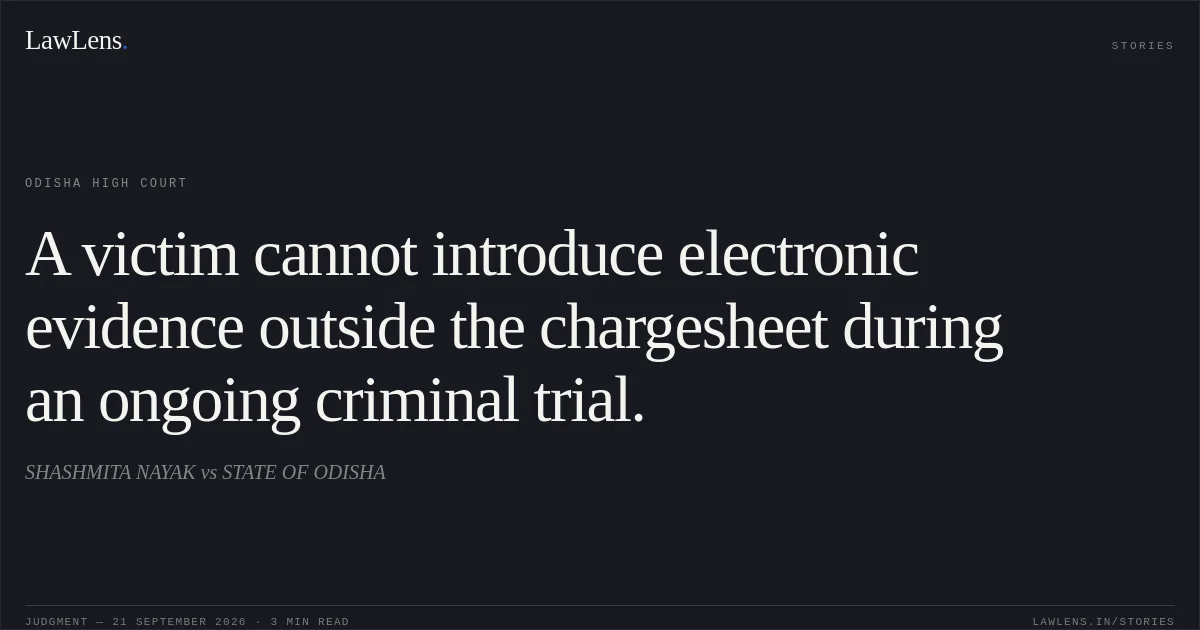
Source reference: pp. 10–11, paras. 10–11Whether the victim-informant could introduce, in the midst of trial, a pen drive that had not been collected during investigation or included in the charge-sheet?
Source reference: pp. 12–13, paras. 14, 19–21Whether the principles governing admissibility and certification of electronic evidence under Section 65-B of the Indian Evidence Act, 1872, enabled the petitioner to place the pen drive on record at that stage?
Source reference: pp. 12, 15–18, paras. 13–14, 18Law Applied
The Court applied the statutory scheme governing criminal trials under the Cr.P.C./BNSS, including the prosecution’s responsibility to conduct the case through the Public Prosecutor and the accused’s right to receive the prosecution documents before trial under Section 207 Cr.P.C.
Source reference: pp. 13–18, paras. 15–18Relying on Thakur Ram v. State of Bihar, AIR 1966 SC 911, the Court reiterated that, ordinarily, the State is the aggrieved party and is responsible for bringing an offender to justice.
Source reference: pp. 13–14, para. 16Under Shiv Kumar v. Hukam Chand, (1999) 7 SCC 467, privately engaged counsel for the victim may assist the Public Prosecutor but cannot transform the prosecution into a private contest or displace the Public Prosecutor’s statutory role.
Source reference: pp. 14–15, para. 17The Court relied on Arjun Panditrao Khotkar v. Kailash Kushanrao Gorantyal, (2020) 7 SCC 1, which held that the requirement of a Section 65-B certificate arises when electronic evidence is produced in evidence, but also emphasized that, in criminal trials, documents on which the prosecution relies must ordinarily be supplied to the accused before commencement of trial to preserve the right to a fair defence.
Source reference: pp. 15–18, para. 18Reasoning
The Court distinguished between the admissibility of an electronic record under Section 65-B and the procedural authority to introduce new evidence during a criminal trial.
Source reference: pp. 15–18, para. 18Although the absence or timing of a Section 65-B certificate may, in an appropriate case, be curable when the electronic record is otherwise properly produced, the present pen drive had never formed part of the investigation materials or the charge-sheet.
Source reference: pp. 15–18, para. 18Permitting the victim to independently introduce it midway through the trial would bypass the prosecution’s statutory control over the case and undermine the accused’s right to prior disclosure of the materials relied upon against him under Section 207 Cr.P.C.
Source reference: pp. 13–18, paras. 15–18The Court further found that the petitioner had identified no provision in the Cr.P.C. or BNSS authorising the victim-informant to place such material directly on record when it had not been collected during investigation or relied upon by the prosecution.
Source reference: p. 19, paras. 19–21Consequently, the issue was not merely a technical defect in electronic evidence but the absence of procedural entitlement and the potential prejudice to the accused’s fair-trial rights.
Source reference: p. 19, paras. 20–21Holding
The High Court held that there was no infirmity in the Trial Court’s rejection of the informant’s prayer to introduce the pen drive during the ongoing trial.
The criminal revision was accordingly dismissed, and the interim order was vacated.
Source reference: p. 20, para. 23The Court expressly left the question of revisionary maintainability open and directed the Trial Court to proceed with the trial expeditiously.
Source reference: p. 20, paras. 23–24Acts & Sections Cited
8 provisions across 2 statutes referred to in this judgment. Each provision opens on LawLens.
Code of Criminal Procedure, 19734
Indian Penal Code, 18604
Original Court PDF
SHASHMITA NAYAKvsSTATE OF ODISHA
Click to open original judgment
Original judgment, available to read, download and summarize on LawLens.in