Facts
The applicant, a 71-year-old senior citizen, was implicated in Crime No. 62/2016 for offences under Sections 420, 467, and 468 of the IPC.
Source reference: para. 3On 06.04.2016, the High Court granted him anticipatory bail subject to a condition of depositing Rs. 2,00,000/- with the Zila Panchayat, Betul.
Source reference: para. 3Following a trial, the applicant was acquitted of all charges on 05.07.2023.
Source reference: para. 4Despite his acquittal and several representations made to the authorities for a refund, respondent Nos. 2 and 3 failed to release the amount.
Source reference: para. 4Notably, a co-accused on identical footing was refunded the principal amount along with interest.
Source reference: para. 4The applicant subsequently filed this petition under Section 528 of the Bhartiya Nagarik Suraksha Sanhita (BNSS), 2023.
Source reference: para. 1Issues
1. Whether the continued retention of a bail deposit by the State after the acquittal of the accused amounts to arbitrary action and unjust enrichment.
Source reference: para. 2, 72. Whether the denial of refund and interest to the applicant, while granting the same to a similarly situated co-accused, violates the principle of equality under Article 14 of the Constitution.
Source reference: para. 5, 8Law Applied
Section 528 of the Bhartiya Nagarik Suraksha Sanhita (BNSS), 2023, which preserves the inherent powers of the High Court to prevent abuse of process and secure the ends of justice.
Source reference: para. 1, 10Constitutional principle of Equality before Law under Article 14, which mandates that similarly situated persons must be treated alike unless there is a reasonable classification.
Source reference: para. 8A deposit for bail is a temporary security to ensure cooperation and is neither punitive nor compensatory; therefore, once the proceedings terminate in acquittal, the legal basis for retention ceases.
Source reference: para. 7Reasoning
The court reasoned that the deposit made by the applicant was a condition precedent for bail and not a fine or penalty.
Source reference: para. 7Since the trial resulted in acquittal and the applicant was discharged from all bail and surety liabilities, the State had no statutory authority to retain the funds.
Source reference: para. 7The court observed that the respondents failed to provide any "cogent or legally sustainable reason" for withholding the applicant's money while having already refunded the co-accused.
Source reference: para. 6, 8This discrepancy was deemed "hostile discrimination" and a violation of Article 14.
Source reference: para. 5, 8The court noted that while interest may be subject to administrative policy, the principle of parity requires the authorities to consider the applicant's claim for interest in light of the benefit already extended to the co-accused.
Source reference: para. 9Holding
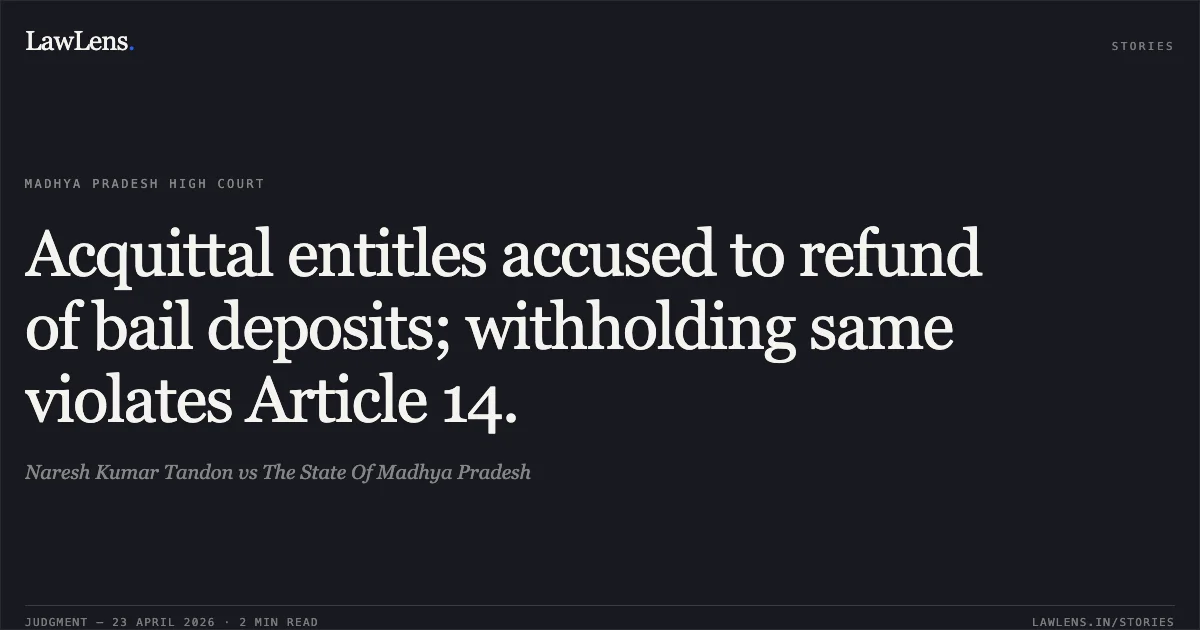
The court allowed the petition in part, holding that the respondents were under a legal obligation to refund the amount to prevent an abuse of process.
The court directed Respondent Nos. 2 and 3 to release the principal sum of Rs. 2,00,000/- within 45 days.
Source reference: para. 11(a)It further ordered the competent authority to pass a reasoned order regarding the grant of interest based on parity with the co-accused within the same period.
Source reference: para. 11(b)Finally, it directed that if the amount is not released within the stipulated timeframe, the applicant shall be entitled to simple interest at 6% per annum from the date of expiry until actual payment.
Source reference: para. 11(c)Acts & Sections Cited
5 provisions across 3 statutes referred to in this judgment. Each provision opens on LawLens.
Bharatiya Nagarik Suraksha Sanhita, 20231
Code of Criminal Procedure, 19731
Indian Penal Code, 18603
Original Court PDF
Naresh Kumar TandonvsThe State Of Madhya Pradesh
Click to open original judgment
Original judgment, available to read, download and summarize on LawLens.in