Facts
The petitioner’s electricity supply was disconnected on the allegation that the meter had been bypassed and electricity had been unauthorisedly consumed.
Source reference: p.2–3, para. 2The disputed connection stood in the name of the petitioner’s wife and was allegedly used for M/s Nandini Drinking Water, under Meter No. LANDIS409LNG131317.
Source reference: p.2–3, para. 2The petitioner was prosecuted for electricity theft in Special Electricity Case No. 24/2017 and was acquitted by the Special Judge (Electricity Act), Rajnandgaon, on 10 February 2020, on the ground that the charge was not proved beyond reasonable doubt.
Source reference: p.5, para. 5The petitioner thereafter sought restoration/provision of electricity connection to his residence and refund of ₹95,000 deposited towards the electricity demand.
Source reference: p.2–3, para. 2His representation was forwarded by the Superintending Engineer to the Junior Engineer, but no decision was taken. He consequently invoked the writ jurisdiction of the High Court.
Source reference: p.2–3, para. 2Issues
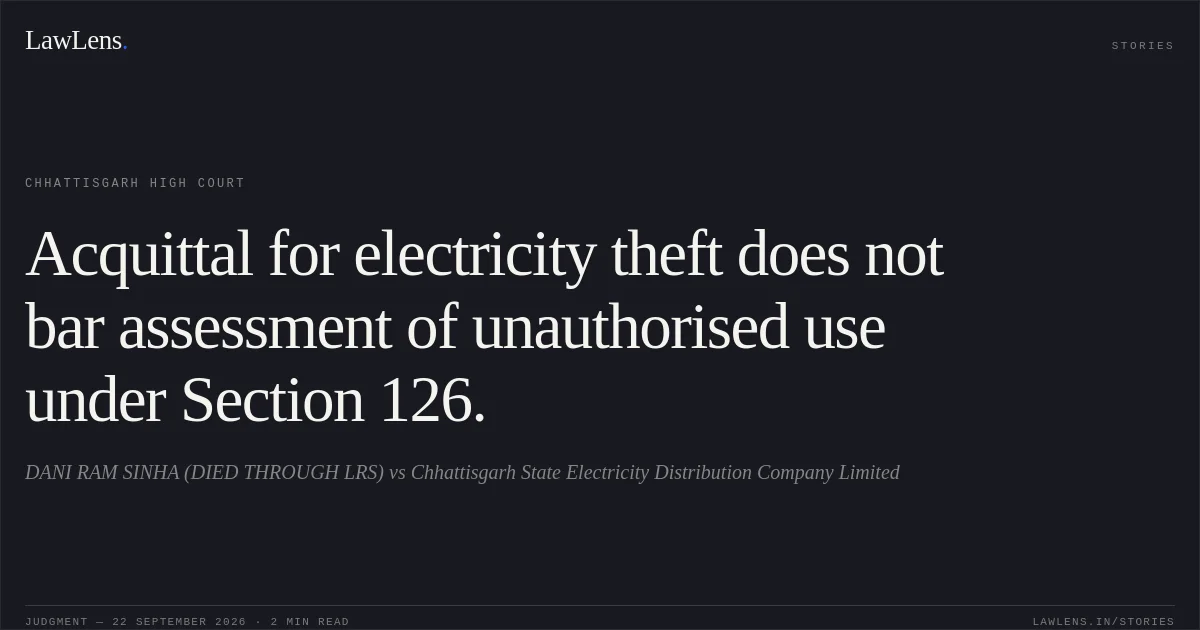
Whether the petitioner’s acquittal in the criminal prosecution for electricity theft barred the respondents from assessing or recovering liability for unauthorised use or consumption of electricity under Section 126 of the Electricity Act, 2003.
Source reference: p.4, para. 3; p.6, para. 6Whether the petitioner was entitled to interference with the electricity demand, refund of the deposited amount of ₹95,000, and restoration/provision of electricity connection.
Source reference: p.2, para. 1; p.6–7, paras. 7–8Law Applied
The Court applied the distinction under the Electricity Act, 2003 between unauthorised use of electricity under Section 126, which gives rise to an assessment and civil liability, and theft of electricity under Section 135, which attracts criminal liability.
Source reference: p.6, para. 6An acquittal under Section 135, based on failure to prove theft beyond reasonable doubt, does not by itself extinguish or bar a separate assessment or recovery for unauthorised use under Section 126.
Source reference: p.4, para. 3; p.6, para. 6The Court relied on West Bengal State Electricity Distribution Company Limited v. Orion Metal Private Limited, (2020) 18 SCC 588, which recognises that proceedings under Sections 126 and 135 operate in distinct fields.
Source reference: p.4, para. 3; p.6, para. 6Reasoning
The criminal court had only determined that the allegation of theft was not proved to the criminal standard of proof; it had not adjudicated or extinguished any distinct civil liability for unauthorised consumption or use of electricity.
Source reference: p.5, para. 5; p.6, para. 6Applying the principle in Orion Metal, the High Court held that the respondents remained competent to assess and recover the amount payable under Section 126 notwithstanding the petitioner’s acquittal in the criminal case.
Source reference: p.6, para. 6Since the Court found no sufficient ground to interfere with the demand and noted that the demanded amount had already been deposited, it declined to order refund or grant further interference in the matter.
Source reference: p.6–7, para. 7Holding
The Court held that the petitioner’s acquittal for electricity theft did not preclude the respondents from maintaining or recovering a demand arising from unauthorised use of electricity under Section 126 of the Electricity Act, 2003.
Finding no sufficient ground to interfere with the demand, the Court dismissed the writ petition, thereby declining the requested restoration/provision of connection and refund of ₹95,000.
Source reference: p.7, paras. 7–9No order as to costs was made.
Source reference: p.7, paras. 7–9Acts & Sections Cited
2 provisions across 1 statute referred to in this judgment. Each provision opens on LawLens.
Electricity Act, 20032
Original Court PDF
DANI RAM SINHA (DIED THROUGH LRS)vsChhattisgarh State Electricity Distribution Company Limited
Click to open original judgment
Original judgment, available to read, download and summarize on LawLens.in