Facts
The petitioner, a Regional Transport Officer in Puducherry, was charged by the CBI under Sections 7 and 13 of the Prevention of Corruption Act, 1988, for allegedly demanding and accepting a bribe.
Source reference: para. 2, 10Following a conviction by the Trial Court on 06.03.2012, the petitioner was removed from service on 30.09.2013, the date of his superannuation, under Rule 19(1) of the CCS (CCA) Rules, 1965.
Source reference: para. 4, 6, 11On 18.01.2018, the High Court allowed the petitioner’s criminal appeal (Crl.A.No. 185 of 2012), acquitting him of all charges.
Source reference: para. 7, 13When the petitioner sought revocation of his removal and grant of pensionary benefits, the respondents refused, and the Central Administrative Tribunal (CAT) subsequently dismissed his application on 12.03.2025, holding that his acquittal was not "honourable".
Source reference: para. 8, 15Issues
1. Whether a judgment of acquittal can be classified as "honourable" or otherwise for the purpose of reinstating service benefits.
Source reference: para. 172. Whether the petitioner, having been acquitted by the High Court, is entitled to the withdrawal of the punishment of removal and the receipt of terminal benefits.
Source reference: para. 14, 17Law Applied
The court applied Rule 19(1) of the Central Civil Services (Classification, Control and Appeal) Rules, 1965, which allows a disciplinary authority to impose a penalty based on conduct leading to a criminal conviction without a standard inquiry.
Source reference: para. 11It further applied the principle that a criminal judgment must be read as a whole to determine if the prosecution failed to prove charges beyond reasonable doubt due to a lack of credible evidence.
Source reference: para. 18, 19The court scrutinized the distinction between "honourable acquittal" and acquittal on "benefit of doubt," emphasizing that an acquittal based on a total lack of credible evidence regarding the core of the charge cannot be treated as a mere "grace" shown to the accused.
Source reference: para. 22Reasoning
The Court examined the acquittal judgment in Crl.A.No. 185 of 2012, noting it categorically found the prosecution failed to prove the demand or acceptance of a bribe.
Source reference: para. 19The evidence of the recovery of tainted notes was effectively rebutted by a "plausible explanation" that the money was a penalty amount for a seized vehicle, and the credibility of the prosecution witnesses was found to be "highly doubtful".
Source reference: para. 20, 21The Court reasoned that since the "very genesis of the prosecution case had failed" due to a lack of credible evidence, it was "highly improper" for the Tribunal to label the acquittal as something less than "honourable".
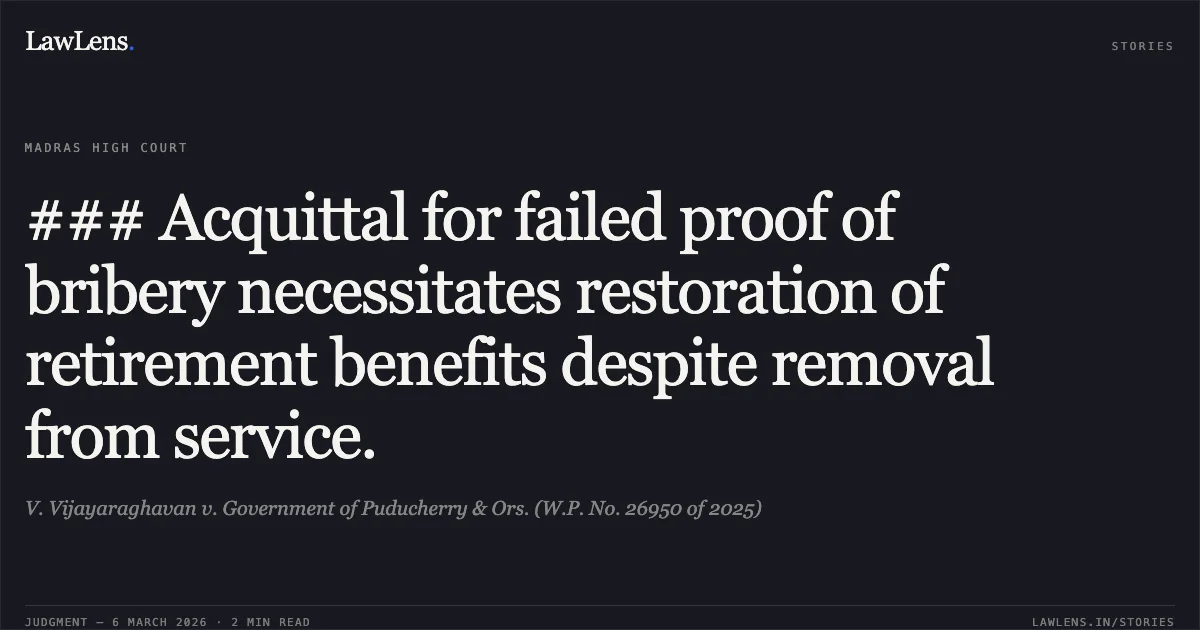
Source reference: para. 21, 22The Court held that an acquittal based on the failure of the prosecution to prove the crux of the charge entitles the employee to the revocation of penalties imposed solely due to the initial conviction.
Source reference: para. 22, 23Holding
The High Court allowed the Writ Petition and set aside the CAT’s order.
The Court held that the petitioner’s acquittal was definitive and not merely a "benefit of doubt" in a restrictive sense that would bar service benefits.
Source reference: para. 22, 23The respondents were directed to pass orders setting aside the removal from service and to pay all pensionary and terminal benefits to the petitioner effective from his date of superannuation.
Source reference: para. 24Acts & Sections Cited
2 provisions across 1 statute referred to in this judgment. Each provision opens on LawLens.
Prevention of Corruption Act, 19882
Original Court PDF
V. Vijayaraghavan v. Government of Puducherry & Ors. (W.P. No. 26950 of 2025)
Click to open original judgment
Original judgment, available to read, download and summarize on LawLens.in