Facts
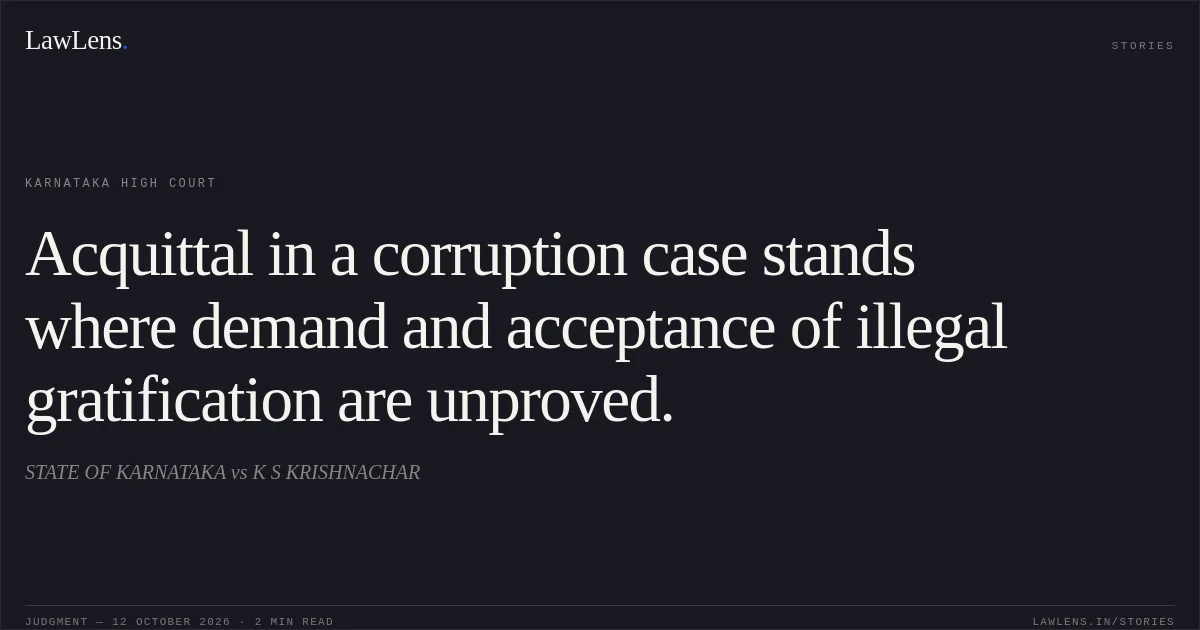
The State, through the Karnataka Lokayukta Police, appealed the acquittal of the respondent, a Panchayat Development Officer, who had been charged under Sections 7 and 13(1)(d) read with Section 13(2) of the Prevention of Corruption Act, 1988.
Source reference: paras. 3–4, 14–15The prosecution alleged that he demanded ₹5,000 from the complainant for allotting work under the National Rural Employment Scheme and accepted the money during a trap.
Source reference: paras. 3–4, 14–15The trial court acquitted the respondent.
Source reference: paras. 16, 20The complainant, examined as PW1, denied the demand and the complaint’s contents; the prosecution also did not examine the beneficiaries named in the work-allotment records.
Source reference: paras. 16, 20The State appealed under Section 378(1) and (3) of the Code of Criminal Procedure.
Source reference: p. 1; para. 1Issues
Whether the State-Lokayukta had established grounds to interfere with the trial court’s judgment of acquittal.
Source reference: para. 11What order should follow from the Court’s determination of that issue.
Source reference: para. 11Law Applied
The Court considered Sections 7 and 13(1)(d) read with Section 13(2) of the Prevention of Corruption Act, 1988, which were the provisions under which the respondent had been charged.
Source reference: paras. 3, 14It applied the principles governing appeals against acquittal under Section 378 of the Code of Criminal Procedure: an appellate court may reappraise the evidence, but an acquittal strengthens the presumption of innocence; where the trial court’s view is a possible view on the evidence, the appellate court should not substitute another view.
Source reference: para. 13Interference is warranted where the acquittal is perverse, materially misreads or omits evidence, or no reasonable view other than guilt is available.
Source reference: para. 13The Court cited Constable 907 Surendra Singh v. State of Uttarakhand, Babu Sahebgouda Rudragoudar v. State of Karnataka, Chandrappa v. State of Karnataka, and H.D. Sundara v. State of Karnataka for these principles.
Source reference: para. 13Reasoning
The Court found no basis to displace the trial court’s assessment of the evidence.
Source reference: paras. 16–19, 21PW1 denied that the respondent had demanded ₹5,000 and disowned the complaint’s contents, while the trial court had identified weaknesses in the supporting witnesses’ evidence.
Source reference: paras. 16–19, 21The beneficiaries named in Ex.P29 were not examined, and that document showed that work had been allotted to the complainant and others on 18 February 2011, before the complaint and trap on 24 February 2011.
Source reference: paras. 20–21In light of those evidentiary gaps, the trial court’s conclusion that demand and acceptance had not been proved was a possible view; the appellate standard did not permit reversal merely because another view might be available.
Source reference: paras. 13, 21–22Holding
The Court answered the issue of interference in the negative, holding that the State had not shown legal or factual error warranting reversal of the acquittal.
The appeal was dismissed, and the trial court’s judgment of acquittal remained undisturbed.
Source reference: para. 23Acts & Sections Cited
3 provisions across 2 statutes referred to in this judgment. Each provision opens on LawLens.
Code of Criminal Procedure, 19731
Prevention of Corruption Act, 19882
Original Court PDF
STATE OF KARNATAKAvsK S KRISHNACHAR
Click to open original judgment
Original judgment, available to read, download and summarize on LawLens.in