Facts
The deceased, Shyam Yadav, went to village Chilona with his son-in-law (P.W.1) on 08.12.1994 regarding a land dispute and allegedly stayed with the appellants for dinner
Source reference: para 4When he did not return, he was found unconscious with severe injuries near the Kajiya river bridge on 09.12.1994
Source reference: para 4He was hospitalized and subsequently died, leading to a charge under Section 302/34 IPC
Source reference: para 5The Trial Court convicted the appellants primarily on the "last seen theory" and motive related to a previous murder case
Source reference: paras 8-9During the appeal, two original appellants died, and the case proceeded for the surviving three
Source reference: para 2Issues
1. Whether the impugned judgment and order of conviction and sentence passed by the trial court suffer from any error of law requiring interference
Source reference: para 122. Whether the prosecution successfully established the chain of circumstantial evidence, specifically the "last seen theory," to prove the guilt of the appellants beyond reasonable doubt
Source reference: paras 15-16Law Applied
The court primarily applied Section 302 read with Section 34 of the Indian Penal Code regarding murder and common intention
Source reference: para 3It scrutinized the "last seen theory" as a facet of circumstantial evidence, which requires a proximity of time and a conclusive link between the accused and the crime
Source reference: para 9The court also referenced Section 277 of the Cr.P.C. regarding the procedure for recording evidence and the necessity of providing translators when evidence is recorded in a language other than that of the witness, citing the precedent Naim Ahamed v. State (NCT of Delhi) (2023) 15 SCC 385
Source reference: para 9Reasoning
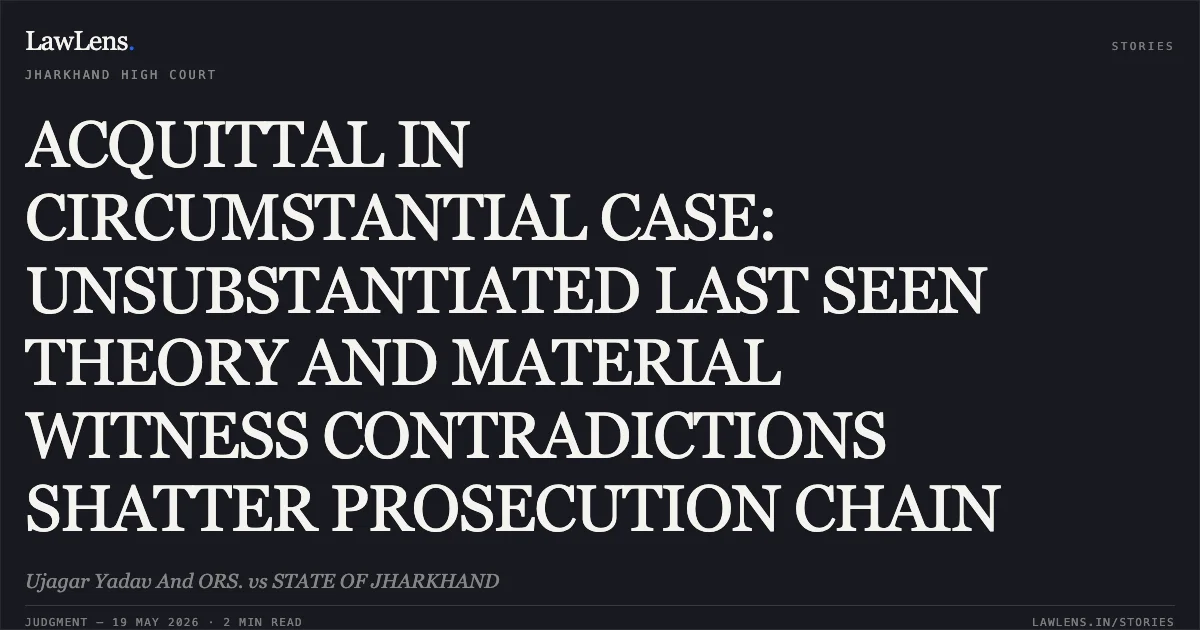
The High Court found the prosecution's "last seen theory" to be highly unreliable due to material contradictions between the testimony of the informant (P.W.1) and the son of the deceased (P.W.8)
Source reference: para 15While P.W.1 claimed he left the deceased alone with the accused, P.W.8 testified that P.W.1 had also stayed the night at the village, a fact P.W.1 suppressed
Source reference: para 15Furthermore, P.W.4’s claim of seeing the accused carrying the deceased on a cot was dismissed as a concocted story because it contradicted the fact that the deceased was found alive and unconscious
Source reference: para 15The court noted a lack of forensic evidence, such as bloodstains at the alleged first place of occurrence (the house), and highlighted that the investigation was perfunctory, with the second I.O. submitting a charge-sheet without visiting the site or recording fresh statements
Source reference: paras 14-16The Bench concluded that the motive cited—a previous acquittal in a different murder case—actually suggested a reason for the informant to falsely implicate the appellants
Source reference: paras 15-16Holding
The Court held that the prosecution failed to provide any legal evidence, direct or circumstantial, to prove the appellants' culpability
It found that the Trial Court ignored vital suspicious circumstances and failed to establish a conclusive chain of evidence
Source reference: para 16-17Consequently, the High Court set aside the judgment of conviction dated 14.11.2003 and the order of sentence dated 17.11.2003
Source reference: para 17The appellants were acquitted of all charges, their bail bonds were discharged, and they were set at liberty
Source reference: paras 18-19Acts & Sections Cited
9 provisions across 2 statutes referred to in this judgment. Each provision opens on LawLens.
Indian Penal Code, 18607
Code of Criminal Procedure, 19732
Original Court PDF
Ujagar Yadav And ORS.vsSTATE OF JHARKHAND
Click to open original judgment
Original judgment, available to read, download and summarize on LawLens.in