Facts
The respondent, a retired Inspector of Police, was issued a charge memo on 15.02.1999 under Rule 3(b) of the Tamil Nadu Police Subordinate Services (Discipline and Appeal) Rules, 1955.
Source reference: p.3Following an enquiry, the findings of the Enquiry Officer recorded the charges as proved. Though the respondent attained superannuation on 30.09.2005, he was allowed to retire without prejudice to the pending disciplinary proceedings and a concurrent criminal case.
Source reference: p.4After the criminal case ended in acquittal on 16.02.2007, the respondent submitted his explanation to the enquiry findings on 01.07.2007.
Source reference: p.4The Disciplinary Authority subsequently imposed a punishment of a pension cut of Rs.50/- per month for one year under the Tamil Nadu Pension Rules, 1978. The Writ Court set aside this punishment on 24.03.2022, leading to this intra-court appeal by the State.
Source reference: p.2, 6Issues
1. Whether the delay in concluding the departmental disciplinary proceedings vitiated the order of punishment.
Source reference: p.4, 52. Whether an order of acquittal in a criminal case necessitates exoneration in departmental proceedings.
Source reference: p.53. Whether the punishment of a pension cut of Rs.50/- for one year was disproportionate to the proved charges.
Source reference: p.7Law Applied
The Court applied the "Preponderance of Probabilities" doctrine, noting that departmental proceedings do not require the "strict proof" necessary for criminal convictions.
Source reference: p.5It invoked the principles of Judicial Review, which limit the High Court's interference to verifying compliance with natural justice, statutory rules, lack of perversity, and proportionality of punishment.
Source reference: p.6The proceedings were governed by Rule 3(b) of the Tamil Nadu Police Subordinate Services (Discipline and Appeal) Rules, 1955, and the Tamil Nadu Pension Rules, 1978.
Source reference: p.3, 6Reasoning
The Court reasoned that the delay in concluding the proceedings was not attributable to the Department but arose because the respondent submitted his final explanation only after the disposal of his criminal case in 2007.
Source reference: p.4Regarding the findings, the Court held that even if witnesses turned hostile during the enquiry, the Disciplinary Authority is entitled to form an opinion based on documents and the preponderance of probabilities.
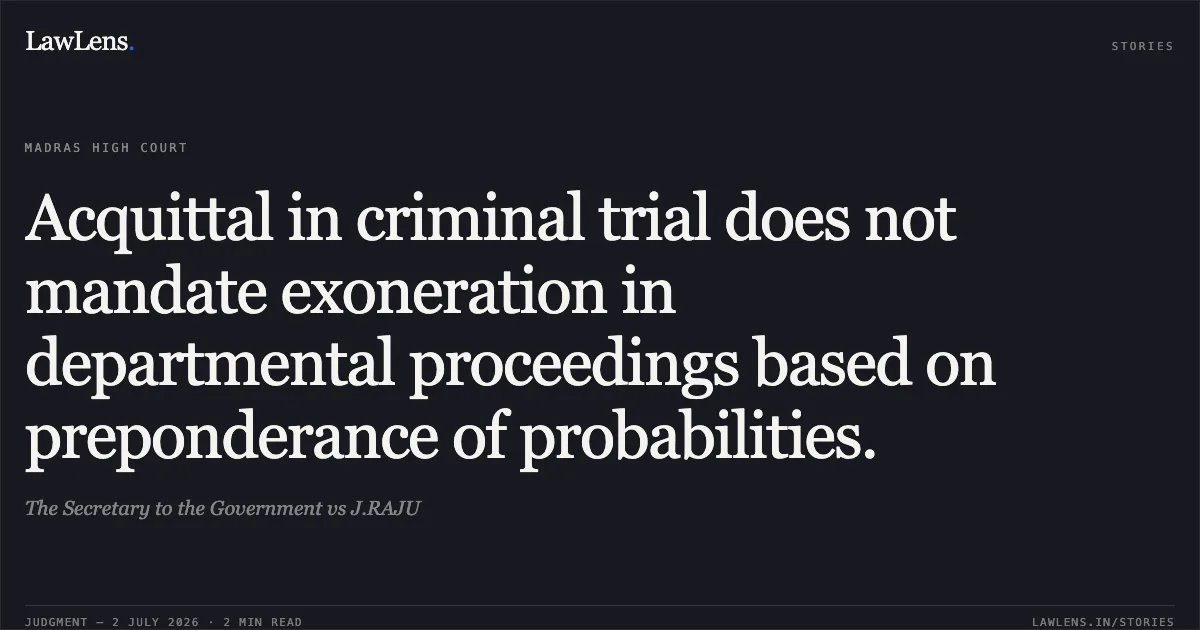
Source reference: p.5It clarified that criminal procedures and departmental proceedings are "distinct and different"; thus, a criminal acquittal does not automatically invalidate a disciplinary penalty.
Source reference: p.5The Court found that statutory procedures and principles of natural justice were strictly followed, as the respondent participated in the enquiry and was afforded opportunities to represent his case.
Source reference: p.6Holding
The Court answered the issues in the negative, holding that there was no procedural infirmity or perversity in the Disciplinary Authority's order.
It further held that a pension cut of Rs.50/- for one year is not disproportionate. Consequently, the High Court set aside the Writ Court’s order dated 24.03.2022 and allowed the Writ Appeal, upholding the punishment imposed by the State.
Source reference: p.7Original Court PDF
The Secretary to the GovernmentvsJ.RAJU
Click to open original judgment
Original judgment, available to read, download and summarize on LawLens.in


