Facts
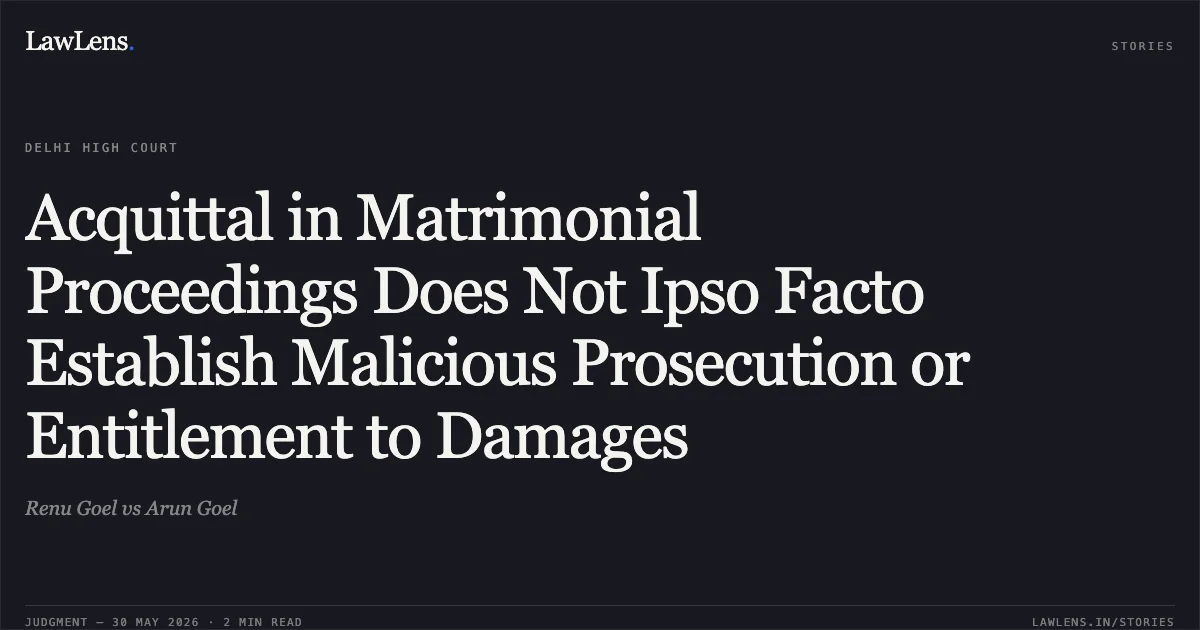
The parties married in 1997 and separated in 2000
Source reference: para. 3, 12Following the separation, multiple litigations ensued: the wife (Appellant) filed an FIR under Sections 498A/406/34 IPC, a maintenance claim under Section 125 Cr.PC, and civil suits for injunction
Source reference: para. 13, 19, 22The husband (Respondent) was acquitted in the criminal case in 2014, and the subsequent appeal by the wife was dismissed in 2016
Source reference: para. 14, 15The husband then filed a suit for damages (CS DJ No. 810/2017) claiming ₹10,00,000/- for malicious prosecution, mental agony, and loss of reputation
Source reference: para. 2, 29The Trial Court decreed the suit for ₹1,55,000/-, holding that the wife had misused state machinery
Source reference: para. 1, 39The wife appealed this judgment to the High Court
Source reference: para. 43Issues
1. Whether the Trial Court was justified in awarding damages for malicious prosecution and litigation expenses in the absence of evidence of malice
Source reference: p.15 / para. 572. Whether the acquittal in a matrimonial criminal case automatically entitles the husband to damages for harassment and mental agony
Source reference: p.20 / para. 79-803. Whether the grant of damages for loss of reputation is sustainable without specific evidence of injury to the husband's standing in society
Source reference: p.21 / para. 83Law Applied
The Court applied the principles of the tort of malicious prosecution, requiring the plaintiff to prove: (i) initiation of a lawsuit, (ii) lack of probable cause, (iii) malice, and (iv) favorable termination
Source reference: para. 60-61It relied on West Bengal State Electricity Board v. Dilip Kumar Ray, which establishes that "malice" and "want of reasonable cause" must be proven by the plaintiff
Source reference: para. 62Furthermore, it applied the precedent from Gangadhar Padhy v. Prem Singh and Sannam Bharti v. DTC, which mandates that mere acquittal in a criminal case—especially one based on "benefit of doubt"—does not automatically equate to malicious prosecution
Source reference: para. 68-69Reasoning
The Court observed that the Respondent’s plaint lacked specific allegations or evidence of "malice," focusing only on the existence of multiple litigations
Source reference: para. 59, 63It reasoned that the wife's pursuit of legal remedies for dowry harassment and maintenance were exercises of her legal rights and could not per se be termed malicious
Source reference: para. 63-64The Court found that the Trial Court erroneously "conflated" the husband's acquittal with proof of malice; since the acquittal was based on the prosecution's failure to prove the case beyond reasonable doubt rather than a finding that the complaint was "groundless," it did not satisfy the requirements of tortious liability
Source reference: para. 65, 70Regarding "loss of reputation," the Court noted that the husband failed to examine any witnesses or produce documents to prove actual damage to his social standing, rendering the award of ₹30,000/- speculative
Source reference: para. 85-86Finally, the Court noted that in matrimonial discord, pain and agony are suffered by both parties and the child, and such suffering cannot be attributed solely to the wife's "intentional" acts
Source reference: para. 80-81Holding
The High Court set aside the Trial Court's judgment and decree dated 22.12.2023
It held that the Respondent/husband failed to discharge the burden of proving that the suits were initiated without reasonable cause or with malicious intent
Source reference: para. 71The Court concluded that in the absence of foundational pleadings and evidence of actual damages, the decree was unsustainable
Source reference: para. 87The Appeal was allowed, and the husband’s suit was dismissed
Source reference: para. 89Acts & Sections Cited
8 provisions across 6 statutes referred to in this judgment. Each provision opens on LawLens.
Code of Civil Procedure, 19081
Indian Penal Code, 18602
Code of Criminal Procedure, 19732
Hindu Marriage Act, 19551
Family Courts Act, 19841
Limitation Act, 19631
Original Court PDF
Renu GoelvsArun Goel
Click to open original judgment
Original judgment, available to read, download and summarize on LawLens.in