Facts
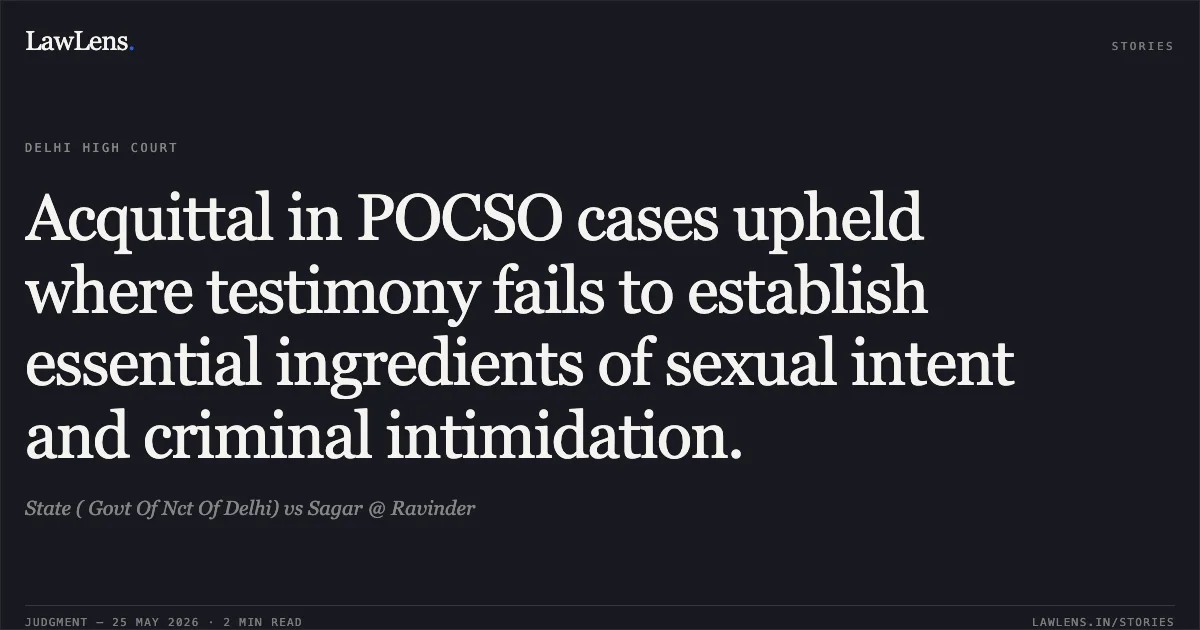
The State appealed against the trial court's acquittal (dated 25.01.2016) of the respondent, who was charged under Sections 341, 354A, and 506 of the IPC, and Sections 8 and 12 of the POCSO Act.
Source reference: p. 1-2The prosecution alleged that between May 4-8, 2013, the accused repeatedly stalked and harassed PW2 (a 13-year-old girl). On 08.05.2013, he allegedly restrained her and held her hand with sexual intent.
Source reference: p. 2The accused contended he was falsely implicated following a quarrel where he caught PW2’s brother (PW7) attempting to steal a car stereo.
Source reference: p. 4, 11-12The trial court acquitted the accused under Section 235(1) Cr.P.C.
Source reference: p. 5Issues
1. Whether there was any infirmity or perversity in the trial court's judgment of acquittal that warrants interference by the High Court.
Source reference: p. 72. Whether the testimonies of the prosecution witnesses established the essential ingredients of sexual harassment and criminal intimidation under the IPC and POCSO Act.
Source reference: p. 16-19Law Applied
The court applied the standards of appellate review for acquittals established in Chandrappa v. State of Karnataka, Babu Sahebogouda Rudragoudar v. State of Karnataka, and Rajesh Prasad v. State of Bihar, holding that if two reasonable conclusions are possible, the appellate court should not disturb an acquittal.
Source reference: p. 14-15It applied Section 354A IPC (Sexual Harassment), requiring unwelcome sexual conduct/intent; Section 506 IPC (Criminal Intimidation), requiring a threat intended to cause "alarm"; and Sections 7, 8, 11, and 12 of the POCSO Act, which define sexual assault and harassment involving sexual intent or remarks.
Source reference: p. 16, 17, 19Reasoning
Regarding Section 354A IPC and POCSO, the court noted that the evidence did not demonstrate the requisite "sexual intent" or "sexual conduct," but rather depicted a physical restraint (holding the hand) that did not meet the definition of sexual assault or harassment.
Source reference: p. 17, 19Regarding Section 506 IPC, the court observed that while threats were allegedly made, there was no evidence that these threats caused "alarm" to the victims, which is a mandatory prerequisite for criminal intimidation.
Source reference: p. 18The Court further noted that while Section 341 IPC (wrongful restraint) might have been plausible, the trial court’s overall decision to acquit was a "reasonable and plausible view" based on the evidence.
Source reference: p. 20Holding
The High Court dismissed the appeal and upheld the acquittal. It held that an appellate court should not reverse a trial court's findings merely because another view is possible, provided the trial court's view is not perverse or manifestly erroneous.
The prosecution failed to bridge the gap between the alleged acts and the specific legal requirements of sexual intent and alarm required for conviction.
Source reference: p. 18-20Acts & Sections Cited
15 provisions across 3 statutes referred to in this judgment. Each provision opens on LawLens.
Code of Criminal Procedure, 19737
Indian Penal Code, 18604
Protection of Children from Sexual Offences Act, 20124
Original Court PDF
State ( Govt Of Nct Of Delhi)vsSagar @ Ravinder
Click to open original judgment
Original judgment, available to read, download and summarize on LawLens.in