Facts
The Respondent (Plaintiff) filed a summary suit under Order XXXVII of the CPC for recovery of Rs. 12,00,000/- based on three cheques issued by the Appellant (Defendant) in November 2021.
Source reference: para. 2, 5The Respondent alleged the cheques were issued to repay personal loans advanced between 2013 and 2016.
Source reference: para. 4The cheques were dishonoured due to "insufficient funds".
Source reference: para. 5Earlier, a criminal complaint under Section 138 of the Negotiable Instruments (NI) Act resulted in the Appellant's acquittal on 30.09.2024.
Source reference: para. 6In his Leave to Defend application, the Appellant denied the loan, alleged his blank signed cheques were stolen by the Respondent’s son, and contended the debt was time-barred.
Source reference: para. 8-10The District Judge dismissed the Leave to Defend and decreed the suit on 16.01.2026.
Source reference: para. 1, 14Issues
1. Whether the Appellant raised a substantial or bona fide triable issue regarding the alleged theft and misuse of cheques.
Source reference: para. 34-372. Whether a cheque issued for a debt advanced more than three years prior is legally enforceable and within the limitation period.
Source reference: para. 39-413. Whether an acquittal in criminal proceedings under Section 138 of the NI Act operates as a bar or binding precedent for a subsequent civil suit for recovery.
Source reference: para. 44, 53-54Law Applied
Order XXXVII Rules 1 and 2 of the CPC regarding summary procedure.
Source reference: p. 1Sections 20, 87, 118, and 139 of the Negotiable Instruments Act, 1881, which create a statutory presumption that a signed cheque is issued for a legally enforceable debt.
Source reference: para. 42Section 25(3) of the Indian Contract Act, 1872, acknowledging that a written promise to pay a time-barred debt constitutes a valid contract.
Source reference: para. 41The doctrine from Iqbal Singh Marwah v. Meenakshi Dahiya Marwah, holding that findings of a criminal court are not binding on a civil court due to different standards of proof.
Source reference: para. 52Reasoning
The Court found the Appellant’s defense of "stolen cheques" implausible because he admitted to signing the cheques and filling in the amounts.
Source reference: para. 34, 37The Appellant failed to provide contemporaneous police reports or "stop payment" instructions, filing such documents only after his initial application was dismissed.
Source reference: para. 35-36On the issue of limitation, the Court reasoned that the issuance of a cheque acts as an acknowledgment of liability and a promise to pay; thus, the limitation begins from the cheque date, not the original loan date.
Source reference: para. 40, 43The Court emphasized that civil cases are decided on a "preponderance of probabilities" unlike the criminal standard of "beyond reasonable doubt".
Source reference: para. 52Since the Appellant’s signatures were admitted, the statutory presumptions under the NI Act were not rebutted by any cogent evidence, rendering the defense frivolous and illusory.
Source reference: para. 55Holding
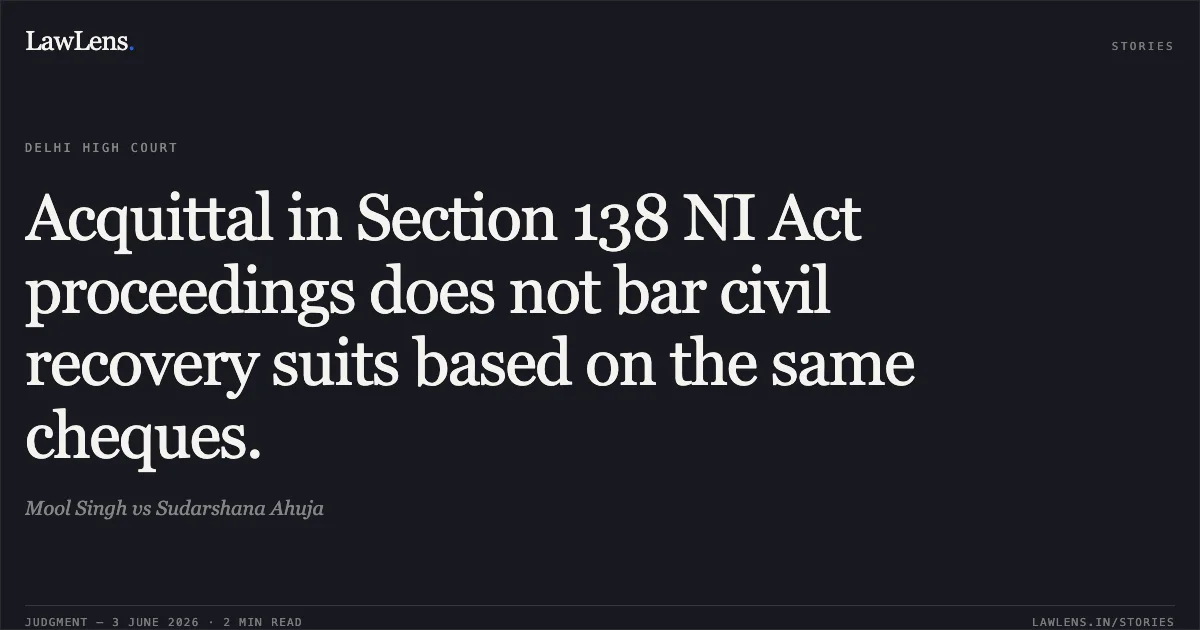
The Court held that mere allegations of theft without immediate legal action do not constitute a triable defense; a cheque issued for a prior loan constitutes an enforceable acknowledgment of debt for limitation purposes; and an acquittal in a Section 138 NI Act case does not bar a civil decree for recovery.
The High Court dismissed the appeal, upheld the District Court’s judgment, and affirmed the decree for Rs. 12,00,000/- with 9% interest.
Source reference: para. 1, 56Acts & Sections Cited
4 provisions across 2 statutes referred to in this judgment. Each provision opens on LawLens.
Code of Civil Procedure, 19083
Indian Contract Act, 18721
Original Court PDF
Mool SinghvsSudarshana Ahuja
Click to open original judgment
Original judgment, available to read, download and summarize on LawLens.in


