Facts
The prosecution alleged that railway employee S. Raju stole cardamom from a railway consignment and, with others, transported, concealed and sold it.
Source reference: pp. 2–6The Special Court for Economic Offences acquitted accused Nos. 1, 3, 5 and 6; proceedings against accused Nos. 2 and 4 had abated.
Source reference: pp. 2–6The State appealed, challenging the acquittal and alleging that the trial court had failed to properly assess the evidence concerning the missing consignment and the accused’s involvement.
Source reference: pp. 2–6Issues
1. Whether the State had established grounds for the High Court to interfere with the judgment of acquittal
Source reference: p. 7, para. 72. Whether the evidence on record—including the evidence concerning accused No. 1’s duty status and the seizure of the cardamom—supported the prosecution case sufficiently to displace the acquittal
Source reference: pp. 8–12, paras. 9–10Law Applied
The appeal was brought under Sections 378(1) and 378(3) of the Code of Criminal Procedure, 1973, against an acquittal for an alleged offence under Section 3(a) of the Railway Property (Unlawful Possession) Act, 1966.
Source reference: pp. 2, 7The judgment referred to Chandrappa v. State of Karnataka, H.D. Sundara v. State of Karnataka, Babu Sahebgouda Rudragoudar v. State of Karnataka and Constable 907 Surendra Singh v. State of Uttarakhand in relation to the principles governing an appeal against acquittal.
Source reference: p. 7The judgment did not set out those principles in detail; it proceeded to assess whether the trial court’s acquittal disclosed a legal or factual error warranting appellate interference.
Source reference: pp. 11–12, para. 10Reasoning
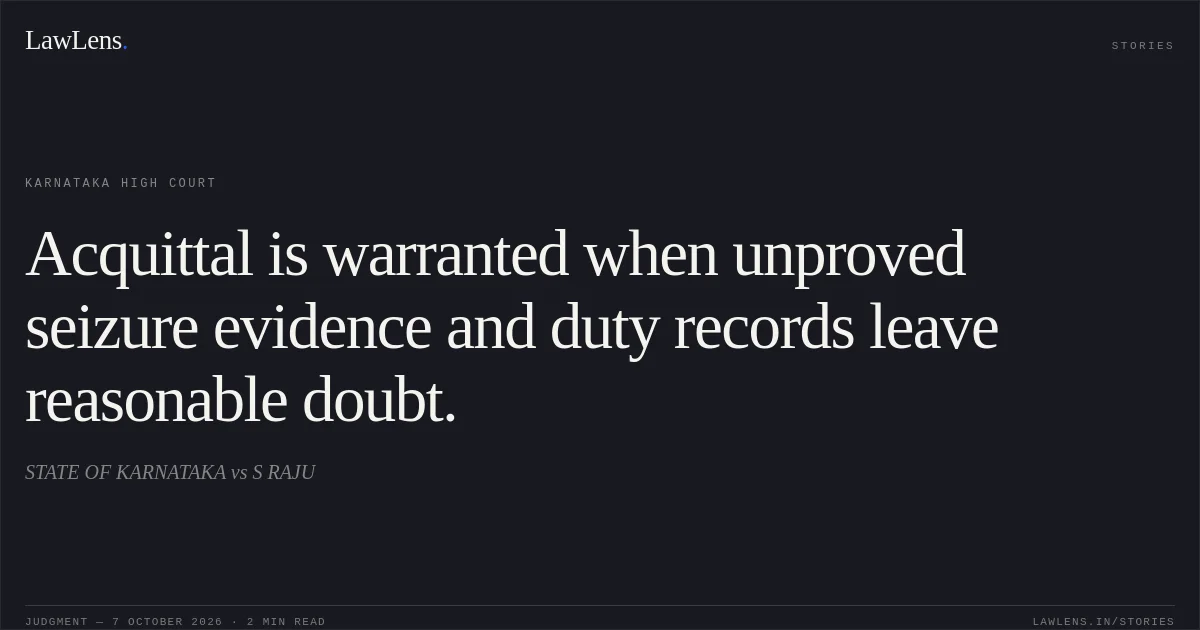
The High Court found that the trial court had reasonably relied on evidence indicating that accused No. 1 was on duty at the relevant time, including duty records marked by the defence, and that the defence evidence had not been materially undermined in cross-examination.
Source reference: pp. 8–10, paras. 9(45)–(49)The seizure mahazars relating to the cardamom allegedly recovered from accused Nos. 1 and 5 were not proved, and several witnesses, including mahazar witnesses, had turned hostile or were not examined.
Source reference: p. 10, para. 9(49)Although witnesses testified about the Ambassador car, its ownership and seizure, the court held that this evidence did not resolve the doubts arising from the duty records and the unproved seizure mahazars.
Source reference: pp. 10–11, paras. 9(50)–(54)It therefore found no legal or factual error in the trial court’s assessment.
Source reference: p. 11, para. 10Holding
The High Court answered the interference issue in the negative and dismissed the State’s appeal, leaving the acquittals undisturbed.
It also directed the Registry to pay Rs. 10,000 to the amicus curiae for assisting the Court.
Source reference: p. 12, para. 11Acts & Sections Cited
2 provisions across 1 statute referred to in this judgment. Each provision opens on LawLens.
Code of Criminal Procedure, 19732
Original Court PDF
STATE OF KARNATAKAvsS RAJU
Click to open original judgment
Original judgment, available to read, download and summarize on LawLens.in