Facts
The deceased, Lakhajai Jethaji Odedara, and the accused, Bhaveshji Odedara, were relatives and owned adjoining agricultural lands at Village Majivana, Porbandar.
Source reference: pp.2–3, para.4The prosecution alleged prior hostility concerning a right of way, including complaints and threats allegedly made by the accused against the deceased.
Source reference: pp.2–3, para.4On the night of 7 June 2020, the deceased was allegedly assaulted with a pickaxe while sleeping on the veranda of his house and died from the injuries.
Source reference: p.3, para.4The accused was arrested, and the investigating agency claimed recovery of the weapon and clothes pursuant to his disclosure statement; the seized articles were sent for forensic examination.
Source reference: p.3, para.4The Sessions Court, Porbandar, in Sessions Case No. 28 of 2020, acquitted the accused of the offences charged under Sections 302 and 450 of the IPC, holding that the prosecution had failed to establish the motive, the discovery under Section 27 of the Evidence Act, and a conclusive forensic link.
Source reference: p.4, paras.8–9The complainant-victim preferred the present appeal against acquittal under Section 413 of the Bharatiya Nagarik Suraksha Sanhita, 2023, corresponding to Section 372 of the CrPC.
Source reference: p.1, para.1Issues
Whether the Trial Court was justified in acquitting the accused despite the prosecution’s reliance on motive, recovery of the weapon and clothes, and forensic evidence?
Source reference: p.9, para.18Whether the circumstances relied upon by the prosecution formed a complete chain pointing exclusively to the guilt of the accused beyond reasonable doubt?
Source reference: pp.7–9, paras.15–18Whether the findings of acquittal were perverse or otherwise warranted appellate interference?
Source reference: p.6, para.14; p.12, para.23Law Applied
The Court considered the complainant’s statutory right to appeal against acquittal under Section 413 of the BNSS, 2023, corresponding to Section 372 of the CrPC.
Source reference: p.1, para.1It applied the settled rule that an appellate court should interfere with an acquittal only in exceptional cases involving perversity, compelling reasons, or serious legal error, since acquittal reinforces the presumption of innocence.
Source reference: p.6, para.14For circumstantial evidence, the Court relied on Sharad Birdhichand Sarda v. State of Maharashtra, 1984 (4) SCC 116, requiring every incriminating circumstance to be fully established, consistent only with the guilt of the accused, conclusive in nature, and forming a complete chain excluding every reasonable hypothesis of innocence.
Source reference: pp.7–9, para.15The Court also applied Section 27 of the Indian Evidence Act, under which only that portion of an accused’s disclosure statement distinctly relating to the discovery of a fact is admissible; a recovery must therefore be duly proved through reliable evidence.
Source reference: p.10, para.20Medical and forensic evidence could support the prosecution, but forensic evidence could not independently establish guilt where the foundational recovery was not legally proved.
Source reference: p.10, para.20Reasoning
The Court accepted that the death was homicidal but held that the prosecution failed to establish the accused’s identity as the assailant through a complete chain of circumstances.
Source reference: p.9, para.17Although evidence of prior hostility and complaints suggested strained relations, the deceased was not alone in the house and other family members were present; considering the number of injuries and the alleged manner of assault, the Court found it difficult to accept that the accused could have committed the assault and escaped without causing alarm. Motive was therefore not conclusively established.
Source reference: p.10, para.19The alleged recovery of the weapon and clothes was also rejected because the panch witnesses did not support the discovery panchnama, and the Investigating Officer failed to state the exact words of the accused’s disclosure statement. Consequently, the statutory requirements of Section 27 of the Evidence Act were not satisfied.
Source reference: p.10, para.20Since the recovery itself was unreliable, the FSL report showing blood on the articles could not constitute conclusive evidence linking the accused to the murder.
Source reference: pp.10–12, paras.20–23Applying the principles governing circumstantial evidence and the heightened restraint applicable in an appeal against acquittal, the Court held that suspicion arising from the accused’s conduct could not substitute legally admissible and conclusive proof.
Source reference: pp.10–12, paras.20–23Holding
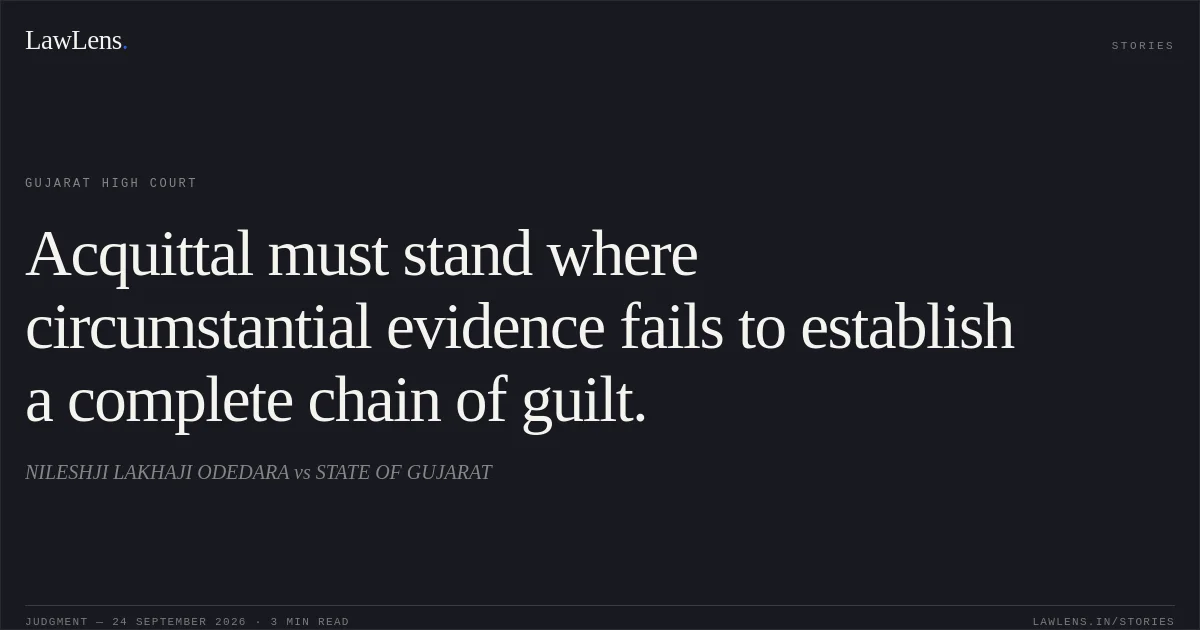
The High Court held that the prosecution had failed to prove the motive, the recovery under Section 27 of the Evidence Act, and a complete chain of circumstances establishing the accused’s guilt beyond reasonable doubt.
The Trial Court’s acquittal was neither perverse nor legally unsustainable, and no substantial or compelling ground for appellate interference existed.
Source reference: p.12, para.23The appeal was accordingly dismissed at the admission stage, and the order of acquittal was affirmed.
Source reference: p.12, para.24Acts & Sections Cited
7 provisions across 4 statutes referred to in this judgment. Each provision opens on LawLens.
Bharatiya Nagarik Suraksha Sanhita, 20231
Code of Criminal Procedure, 19732
Indian Penal Code, 18603
Gujarat Police Act, 1951.1
Original Court PDF
NILESHJI LAKHAJI ODEDARAvsSTATE OF GUJARAT
Click to open original judgment
Original judgment, available to read, download and summarize on LawLens.in