Facts
On 9 June 2010, officials of UGVCL allegedly found that the respondent had illegally connected a private cable directly to the electricity line at Village Changod, Taluka Khedbrahma, and was abstracting electricity without authorisation.
Source reference: p.2; para.10UGVCL assessed the alleged theft at ₹26,061.02 and issued a supplementary bill.
Source reference: p.2; para.10Following non-payment, a complaint was lodged and a charge-sheet was filed for an offence under Section 135(1)(a) of the Electricity Act, 2003.
Source reference: p.2The matter was committed to the Special Court as Special (Electricity) Case No. 16 of 2011.
Source reference: p.2The prosecution examined eight witnesses and produced eight documents; the respondent denied the allegation in his statement under Section 313 of the Code of Criminal Procedure.
Source reference: p.2; para.3The trial Court acquitted him.
Source reference: no citationThe State challenged the acquittal under Section 378(1) and (3) CrPC.
Source reference: p.1The trial Court found, inter alia, that the complainant had not obtained the requisite permission under Section 151 read with Section 50 of the Electricity Act, no panchnama had been prepared, and no alleged theft apparatus had been seized or produced.
Source reference: p.6; para.11The High Court also noted the unexplained delay between the inspection and complaint, and that the initial FIR allegedly implicated the respondent’s minor son, while the respondent was subsequently arraigned as accused.
Source reference: p.6; para.12Issues
1. Whether the trial Court was justified in acquitting the respondent of the offence under Section 135(1)(a) of the Electricity Act, 2003.
Source reference: p.5; para.9(1)2. Whether the trial Court properly appreciated the oral and documentary evidence adduced by the prosecution.
Source reference: p.5; para.9(2)3. Whether the impugned judgment of acquittal suffered from any illegality, irregularity, perversity, or other infirmity warranting appellate interference.
Source reference: p.5; para.9(3)Law Applied
The Court applied Section 135(1)(a) of the Electricity Act, 2003, which criminalises dishonest abstraction, consumption, or use of electricity through unauthorised means, and considered the procedural requirements under Section 151 read with Section 50 of the Act.
Source reference: pp.1, 6; paras.1, 11In an appeal against acquittal under Section 378 CrPC, an appellate court has full power to review and reappreciate the evidence, but must account for the double presumption of innocence in favour of the accused.
Source reference: pp.7–9; paras.13–16Relying on Chandrappa v. State of Karnataka, (2007) 4 SCC 415, Rajesh Prasad v. State of Bihar, (2022) 3 SCC 471, Babu Sahebagouda Rudragoudar v. State of Karnataka, (2024) 8 SCC 149, and Ramesh v. State of Karnataka, (2024) 9 SCC 169, the Court held that where two reasonable views are possible, the acquittal should not be disturbed, absent manifest illegality, perversity, or a conclusion incapable of being reached by a reasonable court.
Source reference: pp.7–10; paras.13–16Reasoning
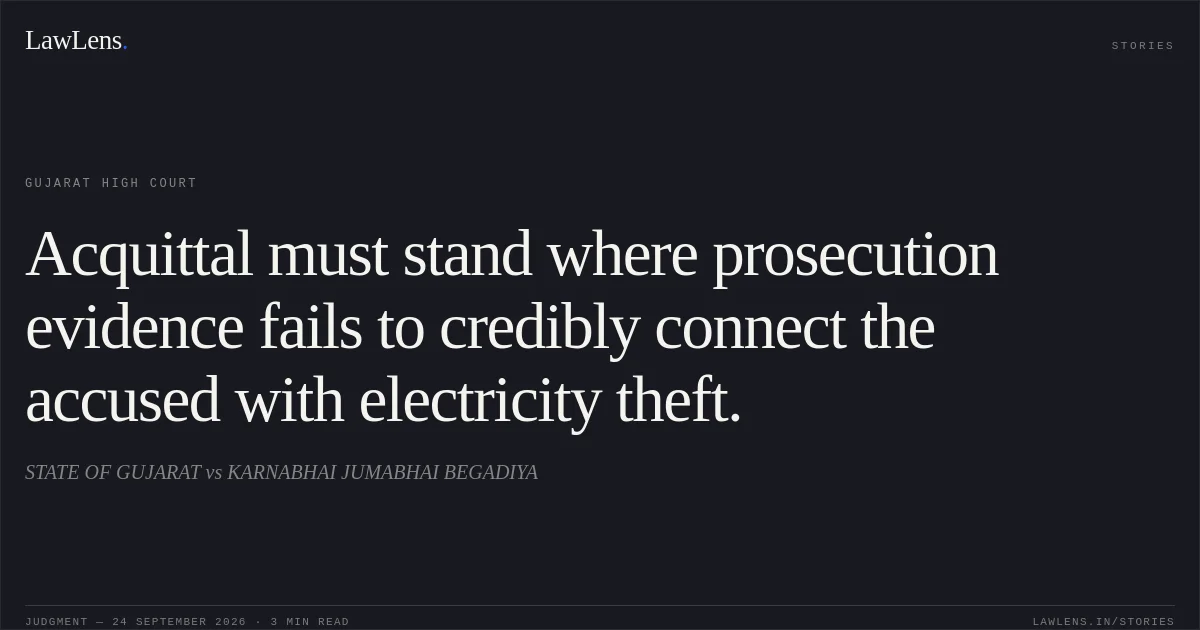
The High Court held that the prosecution evidence did not reliably connect the respondent with the alleged illegal abstraction of electricity.
Source reference: no citationThe trial Court had identified significant deficiencies: absence of the requisite permission for instituting the complaint, failure to prepare a panchnama, non-seizure and non-production of the alleged cable or other apparatus, unexplained delay in lodging the complaint, and uncertainty arising from the initial implication of the respondent’s minor son rather than the respondent himself.
Source reference: p.6; para.11–12These deficiencies created reasonable doubt regarding both the procedural validity of the prosecution and the respondent’s involvement in the offence.
Source reference: no citationApplying the restrictive principles governing interference with acquittals, the High Court found that the trial Court’s view was a reasonable one and was neither perverse nor legally infirm.
Source reference: pp.7–10; paras.13–18Holding
The High Court answered all issues against the State.
It held that the prosecution had failed to prove the charge under Section 135(1)(a) of the Electricity Act beyond reasonable doubt and that the trial Court had committed no error of law or fact in acquitting the respondent.
Source reference: pp.10–11; paras.17–18The State’s appeal was dismissed, the order of acquittal was confirmed, the bail bond was cancelled, and the record and proceedings were directed to be returned to the trial Court.
Source reference: p.11; para.19Acts & Sections Cited
5 provisions across 2 statutes referred to in this judgment. Each provision opens on LawLens.
Code of Criminal Procedure, 19732
Electricity Act, 20033
Original Court PDF
STATE OF GUJARATvsKARNABHAI JUMABHAI BEGADIYA
Click to open original judgment
Original judgment, available to read, download and summarize on LawLens.in