Facts
Sonalben, wife of respondent No.1 Pravinbhai Rakhasiya, died after sustaining burn injuries allegedly caused by pouring kerosene and setting herself on fire at her matrimonial home on 16 July 2008.
Source reference: p.1; paras. 1–5The prosecution alleged that her husband, parents-in-law and sister-in-law subjected her to physical and mental cruelty, taunted her regarding articles allegedly required at the time of delivery, and told her to die.
Source reference: p.1; paras. 1–5An FIR was registered under Sections 498A, 306 and 114 of the IPC, followed by investigation and filing of a charge-sheet.
Source reference: p.1; paras. 1–5After trial in Sessions Case No.43 of 2009, the Additional Sessions Judge, Rajkot, acquitted all four accused by judgment dated 16 September 2009.
Source reference: p.1; paras. 1–5The State preferred the present appeal against acquittal under Section 378(1) and (3) of the Code of Criminal Procedure.
Source reference: p.1; paras. 1–5The prosecution relied, inter alia, on the evidence of the deceased’s relatives, the deceased’s statement before the Executive Magistrate, the statement recorded by the Investigating Officer, and the medical evidence.
Source reference: pp.5–8, paras. 7.1–8.1The defence contended that the deceased’s medical history recorded immediately after the incident merely stated that she had herself poured kerosene and set herself ablaze, without alleging cruelty or naming any accused.
Source reference: pp.5–8, paras. 7.1–8.1Issues
1. Whether the trial court was justified in acquitting the respondents of offences under Sections 498A, 306 and 114 of the IPC?
Source reference: p.10, para. 9(1)2. Whether the trial court properly appreciated the oral and documentary evidence led by the prosecution?
Source reference: p.10, para. 9(2)3. Whether the dying declaration at Exhibit 28 and the statement recorded by the Investigating Officer at Exhibit 46/48 were reliable and sufficient to establish cruelty, abetment or instigation?
Source reference: p.10, para. 9(3)4. Whether the acquittal suffered from illegality, perversity or any other infirmity warranting interference in an appeal against acquittal?
Source reference: p.10, para. 9(4)Law Applied
The Court applied Sections 498A, 306 and 114 of the IPC, requiring proof of cruelty, abetment or instigation of suicide, and common intention or participation, as applicable.
Source reference: pp.10, 13, paras. 11–15It considered Section 32 of the Indian Evidence Act concerning the admissibility and evaluation of a dying declaration, and Sections 113-A and 113-B of the Evidence Act, observing that presumptions relating to abetment of suicide or dowry death arise only after foundational facts are established.
Source reference: pp.10, 13, paras. 11–15Relying on Laxman v. State of Maharashtra, (2002) 6 SCC 710, and Irfan @ Naka v. State of Uttar Pradesh, AIR 2023 SC 4129, the Court applied the principles governing the reliability and appreciation of dying declarations.
Source reference: p.10, para. 12On appellate interference with acquittal, it relied on Chandrappa v. State of Karnataka, (2007) 4 SCC 415; Rajesh Prasad v. State of Bihar, (2022) 3 SCC 471; Babu Sahebagouda Rudragoudar v. State of Karnataka, AIR 2024 SC 2252; and Ramesh v. State of Karnataka, (2024) 9 SCC 169, holding that although an appellate court may fully reappreciate the evidence, the accused enjoy a reinforced or double presumption of innocence and an acquittal should not be disturbed where two reasonable views are possible.
Source reference: pp.14–17, paras. 17–20Reasoning
The Court found that the deceased’s immediate medical history recorded by the attending doctors stated only that she had herself poured kerosene and set herself on fire; it did not name the respondents or allege cruelty or harassment.
Source reference: p.9, para. 10The dying declaration likewise did not describe any incident of quarrel, harassment or ill-treatment on the day of the occurrence, did not specify the nature of the alleged past harassment, and recorded that the deceased had not disclosed such harassment to anyone during her married life.
Source reference: p.10, para. 11This substantially weakened the testimony of her father, mother and sister regarding alleged cruelty.
Source reference: p.10, para. 12The Court further noted that the husband and sister-in-law were allegedly absent at the relevant time, while the father-in-law and mother-in-law immediately took the deceased to hospital; nearby witnesses and persons who allegedly attempted to rescue her were not examined.
Source reference: pp.11–12, para. 13The absence of hydrocarbon traces in samples collected from nearby utensils and dough also created doubt regarding the prosecution narrative.
Source reference: p.12, para. 14In the absence of reliable evidence establishing cruelty, provocation, instigation or abetment, the statutory presumptions under Sections 113-A and 113-B could not be invoked.
Source reference: pp.13–17, paras. 15–20Applying the restrictive standard governing appeals against acquittal, the Court held that the trial court’s view was a reasonable one and was neither perverse nor legally infirm.
Source reference: pp.13–17, paras. 15–20Holding
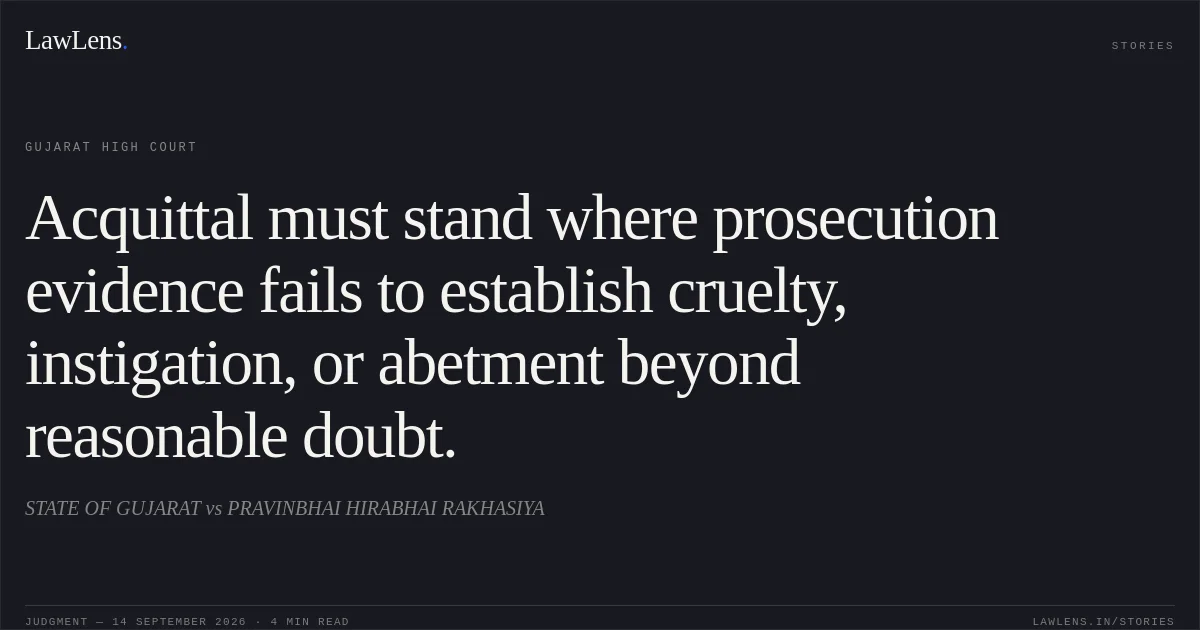
The High Court held that the prosecution failed to prove beyond reasonable doubt that the respondents had subjected the deceased to cruelty or had abetted or instigated her suicide.
The trial court had properly appreciated the evidence and recorded a legally sustainable acquittal.
Source reference: pp.17–18, paras. 21–23Finding no illegality, perversity or infirmity warranting appellate interference, the Court dismissed the State’s appeal and confirmed the acquittal of all respondents under Sections 498A, 306 and 114 of the IPC.
Source reference: pp.17–18, paras. 21–23The bail bonds were cancelled, and the record and proceedings were directed to be returned to the trial court.
Source reference: pp.17–18, paras. 21–23Acts & Sections Cited
5 provisions across 2 statutes referred to in this judgment. Each provision opens on LawLens.
Code of Criminal Procedure, 19733
Indian Penal Code, 18602
Original Court PDF
STATE OF GUJARATvsPRAVINBHAI HIRABHAI RAKHASIYA
Click to open original judgment
Original judgment, available to read, download and summarize on LawLens.in