Facts
The respondent-accused had allegedly been externed by an order dated 30 September 1996 passed by the Deputy Collector, Palitana, for a period of two years.
Source reference: p.2, para. 2The prosecution alleged that, despite the externment order, he was found at Village Turkha on 27 March 1998 at about 6:15 p.m., resulting in registration of an offence under Section 142 of the Bombay Police Act and filing of Criminal Case No. 210 of 1998.
Source reference: p.2, para. 2The Trial Court convicted the accused under Section 142 and sentenced him to fourteen months’ simple imprisonment with a fine of Rs.500, with one month’s further simple imprisonment in default of payment.
Source reference: p.2, para. 1On appeal, the First Appellate Court acquitted him after finding that the prosecution had failed to establish the alleged breach of the externment order and after noting discrepancies in the evidence of the police witnesses.
Source reference: p.6, para. 10The State challenged the acquittal before the Gujarat High Court under Section 378(1) and (3) of the Code of Criminal Procedure, 1973.
Source reference: p.1, para. 1Issues
Whether the prosecution proved beyond reasonable doubt that the respondent had entered or remained within the prohibited territory in breach of the externment order, thereby committing an offence under Section 142 of the Bombay Police Act?
Source reference: p.6, para. 10; p.10, paras. 15–16Whether the First Appellate Court’s order of acquittal suffered from perversity, illegality, or manifest error warranting interference in an appeal against acquittal?
Source reference: p.7, paras. 11–12; p.10, paras. 15–17Law Applied
The Court applied Section 142 of the Bombay Police Act, which penalises breach of an externment order and prescribes imprisonment and fine.
Source reference: p.6, para. 10The appeal against acquittal was considered under Section 378(1) and (3) of the Code of Criminal Procedure, 1973.
Source reference: p.1, para. 1Relying on Chandrappa v. State of Karnataka, (2007) 4 SCC 415, as reaffirmed in Rajesh Prasad v. State of Bihar, (2022) 3 SCC 471, Babu Sahebagouda Rudragoudar v. State of Karnataka, (2024) 8 SCC 149, and Ramesh v. State of Karnataka, (2024) 9 SCC 169, the Court held that an appellate court may fully review and reappreciate the evidence in an appeal against acquittal, but must bear in mind the accused’s double presumption of innocence.
Source reference: pp.7–10, paras. 11–14Where two reasonable conclusions are possible, the acquittal should not ordinarily be disturbed; interference is justified only where the lower court’s conclusion is perverse, manifestly illegal, or contrary to the evidence.
Source reference: pp.7–10, paras. 11–14Reasoning
The High Court found that the prosecution had not produced credible and convincing evidence establishing that the accused was present within the prohibited territory in violation of the externment order.
Source reference: no citationThe First Appellate Court had identified material discrepancies and inconsistencies in the depositions of the police witnesses and had concluded that the essential ingredients of the offence under Section 142 were not proved beyond reasonable doubt.
Source reference: p.6, para. 10On independent reappreciation, the High Court found no perversity, illegality, or misreading of evidence in that conclusion.
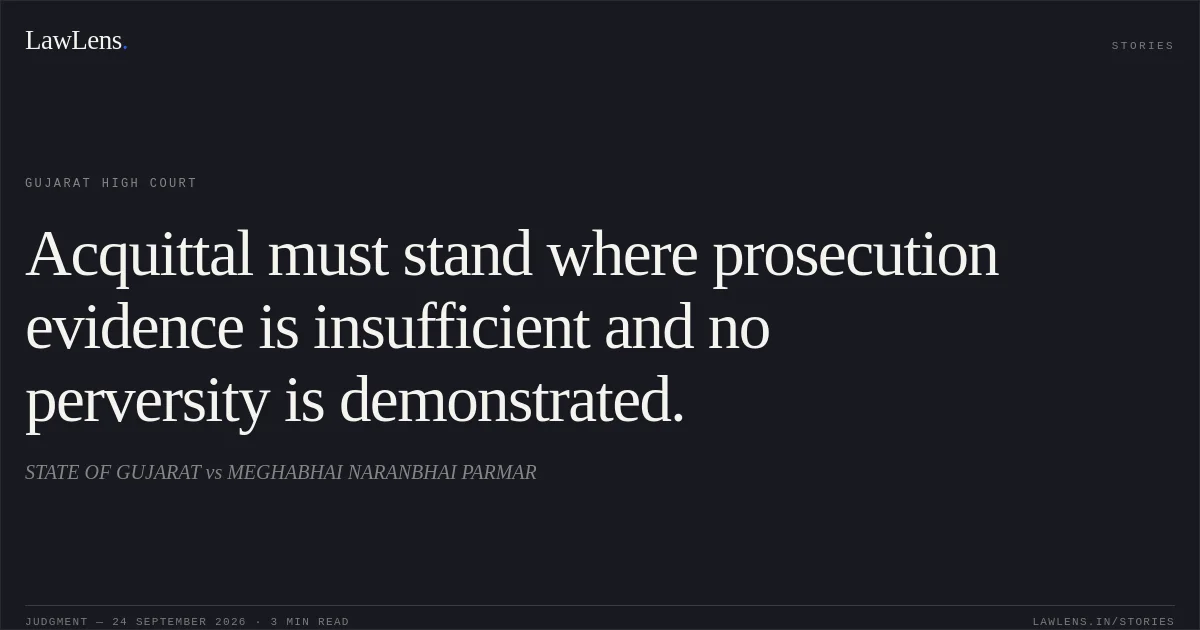
Source reference: p.10, paras. 15–16Since the acquittal reinforced the existing presumption of innocence and the prosecution evidence at least permitted a reasonable view in favour of the accused, the stringent standard governing appellate interference with acquittals was not satisfied.
Source reference: pp.7–10, paras. 11–14Holding
The Court answered the issues against the State. It held that the prosecution failed to prove beyond reasonable doubt that the respondent had breached the externment order and that the First Appellate Court had committed no error of fact or law in acquitting him.
The appeal was consequently dismissed, the order of acquittal was confirmed, the bail bond was cancelled, and the record and proceedings were directed to be returned to the concerned Trial Court.
Source reference: p.11, para. 17Acts & Sections Cited
1 provisions across 1 statute referred to in this judgment. Each provision opens on LawLens.
Code of Criminal Procedure, 19731
Original Court PDF
STATE OF GUJARATvsMEGHABHAI NARANBHAI PARMAR
Click to open original judgment
Original judgment, available to read, download and summarize on LawLens.in