01Facts
Ramilaben was married to the respondent-accused and had two children. The prosecution alleged that the accused subjected her to mental and physical cruelty, leading her to commit suicide by hanging on 26 August 2009.
pp. 6–7 · ¶ 10–11She was taken to hospitals in an unconscious condition and died on 27 August 2009; post-mortem examination found only a ligature mark and no other external or internal injuries.
pp. 6–7 · ¶ 10–11Although an accidental-death entry had initially been registered, the deceased’s father subsequently lodged an FIR alleging cruelty and harassment by the accused.
p. 7 · ¶ 12The prosecution examined, inter alia, the deceased’s father, sister and brother, as well as medical witnesses.
The trial court acquitted the accused of offences under Sections 306 and 498A of the Indian Penal Code, among other charges, in Sessions Case No.10 of 2010.
p. 1 · ¶ 1 · p. 2 · ¶ 3–6The State appealed against the acquittal under Section 378(1) and (3) of the Code of Criminal Procedure, 1973.
p. 1 · ¶ 1 · p. 2 · ¶ 3–602Issues
i.Whether the prosecution proved beyond reasonable doubt that the accused subjected Ramilaben to cruelty or harassment punishable under Section 498A IPC.
pp. 7–9 · ¶ 12–15ii.Whether the accused abetted Ramilaben’s suicide within the meaning of Sections 306 and 107 IPC.
p. 9 · ¶ 15iii.Whether the High Court, in an appeal against acquittal under Section 378 CrPC, was justified in reversing the trial court’s findings in the absence of perversity, manifest illegality or a conclusion unsupported by the evidence.
pp. 9–12 · ¶ 16–2003Law Applied
The Court applied Sections 306 and 107 IPC, requiring proof of abetment or instigation connected with the suicide, and Section 498A IPC, requiring proof of cruelty of the statutory nature alleged against the accused.
p. 9 · ¶ 15It also referred to Sections 113A and 113B of the Indian Evidence Act, 1872, observing that the presumptions concerning abetment of suicide or dowry death cannot arise without foundational facts demonstrating cruelty, harassment, instigation or abetment.
p. 9 · ¶ 15Under Section 378 CrPC, an appellate court has full power to reappreciate evidence in an appeal against acquittal, but must recognize the strengthened or “double” presumption of innocence; where two reasonable views are possible, the acquittal should not be disturbed.
pp. 9–12 · ¶ 16–20The Court relied principally on Chandrappa v. State of Karnataka, (2007) 4 SCC 415; Rajesh Prasad v. State of Bihar, (2022) 3 SCC 471; Babu Sahebagouda Rudragoudar v. State of Karnataka, (2024) 8 SCC 149; and Ramesh v. State of Karnataka, (2024) 9 SCC 169.
pp. 10–12 · ¶ 18–20Provisions in the judgment · 4 · Linked ones open on LawLens
Code of Criminal Procedure, 1973 Section 378Section 313
Indian Penal Code, 1860 Section 306Section 107
04Reasoning
The Court found that the medical evidence established suicide by hanging but did not disclose any physical injury beyond the ligature mark.
pp. 6–7 · ¶ 10–11The evidence of the deceased’s father, sister and brother did not contain a consistent or specific account of cruelty or harassment by the accused.
The Court noted material omissions and exaggerations, including the fact that allegations of ill-treatment were not made when the accidental-death entry was initially recorded.
p. 7 · ¶ 12The deceased’s sister expressly admitted that the accused had not subjected the deceased to physical or mental harassment, and the brother’s evidence did not establish the alleged ill-treatment.
p. 8 · ¶ 13–14In the absence of proof of cruelty, instigation or any positive act amounting to abetment, the statutory ingredients of Sections 498A, 306 and 107 IPC were not established, and the presumptions under Sections 113A and 113B of the Evidence Act could not be invoked.
p. 9 · ¶ 15Since the trial court’s view was reasonably supported by the evidence and was neither perverse nor manifestly illegal, the appellate principles governing acquittals required the High Court to defer to that view.
pp. 9–12 · ¶ 16–2005Holding
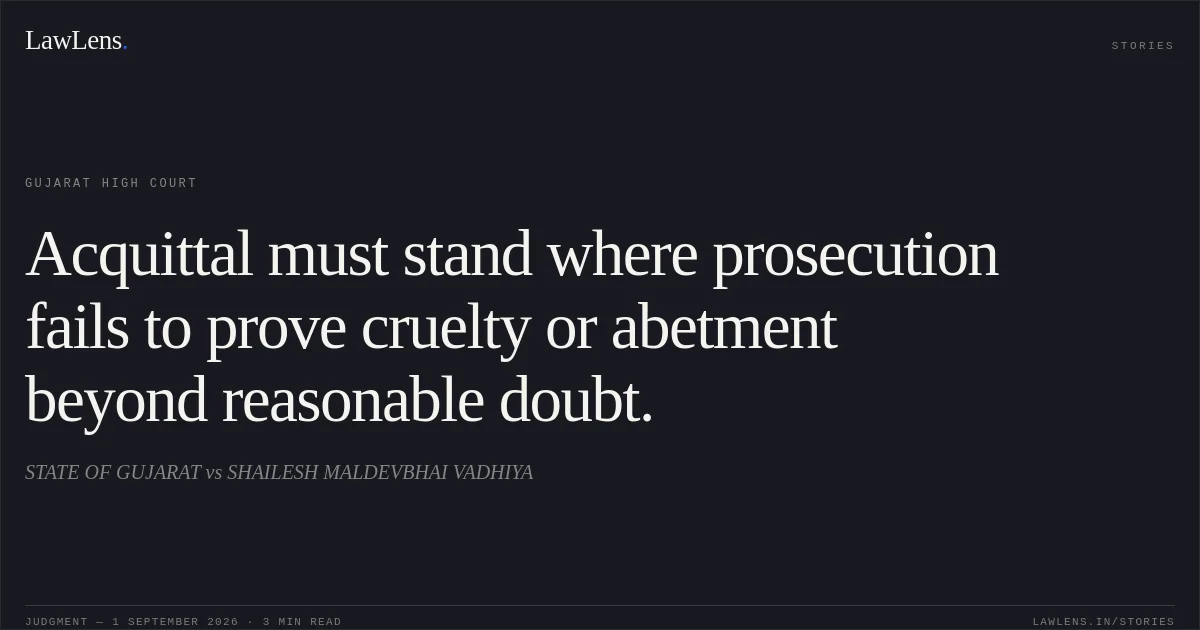
The High Court held that the prosecution failed to prove beyond reasonable doubt that the respondent had subjected the deceased to cruelty or had abetted her suicide.
pp. 12–13 · ¶ 21–22The trial court’s acquittal was found to be legally and factually sustainable, with no perversity or infirmity warranting appellate interference.
pp. 12–13 · ¶ 21–22The State’s appeal was dismissed, the order of acquittal was confirmed, the bail bond was cancelled, and the record and proceedings were directed to be returned to the trial court.
p. 13 · ¶ 23Original Court PDF
STATE OF GUJARATvsSHAILESH MALDEVBHAI VADHIYA
Click to open original judgment
Original judgment, available to read, download and summarize on LawLens.in