01Facts
The complainant, Bharatbhai Prabhudas Parmar, alleged that on 31 March 2011, a tempo and motorcycle connected with the respondents’ ice factory and godown were obstructively parked near his house. Upon questioning Mustakbhai and Yusufbhai, an altercation allegedly followed, during which Yusufbhai struck the complainant’s hand and back with an iron pipe, while other accused allegedly carried a sword and wooden stick. The complainant further alleged that the accused threatened him and used caste-related abuses. He subsequently lodged a complaint at Viramgam Town Police Station
pp. 2–3After investigation, a charge-sheet was filed for offences under Sections 325, 323, 504, 506(2) read with Section 114 of the IPC and Section 3(1)(x) of the Scheduled Castes and Scheduled Tribes (Prevention of Atrocities) Act, 1989. The case was committed to the Special Atrocity Court, which examined 12 prosecution witnesses and 15 documentary exhibits. By judgment dated 31 October 2012, the Trial Court acquitted all the accused. During the appeal, the proceedings abated against respondent Nos. 1 and 2, and the appeal survived against respondent No. 3
pp. 3–4 · ¶ 202Issues
i.Whether the Trial Court committed an error of fact or law in acquitting the accused of the offences under Sections 323, 325, 504, 506(2) read with Section 114 of the IPC and Section 3(1)(x) of the SC/ST Act?
¶ 7 · pp. 1, 17–18ii.Whether the prosecution evidence, including the testimony of the complainant, eyewitnesses, medical evidence, and investigating officer, established the accused’s involvement beyond reasonable doubt?
¶ 9–12, 23–24iii.Whether the prosecution proved the essential ingredients of the offence under Section 3(1)(x) of the SC/ST Act, including the caste status of the complainant and the alleged caste-based insult or humiliation?
¶ 11, 13–17iv.Whether the acquittal was so perverse, illegal, or unreasonable as to warrant appellate interference under Section 378 of the CrPC?
¶ 19–2203Law Applied
The Court applied Section 378 of the Code of Criminal Procedure, 1973, governing appeals against acquittal, and the principle that an appellate court may reappreciate the evidence but must respect the strengthened or “double” presumption of innocence following an acquittal. The prosecution was required to prove the offences under Sections 323, 325, 504, 506(2) read with Section 114 of the IPC beyond reasonable doubt. For Section 3(1)(x) of the SC/ST Act, the prosecution had to establish the statutory ingredients of caste-based intentional insult or humiliation and prove the complainant’s membership of a Scheduled Caste or Scheduled Tribe
¶ 11, 13–17, 19–22Relying on Chandrappa v. State of Karnataka, (2007) 4 SCC 415, as reaffirmed in Rajesh Prasad v. State of Bihar, (2022) 3 SCC 471, Babu Sahebagouda Rudragoudar v. State of Karnataka, (2024) 8 SCC 149, and Ramesh v. State of Karnataka, (2024) 9 SCC 169, the Court held that where two reasonable views are possible, the appellate court should not disturb an acquittal, absent perversity or manifest illegality. The Court also relied on Shajan Skaria v. State of Kerala, 2024 AIR SC 4557, and related authorities for the proposition that the SC/ST Act is not attracted merely because the complainant belongs to a Scheduled Caste; the alleged conduct must satisfy the statutory caste-based ingredients
¶ 14–22Provisions in the judgment · 17 · Linked ones open on LawLens
Code of Criminal Procedure, 1973 Section 156Section 200Section 209Section 228Section 313Section 378Section 438Section 482
Indian Penal Code, 1860 Section 114Section 323Section 325Section 500Section 504Section 506
Scheduled Castes and the Scheduled Tribes (Prevention of Atrocities) Act, 1989 Section 3Section 18
Protection of Civil Rights Act, 1955 Section 7
04Reasoning
The High Court found material inconsistencies in the prosecution case. The evidence of PW-4, PW-6, and PW-7 indicated that the vehicles were parked behind, rather than in front of, the complainant’s house, and that the road remained sufficiently wide for vehicles to pass. This undermined the alleged cause of the altercation. The complainant’s brother, Vasantbhai, was not named as present in the complaint but later claimed to be an eyewitness, creating a material contradiction. Further, the complainant did not name the assailants while giving the medical history, and the doctor admitted that the injury could have resulted from a fall, thereby weakening the medical corroboration
¶ 9–10The independent panch witnesses did not support the prosecution, the caste certificate was not duly proved, and the investigating officer failed to investigate the pre-existing dispute concerning construction of a toilet and the municipal stay order. These circumstances created reasonable doubt regarding both the occurrence as alleged and the accused’s participation. The Court further held that the prosecution had failed to prove the essential ingredients of the offence under Section 3(1)(x) of the SC/ST Act. Since the Trial Court’s view was a reasonable one based on the evidence, and its findings were neither perverse nor manifestly illegal, the enhanced presumption in favour of the acquitted accused precluded appellate interference
¶ 11, 13–18, 23–2405Holding
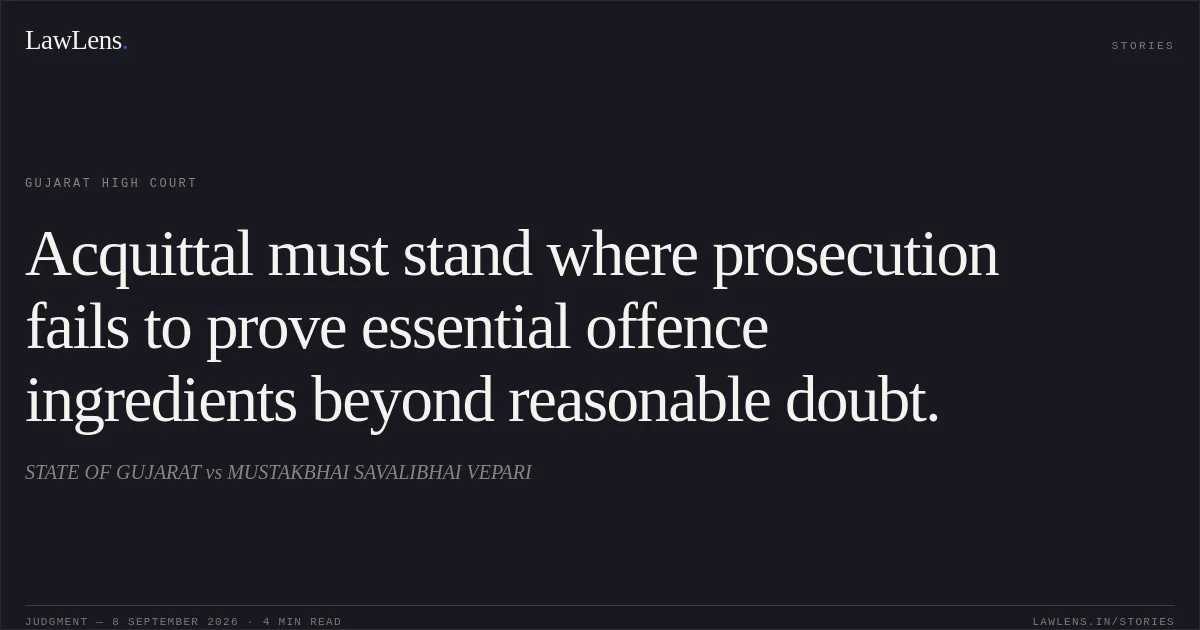
The High Court answered the issues against the State. It held that the prosecution failed to prove the charged IPC offences and the offence under Section 3(1)(x) of the SC/ST Act beyond reasonable doubt, and that the Trial Court had committed no error, illegality, or perversity in acquitting the accused
¶ 17, 23–24The appeal was dismissed, the judgment and order of acquittal dated 31 October 2012 were confirmed, the bail bonds were cancelled, and the record and proceedings were directed to be returned to the Trial Court
¶ 25Original Court PDF
STATE OF GUJARATvsMUSTAKBHAI SAVALIBHAI VEPARI
Click to open original judgment
Original judgment, available to read, download and summarize on LawLens.in