Facts
The respondent, a Head Constable in the Tamil Nadu Police Department, was subjected to disciplinary proceedings under Rule 3(b) of the Tamil Nadu Police Subordinate Service (Discipline and Appeal) Rules on two charges.
Source reference: pp.2–3, paras.2–3He denied the charges, but the departmental Enquiry Officer found them proved.
Source reference: pp.2–3, paras.2–3The disciplinary authority imposed reduction in pay by three stages for three years with cumulative effect.
Source reference: pp.2–3, paras.2–3On appeal, the punishment was reduced to reduction in the time scale of pay by two stages for two years without cumulative effect; the review petition was rejected.
Source reference: pp.2–3, paras.2–3The criminal case arising from the same allegations ended in acquittal on the benefit of doubt.
Source reference: p.3, para.4Relying on the acquittal and the fact that witnesses had turned hostile in the departmental enquiry, the learned Single Judge allowed the respondent’s writ petition and set aside the punishment.
Source reference: p.3, para.4The State authorities challenged that order in the present intra-court appeal.
Source reference: p.3, para.4Issues
1. Whether an acquittal in a criminal case on the benefit of doubt, arising from the same allegations, automatically entitles the delinquent government servant to exoneration in departmental disciplinary proceedings
Source reference: pp.3–5, paras.4–102. Whether the departmental authorities’ finding of misconduct, based on the standard of preponderance of probabilities and the earlier statements of witnesses who subsequently turned hostile, was legally sustainable
Source reference: pp.5–6, paras.10–123. Whether the punishment, as modified by the appellate authority, warranted further interference by the writ court
Source reference: p.6, paras.11–12Law Applied
The Court applied Rule 3(b) of the Tamil Nadu Police Subordinate Service (Discipline and Appeal) Rules governing disciplinary proceedings against police personnel.
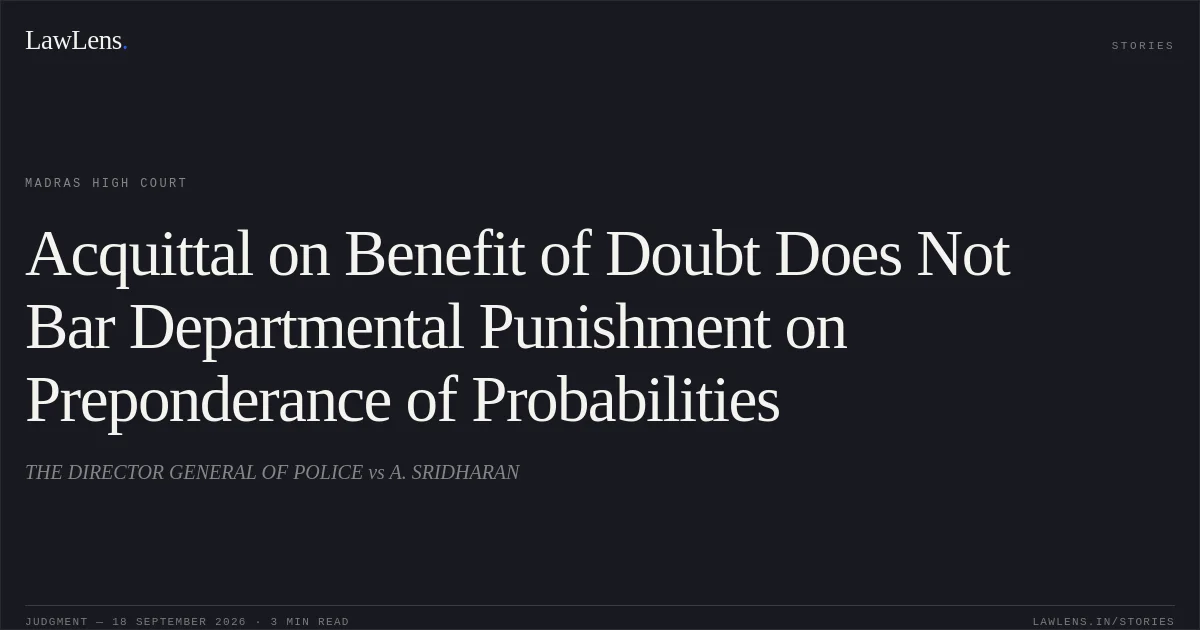
Source reference: p.2, para.2It reiterated that criminal proceedings and departmental disciplinary proceedings are distinct; departmental proceedings are not dependent on the outcome of the criminal case; and an acquittal on the benefit of doubt does not by itself establish entitlement to departmental exoneration.
Source reference: p.4, para.8The Court further held that criminal liability must be established by strict proof beyond reasonable doubt, whereas departmental misconduct may be established on a preponderance of probabilities, and the disciplinary authority may draw reasonable factual inferences from the available material.
Source reference: pp.4–5, paras.8–9It also applied the principle that greater discipline is expected from members of uniformed forces and that such discipline cannot ordinarily be compromised.
Source reference: p.6, para.12Reasoning
The criminal court’s acquittal was based only on the benefit of doubt and was therefore not equivalent to a finding that the allegations were false or that the respondent was fully exonerated.
Source reference: pp.3–5, paras.4,8–10The departmental authorities were entitled to apply the lesser standard of preponderance of probabilities.
Source reference: pp.4–5, paras.8–9Although the complainant and other witnesses turned hostile during the departmental enquiry, the disciplinary authority relied on their earlier statements and on the statements of other witnesses, recording a specific finding that the evidence established the first charge and that the witnesses had turned hostile to favour the delinquent.
Source reference: p.5, para.10The appellate authority had already considered the respondent’s length of service and clean disciplinary record and substantially reduced the punishment.
Source reference: p.6, para.11Since the authorities had considered the respondent’s defence and their conclusions were not perverse, the writ court was not justified in substituting its view or granting further leniency.
Source reference: p.6, paras.11–13Holding
The Court held that the respondent’s acquittal on the benefit of doubt did not invalidate the departmental proceedings or the finding of misconduct.
The disciplinary and appellate authorities had acted within the applicable legal principles, and the modified punishment did not warrant further interference.
Source reference: p.7, para.13The writ order dated 29 September 2022 in W.P. No. 15332 of 2010 was set aside; the writ appeal was allowed, with no order as to costs, and the connected miscellaneous petition was closed.
Source reference: p.7, para.13Original Court PDF
THE DIRECTOR GENERAL OF POLICEvsA. SRIDHARAN
Click to open original judgment
Original judgment, available to read, download and summarize on LawLens.in