Facts
On 27 October 2000, the deceased, Munshi Ram, was found unconscious and lying in a pool of blood in the room of PW-12/Ram Kishan after allegedly consuming liquor with the appellant, PW-6/Jai Bhagwan and PW-12.
Source reference: pp. 3–5; paras 3, 37, 40The appellant was allegedly left alone with the deceased at approximately 9:20–9:30 p.m. and, when PW-6 and PW-12 returned around 12:30–12:40 a.m., the deceased was found injured and the appellant allegedly stated that he had assaulted the deceased with an iron pipe following a quarrel.
Source reference: pp. 3–5, 15–18; paras 3, 37, 40The deceased died later that day from head injuries.
Source reference: p. 4; para 3(g)The prosecution relied principally on the “last seen” circumstance, the alleged extra-judicial confession, medical evidence, and recovery of a cylindrical hand-pump component allegedly used as the weapon.
Source reference: pp. 6–7, 11–13; paras 9–14, 22–34The Trial Court convicted the appellant under Section 302 IPC and sentenced him to life imprisonment with a fine of Rs. 100.
Source reference: pp. 1–2, 6–7; paras 1–2, 14The appellant challenged both conviction and sentence in the present appeal.
Source reference: no citationIssues
Whether the prosecution established beyond reasonable doubt that the appellant caused the deceased’s death, merely on the basis of the “last seen together” circumstance and the appellant’s failure to explain when he parted company with the deceased?
Source reference: pp. 20–27, 28–30; paras 47–53Whether the testimonies of PW-6 and PW-12, including their account of the appellant’s alleged extra-judicial confession, were sufficiently reliable and corroborated to sustain the conviction?
Source reference: pp. 15–20, 30–31; paras 37–46, 50–56Whether the alleged recovery of the hand-pump cylinder and the medical evidence completed the chain of circumstantial evidence against the appellant?
Source reference: pp. 30–33; paras 54–58Law Applied
The Court applied Section 302 of the Indian Penal Code concerning murder and the settled principles governing conviction on circumstantial evidence.
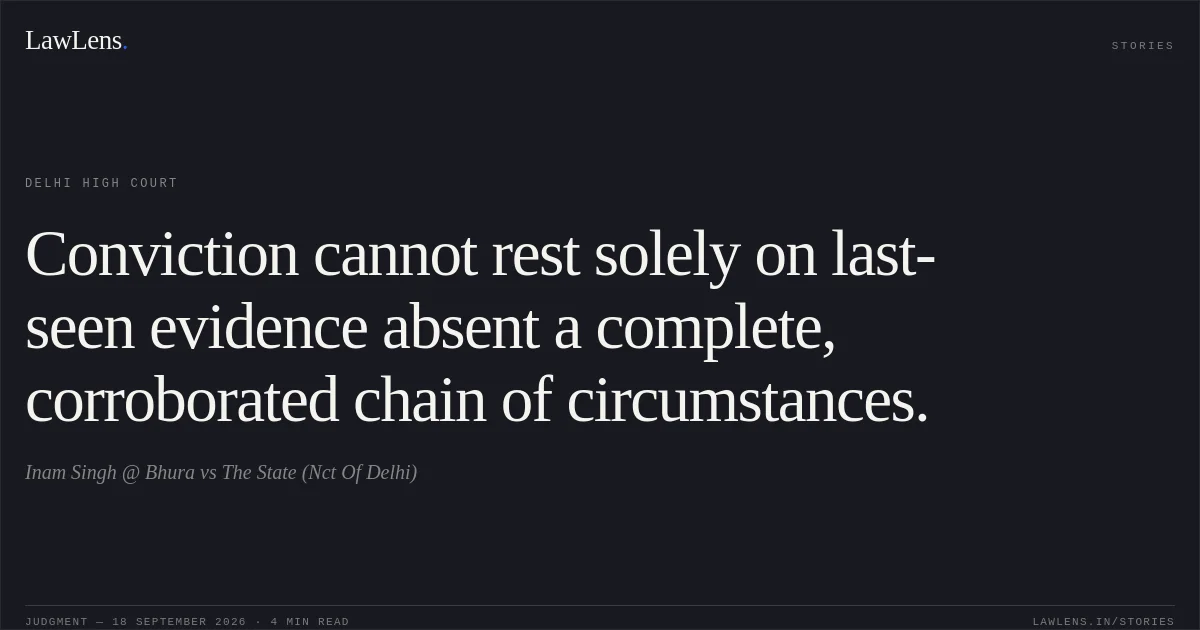
Source reference: no citationUnder the “last seen” doctrine, the time gap between the accused and deceased being last seen together and the discovery of the deceased dead must be so narrow that the possibility of intervention by another person is effectively excluded; in any event, “last seen” ordinarily requires corroboration and cannot, by itself, sustain conviction.
Source reference: pp. 20–27; paras 47–48, relying on State of U.P. v. Satish, Anand Jakkappa Pujari @ Gaddadar v. State of Karnataka and Manoj alias Munna v. State of ChhattisgarhSection 106 of the Indian Evidence Act, 1872 places upon an accused the burden of explaining facts especially within his knowledge, but does not shift the prosecution’s primary burden to prove guilt beyond reasonable doubt.
Source reference: pp. 22–27; para 48The Court also applied the five principles in Sharad Birdhichand Sarda v. State of Maharashtra: every circumstance must be fully established; the circumstances must be consistent only with guilt; they must be conclusive; they must exclude every reasonable hypothesis of innocence; and the chain must be complete.
Source reference: pp. 31–33; para 57An extra-judicial confession is inherently weak evidence and must be examined cautiously, particularly where the witnesses receiving it are themselves not wholly reliable.
Source reference: pp. 30–31; paras 55–56Medical and recovery evidence must meaningfully connect the accused, the weapon and the crime; an unconnected recovery is insufficient to complete the chain.
Source reference: p. 30; para 54Reasoning
The Court assumed, for purposes of analysis, that the appellant had been last seen with the deceased and had not explained when or how they parted company.
Source reference: p. 28; para 49However, the prosecution failed to establish this circumstance with the degree of certainty required for a conviction.
Source reference: no citationThere was no independent corroboration of PW-6’s alleged bus duty or of the asserted movements of PW-6 and PW-12 after leaving the room.
Source reference: pp. 28–29; para 50Their conduct was considered inherently unnatural: after allegedly finding the deceased unconscious and bleeding in PW-12’s own room, they neither took him to hospital nor informed the police, and their accounts materially differed regarding where they went thereafter.
Source reference: pp. 29–30; paras 51–53The Court therefore found that these were not merely peripheral inconsistencies but circumstances affecting the reliability of the principal witnesses.
Source reference: no citationThe alleged extra-judicial confession could not independently assist the prosecution because it was attributed to the same witnesses whose credibility was doubtful.
Source reference: pp. 30–31; paras 55–56Further, the alleged weapon was not shown to the post-mortem doctor for an opinion on whether it could have caused the injuries, and there was no forensic evidence establishing the presence of blood on it.
Source reference: p. 30; para 54Consequently, the evidence constituted only disconnected circumstances and did not form a complete chain excluding the reasonable possibility of another assailant.
Source reference: pp. 31–33; paras 57–58Holding
The Court held that the prosecution failed to prove the appellant’s guilt beyond reasonable doubt.
The “last seen together” circumstance, even coupled with the appellant’s failure to explain the separation, was insufficient in the absence of reliable corroborative evidence.
Source reference: pp. 33–34; paras 59–60The judgment of conviction dated 18 October 2002 and the order on sentence dated 1 November 2002 were set aside, and the appellant was acquitted of the charge under Section 302 IPC.
Source reference: pp. 33–34; paras 59–60The appeal was allowed.
Source reference: pp. 33–34; paras 59–60The appellant’s bail bond and surety were directed to remain valid for six weeks under Section 481 of the Bharatiya Nagarik Suraksha Sanhita, 2023, corresponding to Section 437A CrPC.
Source reference: p. 34; paras 61–63Acts & Sections Cited
6 provisions across 3 statutes referred to in this judgment. Each provision opens on LawLens.
Indian Penal Code, 18603
Code of Criminal Procedure, 19732
Bharatiya Nagarik Suraksha Sanhita, 20231
Original Court PDF
Inam Singh @ BhuravsThe State (Nct Of Delhi)
Click to open original judgment
Original judgment, available to read, download and summarize on LawLens.in