Facts
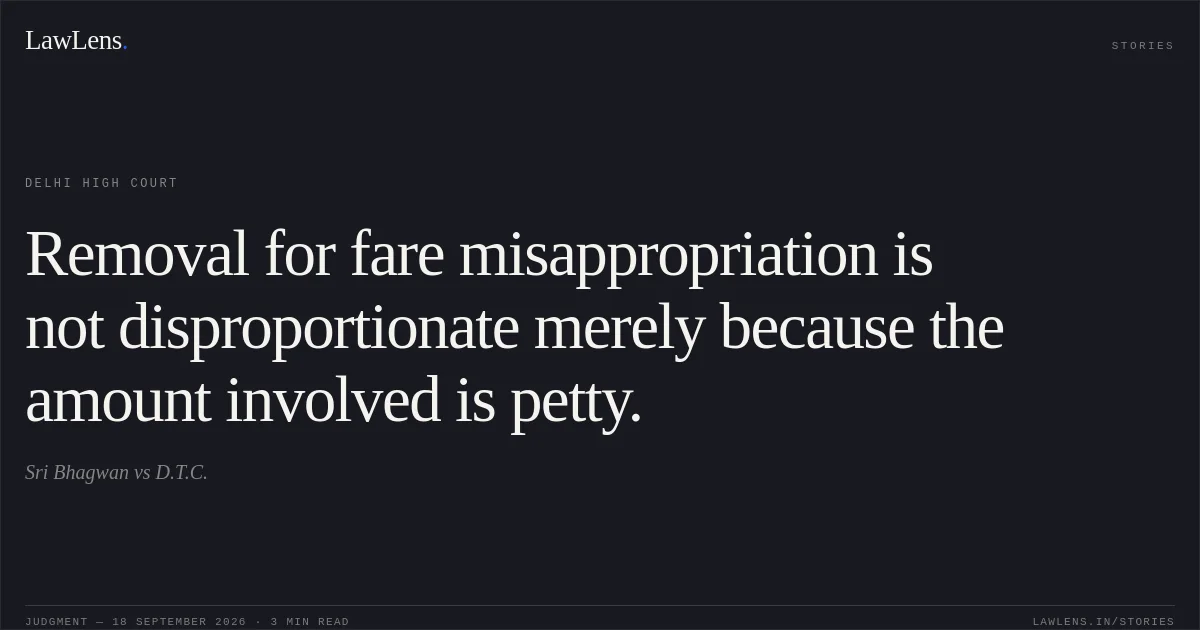
The petitioner, appointed as a conductor by the Delhi Transport Corporation in 1979, was charge-sheeted for allegedly collecting ₹2 from a passenger but issuing a ₹1 ticket, and for a cash shortage of ₹10 during an inspection on 15 July 1991.
Source reference: p.1, para. 2Following a domestic enquiry, he was removed from service on 10 February 1992.
Source reference: p.2, para. 3The Industrial Tribunal approved the punishment under Section 33(2)(b) of the Industrial Disputes Act, 1947, and that approval was upheld by the Delhi High Court in an earlier proceeding.
Source reference: p.2, para. 4In the subsequent reference under Section 10, the petitioner challenged the fairness of the enquiry, contended that the punishment violated the DTC circular dated 3 January 1966, and argued that removal was disproportionate to the alleged misconduct.
Source reference: p.2, paras. 5–6The Industrial Tribunal rejected his claim, holding the enquiry proper and declining to interfere with the punishment.
Source reference: p.3, para. 8The petitioner then invoked the High Court’s writ jurisdiction, principally challenging the enquiry findings and the quantum of punishment.
Source reference: p.3, paras. 9–10Issues
Whether the Industrial Tribunal, while adjudicating the subsequent industrial dispute, could rely upon the earlier proceedings under Section 33(2)(b) of the Industrial Disputes Act, 1947, and whether the domestic enquiry was otherwise fair and proper.
Source reference: pp. 3–6, paras. 11–22Whether the punishment of removal from service was shockingly disproportionate to the misconduct involving the alleged short issuance of a ticket and a cash shortage of ₹10.
Source reference: pp. 3–7, paras. 12, 23–26Whether the petitioner was entitled to a lesser punishment under the DTC circular dated 3 January 1966 on the ground that the misconduct constituted only his second charge of cheating.
Source reference: p.7, para. 25Law Applied
Section 33(2)(b) of the Industrial Disputes Act, 1947 concerns approval of an employer’s action during the pendency of industrial proceedings, whereas a subsequent reference under Section 10, read with Section 11A, requires an independent adjudication and may permit modification of the punishment; approval under Section 33(2)(b) does not, by itself, foreclose that jurisdiction.
Source reference: p.5, para. 16Nevertheless, a court or tribunal may rely upon material and findings recorded in earlier competent proceedings, provided it independently considers the relevant record.
Source reference: p.5, paras. 17–19Judicial review under Article 226 is supervisory, not appellate, and interference is unwarranted merely because another view of the evidence is possible.
Source reference: p.8, para. 27The Court relied on Depot Manager, A.P. SRTC v. B. Swamy, (2007) 12 SCC 40, and U.P. SRTC v. Suresh Chand Sharma, (2010) 6 SCC 555, for the principle that dishonesty or misappropriation by a conductor may warrant dismissal or removal even where the amount involved is small or the misconduct is alleged to be a first occurrence.
Source reference: p.7, para. 26The DTC circular prescribed a general policy but expressly preserved discretion to impose severe punishment even for a first or second case, depending on the merits.
Source reference: p.7, para. 25Reasoning
The Court held that although the proceedings under Section 33(2)(b) and the subsequent reference were legally distinct, the Tribunal had not relied solely on the earlier approval order.
Source reference: p.5, para. 19It independently examined the record and found that the petitioner had participated in the enquiry, had admitted the charges in his reply, and had stated that he did not require any further enquiry.
Source reference: pp. 5–6, paras. 19–21The charge-sheet had supplied the relevant documents, and the petitioner had not requested additional documents; his later objection regarding non-supply of witness and document lists was therefore treated as an afterthought.
Source reference: p.6, paras. 20–21His plea that illness caused the mistaken issuance of a lower-value ticket was unsupported by medical evidence or any contemporaneous material.
Source reference: p.6, para. 22As to punishment, the Court found that the alleged misconduct concerned dishonesty in the discharge of a conductor’s duties and that the DTC circular did not mandate a lesser penalty for a second offence.
Source reference: p.7, paras. 23–25In light of the governing precedents, the small monetary value did not render removal disproportionate.
Source reference: p.7, para. 26Given the limited scope of writ review and the considerable lapse of time since the disciplinary action in 1991, no ground for interference was established.
Source reference: p.8, paras. 27–29Holding
The High Court held that the domestic enquiry was fair and proper, that the Industrial Tribunal had sufficiently and independently considered the petitioner’s challenge, and that removal from service was not shockingly disproportionate to the misconduct proved against him.
The petition was dismissed, and all pending applications, if any, were also disposed of.
Source reference: p.8, para. 30Acts & Sections Cited
3 provisions across 1 statute referred to in this judgment. Linked provisions open on LawLens.
Industrial Disputes Act, 19473
Original Court PDF
Sri BhagwanvsD.T.C.
Click to open original judgment
Original judgment, available to read, download and summarize on LawLens.in