Facts
The assessee, a public limited company engaged in manufacturing and exporting readymade garments, claimed deductions under Section 80HHC of the Income-tax Act, 1961, for assessment years 2000–01 and 2001–02.
Source reference: para. 2–4It treated premiums received from the sale of export quotas as business profits and claimed that such receipts were eligible for treatment analogous to profits from the sale of import licences, cash assistance, and duty drawback under Sections 28(iiia)–(iiic), relying on the CBDT Office Memorandum dated 23 February 1998.
Source reference: para. 2–4The Assessing Officer completed assessments under Section 143(3), accepting the claims.
Source reference: para. 4The Commissioner subsequently exercised revisional jurisdiction under Section 263, holding that 90% of the quota premium ought to have been excluded under Explanation (baa) to Section 80HHC.
Source reference: para. 4The ITAT allowed the assessee’s appeals, but the Delhi High Court reversed the Tribunal and upheld the Commissioner’s exercise of Section 263 jurisdiction.
Source reference: para. 5–7Issues
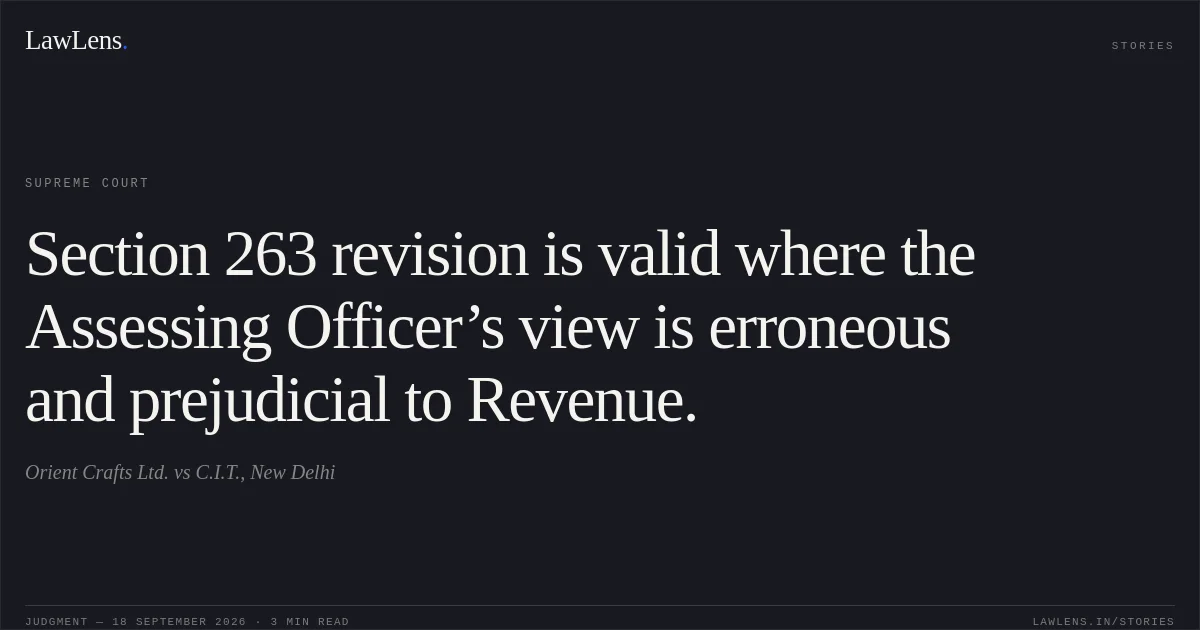
Whether the Commissioner validly exercised revisional jurisdiction under Section 263 by holding that the Assessing Officer’s treatment of export-quota premium under Section 80HHC was erroneous and prejudicial to the interests of the Revenue?
Source reference: para. 11–15Whether the Assessing Officer’s adoption of a view consistent with the CBDT Office Memorandum prevented revision under Section 263, particularly where the legal classification of export-quota premium was debatable?
Source reference: para. 8, 12–15Whether the High Court correctly reversed the ITAT’s finding that the Commissioner had improperly exercised Section 263 jurisdiction?
Source reference: para. 11, 15Law Applied
Section 263 of the Income-tax Act permits revision only where the assessment order is both erroneous and prejudicial to the interests of the Revenue; both conditions must coexist, as held in Malabar Industrial Co. Ltd. v. CIT.
Source reference: para. 12(C)Under CIT v. Max India Ltd., where two legally possible views exist and the Assessing Officer adopts one of them, the order cannot ordinarily be revised merely because the Commissioner prefers another view; however, an unsustainable view may attract Section 263.
Source reference: para. 12(A)CIT v. Amitabh Bachchan establishes that the Commissioner’s revisional power is subject to the requirements of Section 263 and reasonable opportunity of hearing.
Source reference: para. 12(B)The Court also applied the principle that the legal validity of the Commissioner’s revision must be assessed with reference to the law prevailing when the assessment order was passed.
Source reference: para. 12(A)The CBDT Office Memorandum could bind departmental officers but could not control judicial interpretation of Sections 28 and 80HHC.
Source reference: para. 14Reasoning
The Supreme Court observed that the High Court had considered the legal character of export-quota premium and had found the Revenue’s position to be legally tenable, including the view that the premium was not expressly covered by Sections 28(iiia)–(iiic) and therefore attracted the treatment applicable to other receipts under Explanation (baa) to Section 80HHC.
Source reference: para. 6, 13–14Although the CBDT Office Memorandum supported the assessee’s position, it could not compel the High Court or Supreme Court to adopt an interpretation contrary to the statutory scheme.
Source reference: para. 14The Court examined the Commissioner’s order, the ITAT’s decision, and the High Court’s reasoning and concluded that the High Court had not ignored the central Section 263 issue.
Source reference: para. 14–15Since the Commissioner’s conclusion that the assessment was erroneous and prejudicial to the Revenue was legally sustainable, interference was unwarranted.
Source reference: para. 14–15Holding
The Supreme Court upheld the Delhi High Court’s decision and held that the Commissioner had validly exercised jurisdiction under Section 263.
The appeals filed by Orient Crafts Ltd. were dismissed, along with the connected appeals, with no order as to costs.
Source reference: para. 15–17Acts & Sections Cited
9 provisions across 1 statute referred to in this judgment. Linked provisions open on LawLens.
Companies Act, 1956
Original Court PDF
Orient Crafts Ltd.vsC.I.T., New Delhi
Click to open original judgment
Original judgment, available to read, download and summarize on LawLens.in