Facts
Bhajan Singh, aged 60 years, died on 20 June 1999 in a motor vehicle accident caused by the rash and negligent driving of Truck No. PB-12C-1315 by respondent No.1, owned by respondent No.2 and insured with respondent No.3-Insurance Company.
Source reference: para. 4His widow, Mohinder Kaur, instituted a claim petition under Section 166 of the Motor Vehicles Act, 1988. The Motor Accident Claims Tribunal, Rupnagar, awarded Rs.1,72,600 with interest at 9% per annum from the date of filing of the claim petition, holding respondents No.1 and 2 jointly and severally liable while exonerating the Insurance Company on the ground that the driver did not possess a valid driving licence.
Source reference: paras. 4, 7The claimant appealed seeking enhancement, contending that the deceased’s income had been assessed inadequately, future prospects had not been added, an incorrect multiplier had been applied, and appropriate amounts had not been awarded for consortium and loss of estate.
Source reference: para. 10During the pendency of the appeal, the claimant died, and her legal representatives were brought on record under Order XXII Rule 3 read with Section 151 of the Code of Civil Procedure.
Source reference: CM Application order, paras. 1–3Issues
Whether the compensation awarded by the Tribunal was inadequate and required enhancement by reassessing the deceased’s income, future prospects, deduction for personal expenses, multiplier, and conventional heads of compensation?
Source reference: paras. 9–10Whether the Insurance Company, despite the driver’s absence of a valid driving licence, was liable to satisfy the award with a right to recover the amount from the vehicle owner?
Source reference: para. 18Law Applied
The Court applied Section 166 of the Motor Vehicles Act, 1988, governing claims for compensation arising from motor vehicle accidents.
Source reference: no citationIt relied on the principle of “just compensation” explained in Syed Basheer Ahamed v. Mohd. Jameel, which requires a fair and reasoned assessment based on the loss suffered and prohibits arbitrary or windfall compensation.
Source reference: para. 12Following Chandra alias Chander alias Chanda Ram v. Mukesh Kumar Yadav, the Court held that strict documentary proof of income is not indispensable, particularly for persons engaged in the unorganised sector, and that income may be assessed on a reasonable estimate based on the evidence and circumstances.
Source reference: para. 13Under Sarla Verma v. Delhi Transport Corporation, one-third of the income was deductible towards the deceased’s personal expenses and the multiplier of 9 was applicable for a deceased aged 60 years.
Source reference: para. 15In accordance with the principles in Pranay Sethi, compensation was awardable under conventional heads, though the Court adjusted the amounts having regard to the 1999 accident.
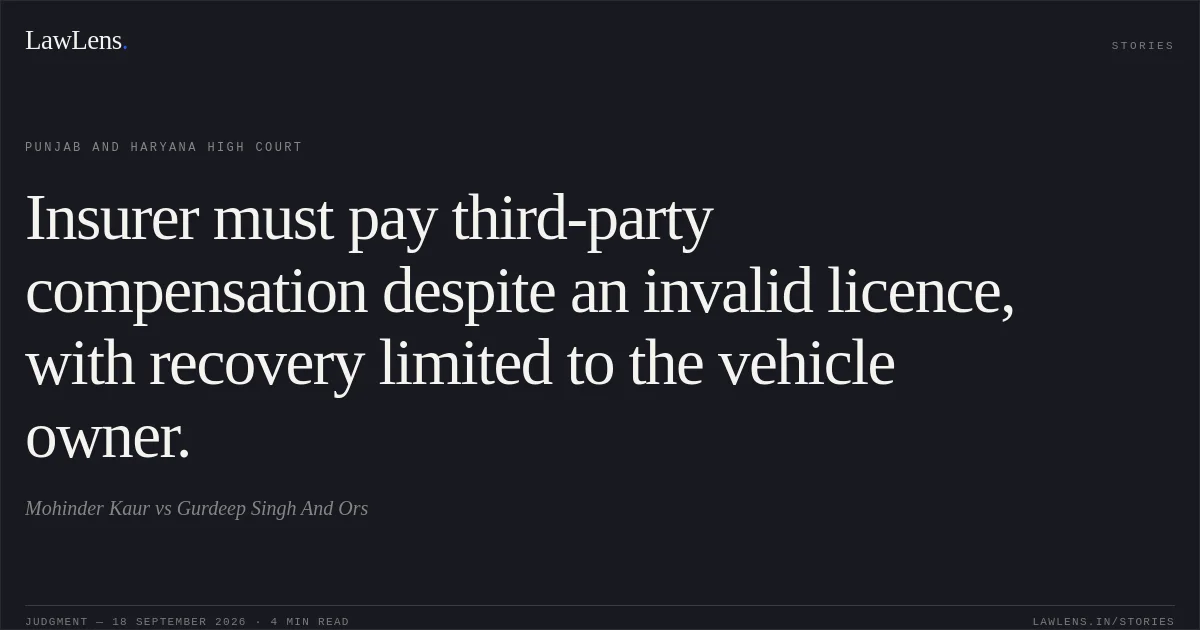
Source reference: para. 16The Court also applied the “pay and recover” principle: where the vehicle was insured but the driver lacked a valid licence, the insurer must first satisfy the award in favour of the third-party claimant and may thereafter recover the amount from the insured owner.
Source reference: para. 18Reasoning
The Court accepted the Tribunal’s finding that the accident resulted from the respondent No.1’s rash and negligent driving, as that finding had not been challenged by any appeal or cross-objection.
Source reference: para. 9It found the assessment of the deceased’s monthly income at Rs.2,100 to be erroneous because he was an agriculturist who assisted in managing agricultural land and domestic affairs. Applying a reasonable assessment rather than treating him merely as an unskilled worker, the Court fixed his monthly income at Rs.2,500.
Source reference: para. 13Since the deceased was 60 years old, 10% was added towards future prospects, resulting in a monthly income of Rs.2,750.
Source reference: para. 14As the deceased left behind his widow and two sons, one-third was deducted for personal expenses, producing a monthly dependency loss of Rs.1,834 and an annual dependency loss of Rs.22,008. Applying the multiplier of 9, the loss of dependency was calculated at Rs.1,98,072.
Source reference: para. 15The Court further awarded Rs.30,000 for loss of consortium, Rs.10,000 for funeral expenses, and Rs.10,000 for loss of estate, fixing total compensation at Rs.2,48,072.
Source reference: para. 16Although the driver had no valid licence and the Insurance Company had been exonerated by the Tribunal, the existence of a valid insurance policy required the insurer to satisfy the third-party award first, subject to recovery from the insured owner alone.
Source reference: para. 18Holding
The appeal was partly allowed with costs. The compensation was enhanced from Rs.1,72,600 to Rs.2,48,072, resulting in an enhancement of Rs.75,472.
The enhanced compensation was directed to carry interest at 9% per annum from 16 August 1999, the date of filing of the claim petition, until realization.
Source reference: para. 19The Insurance Company was directed to first pay the compensation to the legal representatives of the deceased claimant, with liberty to recover the deposited amount from respondent No.2-owner, together with interest at 6% per annum from the date of deposit until realization, without filing a separate suit.
Source reference: para. 19No recovery was permitted against respondent No.1-driver, as there was no contractual privity between the driver and the Insurance Company.
Source reference: para. 19Acts & Sections Cited
2 provisions across 2 statutes referred to in this judgment. Each provision opens on LawLens.
Code of Civil Procedure, 19081
Motor Vehicles Act, 19881
Original Court PDF
Mohinder KaurvsGurdeep Singh And Ors
Click to open original judgment
Original judgment, available to read, download and summarize on LawLens.in