Facts
The claimant, Karan Singh, sustained multiple serious injuries in a motor-vehicle accident dated 10.11.1996 involving Jeep No. DL-4CE-0169, allegedly driven rashly and negligently by respondent No.3, owned by respondents No.1, 2 and 4, and insured with respondent No.5.
Source reference: paras. 3, 6He suffered fractures of the mandible, right tibia and fibula, left humerus, neurological deficit, extensive wounds and permanent disability; he remained under treatment for approximately two years.
Source reference: para. 14The Tribunal found the accident to have resulted from the driver’s rash and negligent driving and awarded Rs.2,30,046/- under various heads, directing the insurer to pay the amount with a right to recover it from the insured owners due to breach of policy conditions.
Source reference: paras. 8, 14–16The claimant appealed under Section 173 of the Motor Vehicles Act, 1988, seeking enhancement. During the pendency of the appeal, he died and was represented by his legal representatives.
Source reference: para. 7The respondents did not challenge the finding on negligence, and the appeal was therefore confined substantially to the adequacy and assessment of compensation.
Source reference: paras. 8, 27Issues
Whether the compensation of Rs.2,30,046/- awarded by the Tribunal was inadequate and required enhancement in view of the claimant’s injuries, permanent disability, treatment expenses and loss of earning capacity?
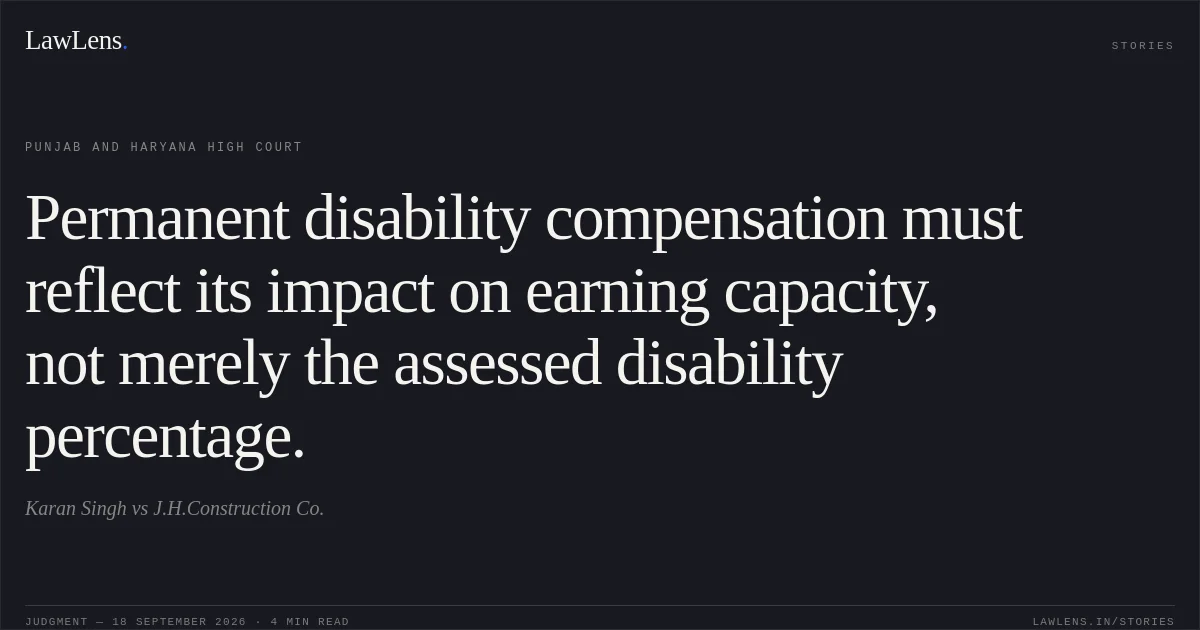
Source reference: paras. 8–10, 17–25Whether compensation for permanent disability was required to be assessed with reference to the claimant’s functional loss of earning capacity and an appropriate multiplier?
Source reference: paras. 18–20Whether the insurer, having been directed to satisfy the award despite breach of policy conditions, could recover the amount from the driver as well as the insured owners?
Source reference: para. 26Law Applied
The Court applied Section 166 of the Motor Vehicles Act, 1988, under which an injured claimant is entitled to just compensation for injuries caused by the negligent use of a motor vehicle.
Source reference: para. 3In personal-injury claims, compensation may be awarded under pecuniary heads—including treatment and hospitalization expenses, transportation, special diet, attendant charges, loss of earnings during treatment, loss of future earning capacity and future medical expenses—and non-pecuniary heads such as pain and suffering, loss of amenities and loss of expectation of life, as explained in G. Ravindranath @ R. Chowdary v. E. Srinivas, 2013 (3) RCR (Civil) 934.
Source reference: para. 12The Court relied on Chandra alias Chander alias Chanda Ram v. Mukesh Kumar Yadav, (2022) 1 SCC 198, for the principle that absence of documentary proof does not justify rejecting oral evidence of income and that income may be reasonably assessed on a notional basis.
Source reference: para. 18It applied Sanjay Verma v. Haryana Roadways, 2014 (1) RCR (Civil) 914, and National Insurance Co. Ltd. v. Pranay Sethi, 2017 (16) SCC 680, regarding addition for future prospects and the use of a multiplier.
Source reference: paras. 9, 19The assessment of loss of earning capacity was based on functional disability rather than merely the percentage of physical disability, consistent with Yadava Kumar v. The Divisional Manager, National Insurance Co. Ltd., 2010 (4) PLR 242.
Source reference: para. 19Where the insurer is required to pay despite a breach of policy conditions, it may recover the amount from the insured; however, absent contractual privity, recovery cannot be ordered against the driver personally.
Source reference: para. 26Reasoning
The Court affirmed the Tribunal’s finding of negligence because it was not challenged by the respondents.
Source reference: para. 8On quantum, it accepted the medical evidence showing multiple fractures, repeated surgeries, prolonged treatment and permanent disability.
Source reference: paras. 14–16, 19Although one medical witness assessed disability at 70%, the Court adopted the Medical Board’s assessment of 42% disability relating to the upper and lower limbs.
Source reference: paras. 14–16, 19Considering the claimant’s age of 52 years, his income was notionally assessed at Rs.1,500/- per month, with a 10% addition for future prospects, resulting in a monthly income of Rs.1,650/-.
Source reference: paras. 18–19Applying the 42% functional impact to earning capacity and a multiplier of 11, the Court awarded Rs.91,476/- for future loss of income, in addition to Rs.36,000/- for loss of income during the two-year treatment period.
Source reference: paras. 19–20It enhanced treatment and future-treatment expenses to Rs.95,000/-, and awarded Rs.15,000/- for special diet, Rs.25,000/- for attendant charges and Rs.20,000/- for loss of amenities.
Source reference: paras. 17, 21–24Pain and suffering was increased from Rs.15,000/- to Rs.35,000/- due to the severity and duration of the injuries, while transportation expenses and motorcycle damage were retained at Rs.25,350/- and Rs.20,000/- respectively.
Source reference: paras. 17, 21–24The total compensation was consequently recalculated at Rs.3,62,826/-.
Source reference: paras. 26–27As the insurer had been exonerated on account of breach of policy conditions but directed to satisfy the award initially, the Court maintained the pay-and-recover arrangement.
Source reference: paras. 26–27However, recovery was limited to the insured owners—respondents No.1, 2 and 4—and did not extend to respondent No.3, the driver, because there was no privity of contract between the driver and the insurer.
Source reference: paras. 26–27Holding
The appeal was partly allowed with costs.
The claimant’s compensation was enhanced from Rs.2,30,046/- to Rs.3,62,826/-, resulting in an enhancement of Rs.1,32,780/-, rounded off to Rs.1,33,000/-, with interest at 9% per annum from 06.06.1997, the date of filing of the claim petition, until realization.
Source reference: para. 27The enhanced compensation was made payable by respondents No.1, 2 and 4.
Source reference: para. 27The insurance company was directed to first pay the compensation to the claimant’s legal representatives, but was granted the right to recover the deposited amount from the insured owners, along with interest at 6% per annum from the date of deposit until realization, without filing a separate suit.
Source reference: paras. 26–27No recovery was permitted against the driver, respondent No.3.
Source reference: paras. 26–27Acts & Sections Cited
1 provisions across 1 statute referred to in this judgment. Each provision opens on LawLens.
Motor Vehicles Act, 19881
Original Court PDF
Karan SinghvsJ.H.Construction Co.
Click to open original judgment
Original judgment, available to read, download and summarize on LawLens.in