Facts
The petitioners claimed to be sthitiban tenants of land recorded in Hal Khata No. 222, formerly forming part of the trust estate of Lord Jagannath. Their predecessor had acquired tenancy rights through an auction purchase and subsequent induction by the ex-intermediary. The estate was notified as vested in the State under the Orissa Estates Abolition Act, 1951 (“OEA Act”) on 18 March 1974, while the settlement Record-of-Rights (“ROR”) was finally published on 1 April 1977, recording Lord Jagannath as landlord.
Source reference: paras. 3–5; pp. 2–5In 2019, the petitioners applied under Rule 34 of the Orissa Survey and Settlement Rules, 1962 (“OSS Rules”) for correction of the landlord entry, contending that vesting and payment of compensation to the ex-intermediary had extinguished the latter’s rights. The Tahasildar initially allowed the application on 30 June 2020 and directed substitution of “Odisha Sarkar” for Lord Jagannath in the landlord column.
Source reference: para. 6; pp. 5–6On review under Rule 43 of the OSS Rules, the Additional Tahasildar set aside that order, holding that the application under Rule 34 was beyond jurisdiction because the cause of action arose before final publication of the ROR. The present writ petition challenged the review order dated 13 April 2021.
Source reference: paras. 7–9; pp. 6–8Issues
1. Whether the petitioners could invoke Rule 34 of the OSS Rules to correct a finally published ROR where the alleged cause of action—the vesting of the estate and the alleged extinguishment of the ex-intermediary’s interest—arose before final publication of the ROR?
Source reference: paras. 24–32; pp. 23–332. Whether the Additional Tahasildar could review and set aside the earlier order under Rule 43 of the OSS Rules on the ground that the earlier order had been passed without jurisdiction and constituted an error apparent on the face of the record?
Source reference: paras. 33–41; pp. 33–403. Whether the Court was required to decide the substantive questions concerning the effect of the OEA Act, the Shri Jagannath Temple Act, 1955, and the judgment in Jagannath Temple Managing Committee v. Siddha Math?
Source reference: paras. 31, 43; pp. 32–33, 41Law Applied
Rule 34 of the OSS Rules permits correction of a finally published ROR only on the specified grounds, including inconsistency with a decree or order of a competent authority and lack of relationship between the entry and existing facts.
Source reference: para. 24; pp. 23–24Applying Harihar Mohapatra v. Commissioner of Land Records and Settlement, the Court held that Rule 34 can be invoked only where the cause of action arose after preparation or publication of the ROR; it cannot be used to circumvent the statutory remedies of objection, appeal, revision, or civil suit in respect of pre-existing claims.
Source reference: paras. 25–26; pp. 24–27The Court further held that a vesting notification is the source of the subsequent compensation proceedings, and an order determining compensation does not itself decide the ex-intermediary’s status as landlord for purposes of Rule 34(c).
Source reference: para. 30; pp. 31–32Under Rule 43, review lies for a mistake or error apparent on the face of the record, and is not an appellate rehearing; however, a prior order passed without jurisdiction is non-est and may be reviewed to correct that fundamental defect.
Source reference: paras. 36–39; pp. 37–40The Court relied on Sow Chandra Kante v. Sk. Habib, Thungabhadra Industries Ltd. v. Government of Andhra Pradesh, and Kishinchand Chellarams (India) (P) Ltd. v. G. Varadappa.
Source reference: paras. 37–39; pp. 38–40Reasoning
The Court held that the petitioners’ challenge to the landlord entry was founded on the vesting notification dated 18 March 1974 and the consequences allegedly flowing from it. Both events preceded the final publication of the ROR on 1 April 1977. The subsequent dismissal of challenges to the vesting notification by the High Court and Supreme Court did not create a new cause of action; those orders merely confirmed the legal effect of the notification. Likewise, interim stays temporarily suspended operation of the notification but did not shift its operative date.
Source reference: paras. 27–29; pp. 27–31The compensation proceedings were consequential to vesting and did not independently establish that the landlord entry was erroneous under Rule 34(c). Nor could the entry be treated as having no relationship with existing facts under Rule 34(e), particularly because the legal effect of the OEA Act had to be considered alongside the special statutory regime governing the Jagannath Temple and the decision in Siddha Math.
Source reference: paras. 30–31; pp. 31–33Accordingly, the original Tahasildar had exceeded the limited jurisdiction conferred by Rule 34 by substantively altering a finally published ROR on the basis of facts and claims predating its publication. This was not merely an incorrect decision on merits but a jurisdictional defect apparent from the relevant dates themselves. The Additional Tahasildar was therefore justified in reviewing and nullifying the earlier order under Rule 43.
Source reference: paras. 32, 34–40; pp. 33–40Holding
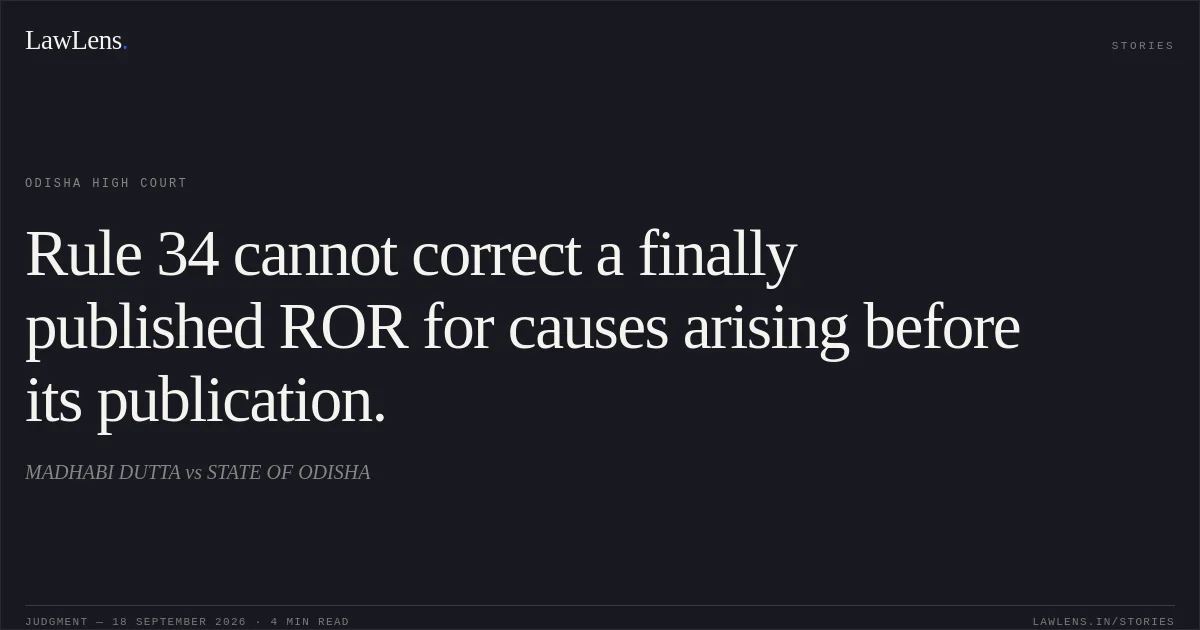
The High Court held that Rule 34 of the OSS Rules was unavailable because the petitioners’ alleged cause of action arose before final publication of the ROR. The original order dated 30 June 2020 had been passed without jurisdiction and was therefore properly reviewed and set aside under Rule 43.
The Court declined to determine the parties’ substantive rights under the OEA Act, the Shri Jagannath Temple Act, or Siddha Math, leaving those questions open for adjudication before the appropriate forum. The writ petition was dismissed, and the review order dated 13 April 2021 was upheld.
Source reference: paras. 41–44; pp. 40–42Acts & Sections Cited
14 provisions across 6 statutes referred to in this judgment. Linked provisions open on LawLens.
Orissa Estates Abolition Act, 19512
Registration (Odisha Amendment) Act, 20131
Orissa Survey and Settlement Act, 19587
Orissa Land Reforms Act, 19601
Orissa Hindu Religious Endowments Act, 19391
Puri Shri Jagannath Temple (Administration) Act, 19522
Original Court PDF
MADHABI DUTTAvsSTATE OF ODISHA
Click to open original judgment
Original judgment, available to read, download and summarize on LawLens.in